




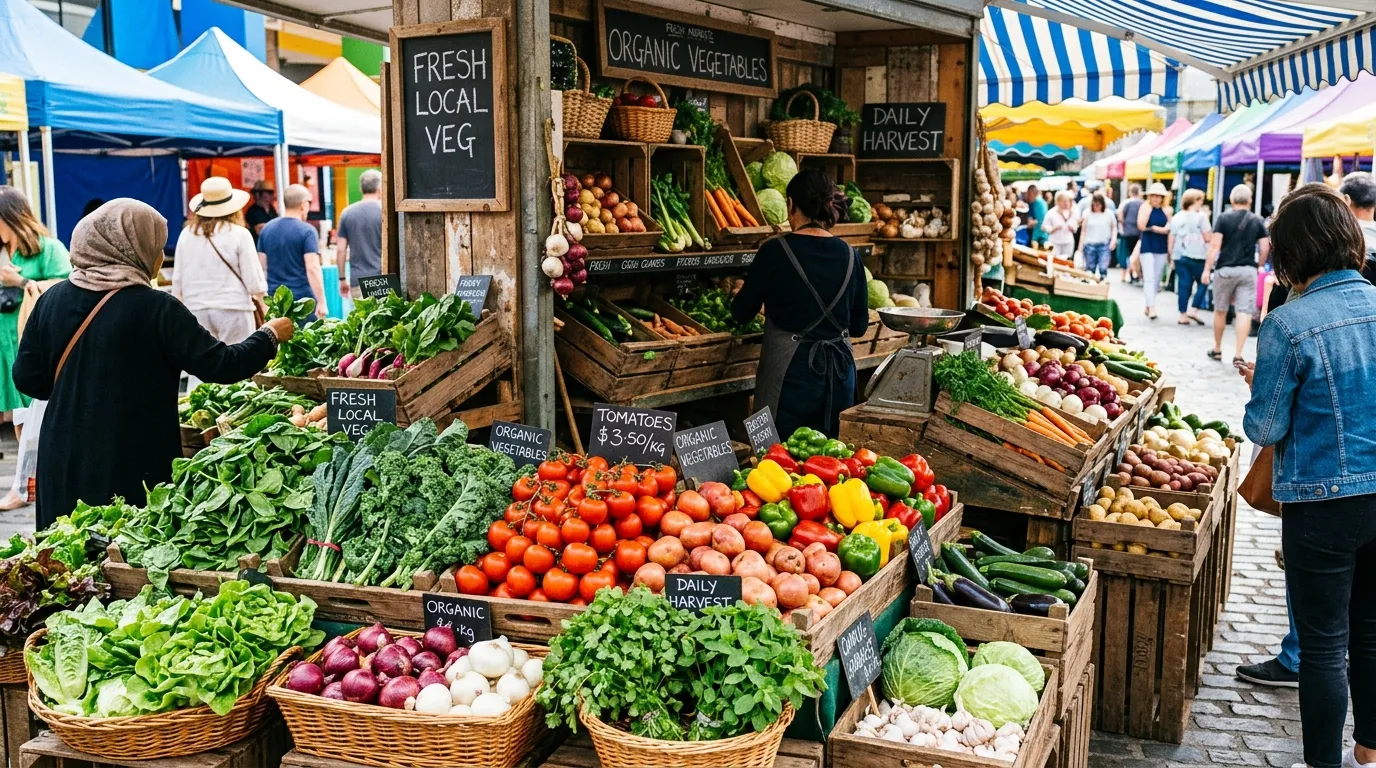
“You are what you eat” is truer than you might think. Not only health-wise, but it can also make a statement or shout out your beliefs. And veganism is a perfect example.
The number of vegans who are getting on the plant-based train is steadily increasing. Yes, it’s a wonderful decision for your health, but it’s also a way to protest or stand behind the animals and the planet.
It’s time we talked about veganism statistics. The number of people who have noble agendas and want to prove them by what they eat might shock you. The realization that one person can make a noticeable difference by what they eat is sinking in.
Who’s becoming vegan? Where in the world are they? Are vegans healthier? Follow me…
Top 10 Most Inspiring Stats
- There Are Almost 88 Million Vegans in the World
- There are 6% of Vegans in the US
- In 2026, 6.3% of the UK Population Is Planning to follow a vegan diet
- 30 million People worldwide tried vegan in January 2026
- Every Month, a Vegan Saves the lives of 30 Animals
- 10% of the People in India Are Vegan
- 40% of Millennials Identify as Vegans in the US
- By 2030, the Global Plant-Based Meat Market Will Reach $22.37 Billion
- A UNO Report Says Plant-Based Diet Is Necessary To Save the World From Starvation
- Plant-Based Diet Can Assist in Preventing Cancers
Why Choose Veganism
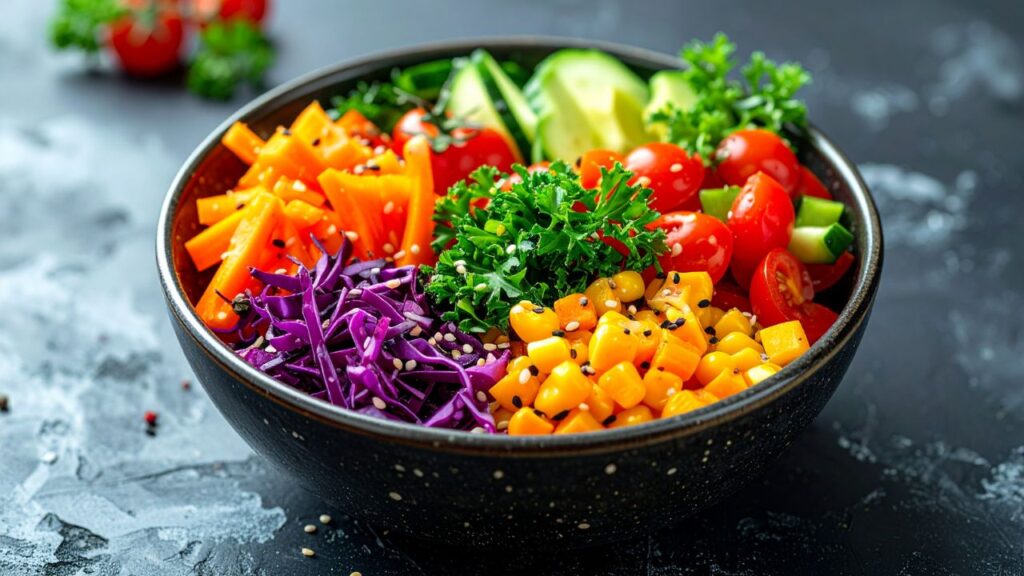
Europe has long been progressive, and with this topic, it’s no different. Israel, India, and the Caribbean are also on board to put their morals where their mouth is and become vegan.
Although the US is one of the most well-respected countries, it has fallen short in the captivating vegan race. I believe we’ve become too pampered with the meat industry and too settled in our ways.
Veganism is more than a diet. It’s multi-layered. Many vegans don’t eat things like gelatin and won’t eat honey either (like me) to help animals and the planet.
I’m a pescatarian, meaning I eat fish but no other meat, a form of vegetarianism. I also wear no animal coverings like fur or feathers. I do it all due to the rampant animal abuse that agricultural farming brings into the world.
Bottom line?… I’m a “vegetarianist” with a vegan lifestyle. It’s been a real thrill to see others want to get involved with this supposedly radical way of life. The more we do, the less the animals need to suffer.
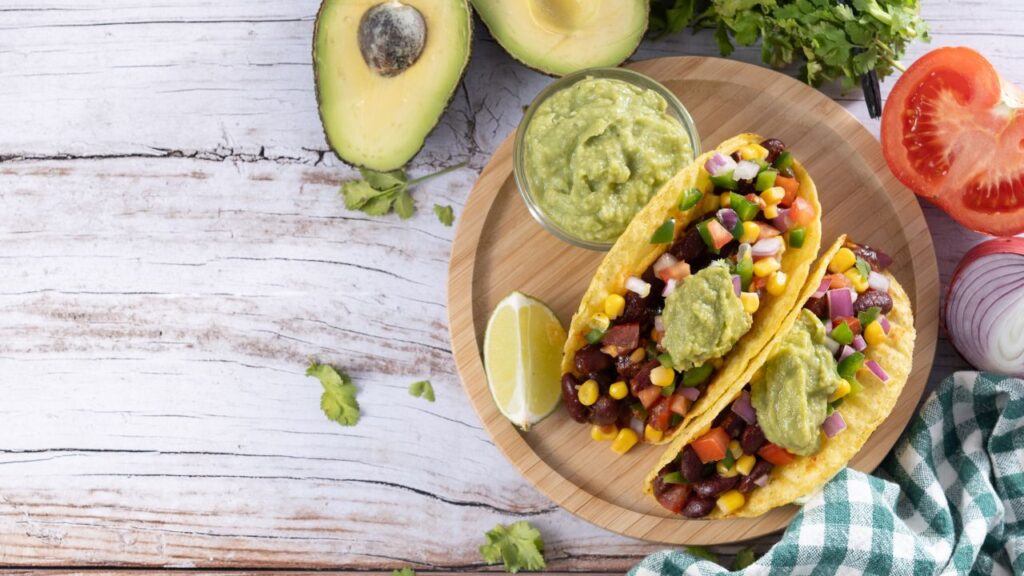
Whatever you believe about animal abuse in agricultural farming, climate change, and greenhouse gas emissions, these facts about how veganism affects the body remain:
- Aids in weight loss
- Lowers blood sugar levels, which benefits those with diabetes. Also lowers the risk of diabetes.
- Improves kidney function
- “According to the World Health Organization, at least one-third of all cancers can be prevented by factors within your control, including diet.” Healthline
- Veganism may protect against various types of cancer.
- Lowers risk of heart disease (reduces LDL cholesterol)
- Can reduce pain from arthritis.
So let’s get into it – veganism statistics – to see just who does what and what that means for our world.
Vegan Statistics
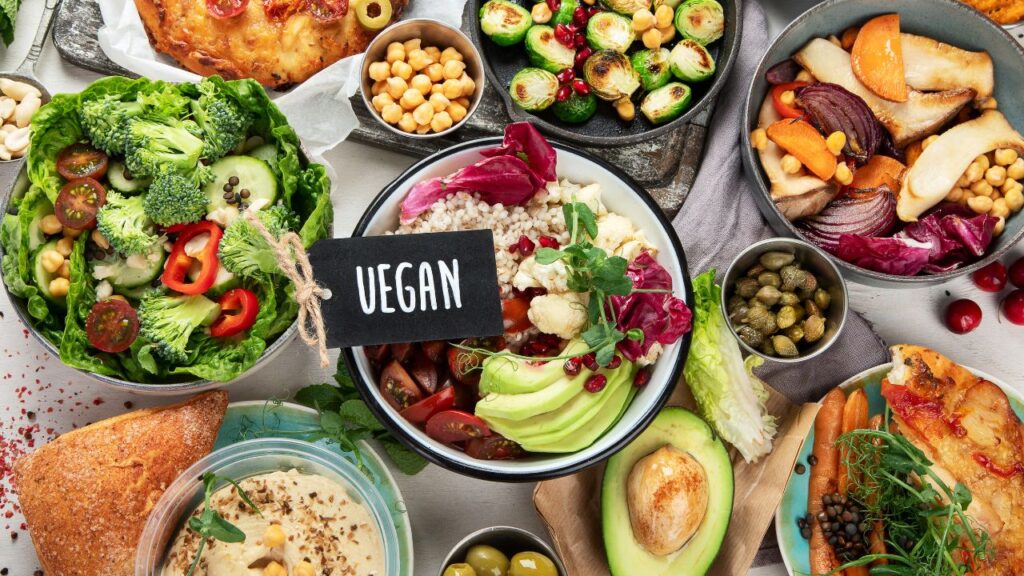
Given below are some vegan stats for you.
As many as 6% of the US Population Is Vegan. (Plant Proteins)
About 6% of people in the U.S. now say they are vegan — a big jump from just 1% in 2014, which means the number has grown six times larger.
Even though that seems like a small percentage, the wave of going vegan is growing. People realize that plant-based options help our bodies and minds and can do so much more.
In the US, Three-Quarters of the Vegan Population Is Covered by Females. (The Health Journal)
From 2013 to 2016, 56.4% of women tried to lose weight, and 41.7% of men tried. Women are more likely to diet and try new ways to lower their weight. They’re also more likely to put their morals where their mouth is and “protest” for the planet or fight animal abuse in the meat industry… Going vegan to help a societal problem.
In January 2026, 30 million People Worldwide Tried Vegan. (Veganuary)

Veganuary’s 2026 campaign reached a new milestone. A record-breaking 30 million people worldwide chose to try vegan this January, based on participation surveys Veganuary commissioned in its core countries, combined with population data for those countries.
Say what?! Veganuary is a movement with the end goal of getting as many people as possible to go vegan. It’s for the month of January, but as they say on their website, “Try vegan this month,” so you can jump in any time.
The Vegan Society Registered 16,439 Products With the Vegan Trademark in 2021. (The Vegan Society)
Created in 1990, the Vegan Trademark helps businesses show which products meet the international standard set by The Vegan Society. There are over 65,000 products from more than 2,500 companies that claim the trademark, including:
- 30,000 toiletries and cosmetics
- 18,000 food and drink
- Over 82% of their product registrations have been in the last five years.
Vegan Trademark Is Present in 85 Countries Globally. (The Vegan Society)
It’s a worldwide movement to go vegan. Due to religion, nutrition, or other reasons, other countries have led the charge for decades. The US appears to be onboard finally, and the number of vegans is growing exponentially as 85 countries now have a vegan trademark.
A Study Conducted by the University of Oxford in 2016 Suggests That 8 Million Human Lives Could Be Saved by 2050 if the World Went Vegan. (Oxford Martin)

And not only for health benefits. Climate change – which creates catastrophic weather occurrences and greenhouse gas emissions – kills people as well. So do viruses and illnesses brought on by shoddy agricultural farming practices. (Outbreaks of salmonella poisoning is a good example.)
Every Month, a Vegan Saves the Life of 30 Animals, i.e., Approximately One Animal per Day. (The Humane League UK)
Saving one animal per day equals saving thousands of animals in a human’s lifetime, and not counting saving animals from the abuse they face when they enter a slaughterhouse for the purpose of obtaining textiles.
Veganism serves as a powerful way to promote compassion, sustainability, and a more harmonious relationship with the animal kingdom.
Animal Welfare Motivated Almost 80% of Adults to Choose a Vegan Lifestyle. (Yougov)
The UK is known for being vegan-friendly; this statistic is one result of a survey conducted in the country. YouGov asked 1,000 vegan and vegetarian individuals (two different ways of life) questions about living a meat-free life. Various reasons were given, and this was one of the seven reasons why.
Vegans are more likely to strongly oppose animal cruelty (80%) than vegetarians (59%), which aligns with the fact that veganism avoids all animal products, not just meat.
How Many Vegans in the World: Vegan Global Population
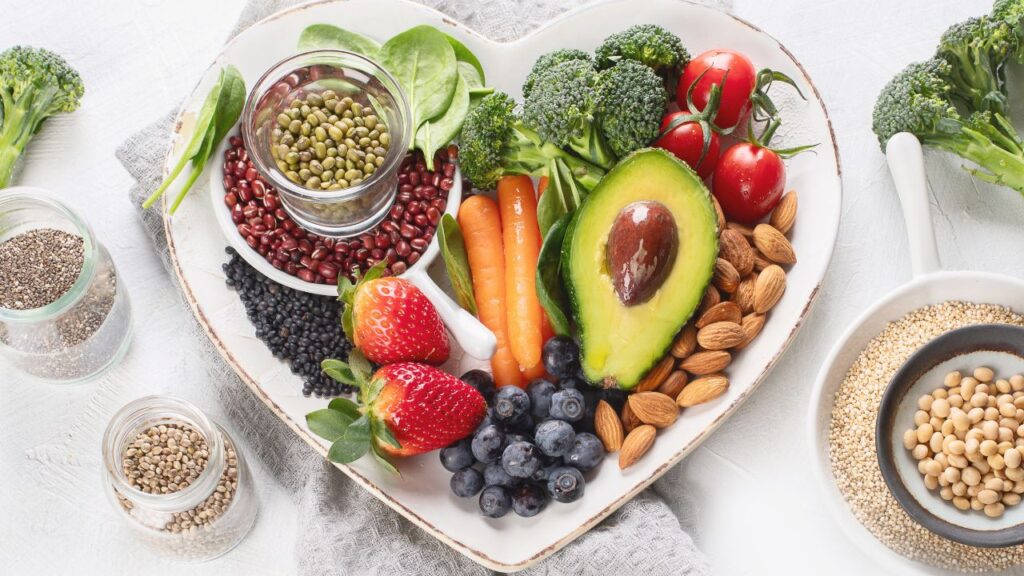
Keep reading to find out how many vegans are there in the world.
As Per Stats of 2023, There Are Almost 88 Million Vegans in the World. (The VOU)
Although that breaks down to almost 1.1%, the momentum for veganism is very real in almost every country in the world. Health concerns and moral reasons are the top reasons why so many want to make the switch.
10% of the People in India Are Vegan. (Statista)
India has the highest share of vegans in the world, with about 10% of its population following a vegan diet.
The data from Statista supports the notion that a substantial portion of the Indian population is embracing a vegan lifestyle, indicating a shift towards more sustainable and compassionate dietary choices.
Eight out of 10 Indians eat little to no meat in their diets. Four in 10 call themselves “vegetarian.” Religion and food culture are the top reasons why.
‘Plant-Based Diet’ Was Among the Top Search Trends in 2025 in Canada. (Google Trends Report)
Between November 2025 and February 2026, searches for “plant-based diet” in Canada remained consistent, generally staying above 50. Interest spiked sharply in January, reaching 100, with another noticeable peak in mid-February.
Manitoba, British Columbia, and Saskatchewan are the top three areas interested in plant-based alternatives. Percentages rose and fell, but Canadians are still on the same track as the rest of the world in wanting to eat meat-free.
In the Last Decade, the Number of Vegans in Portugal Has Increased by 400%. (The Portugal News)
A. 120,000 people follow a vegetarian diet
B. 60,000 people practice a vegan diet – Via the Portuguese Vegetarian Association
C. In 2023, 10.4% of people in Portugal identified as “veggie,” meaning they followed a pescatarian, vegetarian, or vegan diet.
In 2024, 2.3 Percent of the People (Respondents) in Italy Claimed to be Vegan (Statista)
In 2022, the percentage of Italians adhering to a vegan lifestyle was 1.3%; however, by 2023, this figure had risen to 2.4%. In Italy, 2.3% of respondents in a 2024 survey identified themselves as vegan.
In 2014, only 0.6% of the respondents claimed to be vegan, and the number has more than quadrupled now. And pasta fits right in. In 2016, the global market for vegan/vegetarian products was over $51 billion.
Stats Show the Vegan Population Has Doubled in Germany in the Last Decade. (Livekindly)
As of early 2026, around 3.2% of Germany’s population identifies as vegan—equal to more than 2.6 million people. This places Germany among Europe’s leading countries for veganism, a lifestyle that continues to grow rapidly.
The main reasons why? Concerns about health, ethics, and the environment. “…changing lifestyles” and “…influence from abroad” are also listed as motivating factors.
Chinese Government’s New Dietary Guidelines Suggest People Decrease Their Meat Consumption by 50%. (Food Revolution)
Chinese government and society have been a bit slow on the uptake of veganism/vegetarianism, but they’re gaining ground as the government has suggested people cut down their meat consumption by 50%. China’s population is over one billion people, and the suggested goal is to be reached by 2030.
What Percent of Americans Are Vegans

Here are some US vegan statistics for you.
Almost 4% of Americans Are Vegans (Statista)
Around 4% of people in the United States follow a vegan diet. Veganism and vegetarianism are more common among younger consumers than older ones. In addition, more than half of U.S. consumers say that animal welfare practices influence their decision when buying food products.
39% of Americans Actively Try Incorporating Plant-Based Food (Vegan Options) Into Their Diet. (Nielsen)
Doing something and wanting to do something are two different things, but in this instance, it shows how Americans want to eat. If almost 39% of people in the US actually made the change, there would be a certain positive shift in life expectancy, animal abuse, and climate change.
According to 2023 Stats, 40% of Millennials Identify As Vegans in the US. (Strategic Market Research)
Younger generations in America have grown up with the topic of climate change and details about what it’s doing to our world. Since veganism can stop further damage and possibly reverse parts of it, millennials have taken a stand, as 40% of millennials are vegans.
It is expected that the US Vegan Food Market will Cross $26.72 Billion by 2033 (Research and Markets)
Looking ahead, the U.S. plant-based food market is projected to reach $26.72 billion by 2033. It is expected that the American vegan food market will grow at a CAGR of 11.7% between 2025 and 2033. Products with environmental claims are growing three times the total food and beverage activity rate.
The Plant-Based Food Sales Market in the US was Worth $8.1 Billion in 2024. (GFI)
The U.S. plant-based food industry has expanded significantly over the past decade. In 2017, retail plant-based food sales were valued at $3.9 billion. By 2024, the market had grown to $8.1 billion.
It’s easy to see the acceleration in the interest in vegan foods.
UK Vegan Population Statistics

UK residents are right there with the US vegans. Here are some statistics to back that claim.
According to the Latest Stats, 6.3% of adult Brits are planning to follow a vegan diet in 2026. (Finder)
As of 2026, approximately 6.3% UK adults are planning to adopt veganism, constituting 3.5 million people of the population, and 48% of the population say they consume plant-based milk products (like soy milk). As of the end of 2025, 3.1% of UK adults were already vegan, and an additional 3.2%—about 1.8 million people—planned to begin following a vegan diet in 2026.
If more Brits knew about the common practices of beak trimming, the separation of calves from their mothers, and the use of carbon dioxide in slaughter, this statistic would probably be much higher.
Note: These horrific practices also occur in America, along with other inhumane actions.
- Over the past decade, veganism has increased by approximately 360% in the UK. (Food Revolution Network)
- In 2019, the number of vegans was 600,000 or 1.21%
- In 2016, the number of vegans was 276,000 or 0.46%
- In 2014, the number of vegans was 150,000 or 0.25%
This shows that the numbers have more than doubled between 2014 and 2019.
A Report Conducted by IPSOS in 2016 Revealed 3.25% of British Aged 15 and Above Never Eat Meat of Any Form. (IPSOS)
IPSOS reported in 2016 that 3.25% of Brits aged 15 and above have never consumed meat. Flexitarian (sometimes eating plant-based) and vegetarian diets are favored by low-income British households (8%) vs. high-income ones (6%).
Half of the British Eating Meat Feel Hypocritical About Loving Animals. (The Vegan Society)
When asked whether they agreed with the statement, “It’s hypocritical that we eat some animals, such as pigs, while loving others, such as dogs, and keeping them as pets,” 47.8% of respondents said they either slightly or strongly agreed—33.2% slightly and 14.6% strongly. In addition, 40.3% of respondents admitted that they feel at least some guilt about eating meat.
That pull, moral ethics vs. what I’m eating, was the war in my head that made me a vegan in 1995. (I’ve since become a pescatarian due to health concerns.)
Annually, More Than 1.2 Billion Animals Are Killed in the UK. (Viva)
This figure encompasses a wide range of animals raised and slaughtered for various purposes, including livestock farming, poultry production, and fishing.
In the US, there are 10 billion animals killed in slaughterhouses annually. Marine life killed in the US is around 47 billion.
What Percentage of World Population is Vegan

Now, let’s talk about the percentage of vegans worldwide.
Roughly 1–2 Percent of the World’s Population Is Vegan. (The Vegan Society, The VOU)
So what products have we tried before? A survey by Rakuten Insight showed the following percentages of people who have tried:
- Plant-based milk – 81%
- Dairy product substitutes – 51%
- Plant-based meat alternatives – 51%
- Vegan egg substitutes – 26%
- Plant-based condiments – 30%
- Other – 5%
The Cultured Meat market size reached $0.28 billion in 2025 (The Business Research Company)
The cultured meat market was worth $0.28 billion in 2025. It is expected to grow to $0.63 billion by 2030, increasing by about 17.7% each year.
This statistic takes the current projection of veganism into account, which will hopefully continue. I like to think the world has taken notice that what we put in our stomachs can do more than just be a form of diet.
The Share of Vegans in Select Countries in 2022 Was Highest in India, i.e., 13%. (Statista Global Consumer Survey)

According to Truly, 574 million Indians follow a meat-free/plant-based diet. Around 13% of those in India follow a vegan diet.
China had a Share of 6%. (Statista Global Consumer Survey)
As you learned above, China is becoming a player in the world’s race to be meat-free and follow a vegan diet. They weren’t even on the radar initially, but societal and climate change pressures have become too great.
The US Share of Vegans Was 4% in 2022. (Statista Global Consumer Survey)
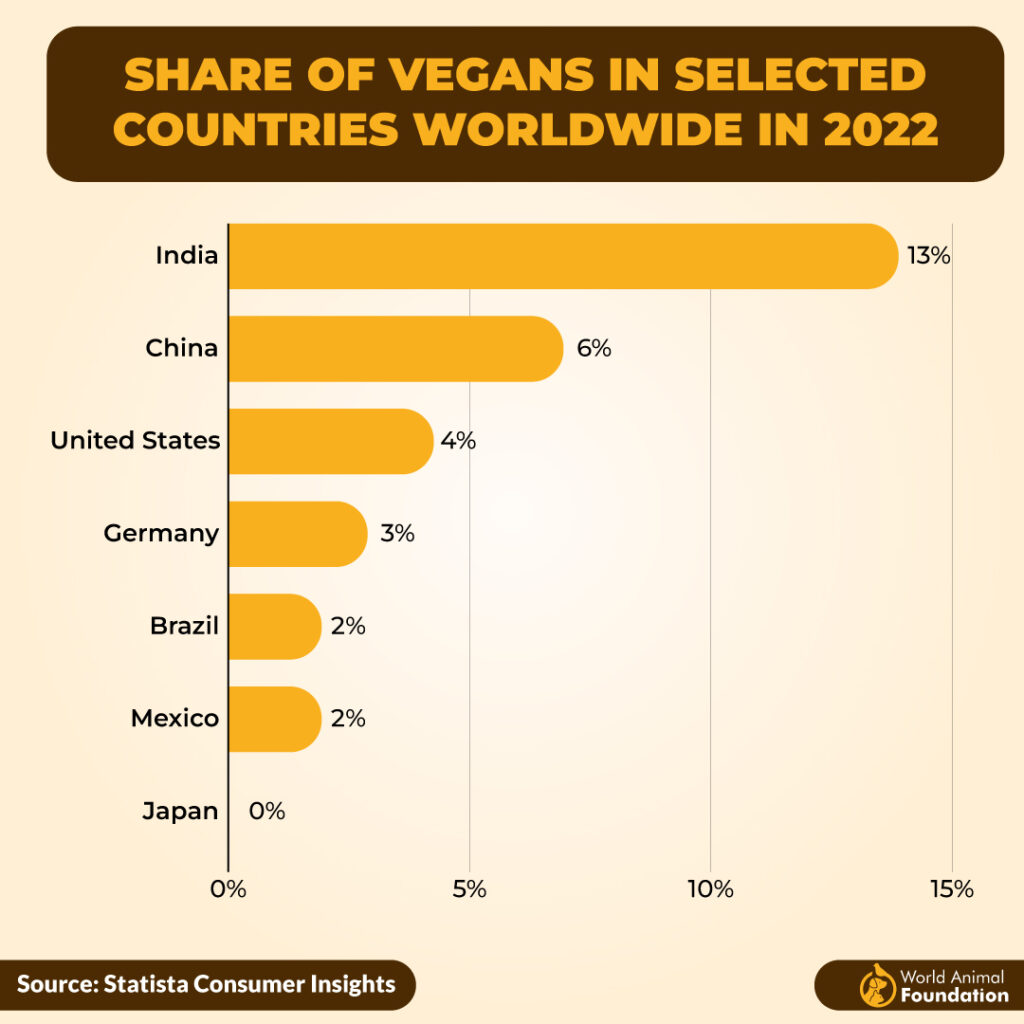
Since the population of the US is over 336 million, we have quite a distance to go. Still, I don’t think it’s pie in the sky to hope for that figure to expand greatly in the next decade.
Veganism Trend

Here are more statistics about veganism and vegan trends.
It is expected that the Global Vegan Food Market will Cross $124.36 Billion by 2030. (The Business Research Company)
In 2025, the plant-based food market was valued at $64.14 billion. Vegan diet offerings have vastly grown, three times as fast as overall food retail sales.
There’s a tremendous amount of money being invested and made in the plant-based market. It is expected that the global vegan food market will grow at a compound annual growth rate of 14.2%.
By 2030, the Global Plant Based Meat Market Will Reach $22.37 Billion. (The Business Research Company)
As per a new report, by 2030, the meat substitute market will be valued at $22.37 billion. As I did my research for this article, I never discovered even one reputable source declaring a decrease or even that the plant-based movement would stay the same regarding production in the coming years.
By 2036, the Global Plant Milk Market Is Expected to Reach $57.2 billion. (FMI)
The plant-based milk market is expected to reach $23.8 billion in 2026, driven by more people switching due to lactose intolerance and the growing popularity of dairy alternatives in stores and restaurants.
Types of plant milk listed by the National Center for Biotechnology Information are:
Oat, Rice, Corn, Spelt, Soy, Peanut, Lupin, Cowpea, Almond, Coconut, Hazelnut, Pistachio, Walnut, Sesame, Flax, Hemp, Sunflower, Quinoa, Teff, Amaranth.
The Founders of Plant Power Fast Food Told a High Growth Surge of 63% in Their San Diego Branch. (Forbes)
They wanted to produce a tasty but healthier version of McDonald’s and the like and have been extremely successful at doing just that, with a growth of 63%.
In 2016, a 1500% Increase Was Observed in Plant-Based Sales in the UK. (Vegan Food & Living)
Brits are way ahead of the curve when it comes to vegan living. In 2016, plant-based food alternatives sales increased by 1500%, showing people’s interest in vegan diets.
From 2014 to 2016, Australian Edible Vegan Products increased by 92%. (Mintel)
In 2016, 12% of food products launched in Australia had a vegetarian claim. Six percent announced they were vegan.
Veganism on the Rise

Keep going to find out more about the growing trend of plant-based products.
A Report by Grand View Research Depicted That Vegan Fashion Is Increasing Steadily. (Grand View Research)
Over the last several decades, I’ve seen animal rights groups going up against the fur industry. I’ve protested it myself. It’s not so much of a frenzy now since many companies produce vegan products, including fur.
Note: I highly recommend Donna Salyers’ Fabulous Furs company. Impeccable work and ethical staff.
By 2035, It Is Expected That the Synthetic (Vegan) Leather Industry Will Reach $146.9 Billion (Research Nester)
The synthetic leather market was worth about $73.98 billion in 2025. It is expected to grow to $146.9 billion by 2035, increasing at an average rate of 7.1% per year between 2026 and 2035. In 2026 alone, the market size is estimated to reach $78.71 billion.
In the ’80s, ’90s, and early ’00s, I could rarely find vegan leather, no matter how hard I tried. It was limited to specialty companies and animal advocacy organizations.
The global vegan cosmetics market was valued at USD 20.48 billion in 2025 and is projected to reach USD 37.43 billion by 2034. (Fortune Business Insights)
The global vegan cosmetics market was worth $20.48 billion in 2025. It is expected to grow to $21.88 billion in 2026 and reach $37.43 billion by 2034. In 2025, Europe led the market, holding about 33.63% of the total share.
The media has done a brilliant job in the last few years educating consumers on the senseless use of animal testing to test cosmetic ingredients.

Between 2025 and 2026, the Vegan Cheese Market Is Projected To Grow at a CAGR of 9.61%. (Research and Markets)
The vegan cheese market increased from $3.54 billion in 2025 to $3.86 billion in 2026. It is expected to keep growing at an average rate of 9.61% per year, reaching $6.74 billion by 2032.
This particular vegan market has nowhere to go but up. Since 1985, I’ve been sniffing out vegan cheeses to find that perfect “Wow, this is delicious” one. They’re out there now, revealing the inclination towards consuming a vegan diet.
Regarding Access to Vegan Foods, the Top 5 Cities in the World Are London, Berlin, Los Angeles, Portland, and Lisbon (Happy Cow)
The vegan diet trend continues to gain momentum all over the world. And what do these places have in common? All of them are progressive in their thinking, cultures, and reactions to problematic worldwide issues.
Vegan Demographics

Here are more vegan demographics facts and figures.
Most Vegans Are Females Aged 35 or Less. (Calendar UK)
It has been and is going to be the younger generations and females that lead our world into a plant-based life.
Overall, 33% of Vegans Are Males. (Calendar UK)
Males are less likely than females to stop eating meat. Diet programs have courted females since the beginning of time and find it easier to win this statistic.
Globally, 67% of vegans are females. (Calendar UK)
This makes sense whether you’re male or female. Both sexes enjoy meat, but it’s mostly females who decide to incorporate a vegan diet for their own reasons.
Almost 78% of People in the US adopted a Plant-Based Lifestyle Between Ages 16 and 24. (Calendar UK)
Young people are passionate about social issues, especially when something as big as climate change and animal welfare is concerned.
In Terms of Political Orientation in the US, 52% of Vegans Identify As Liberals, Whereas 34% and 14% Are Neutral and Conservative, respectively. (Vegan Bits)
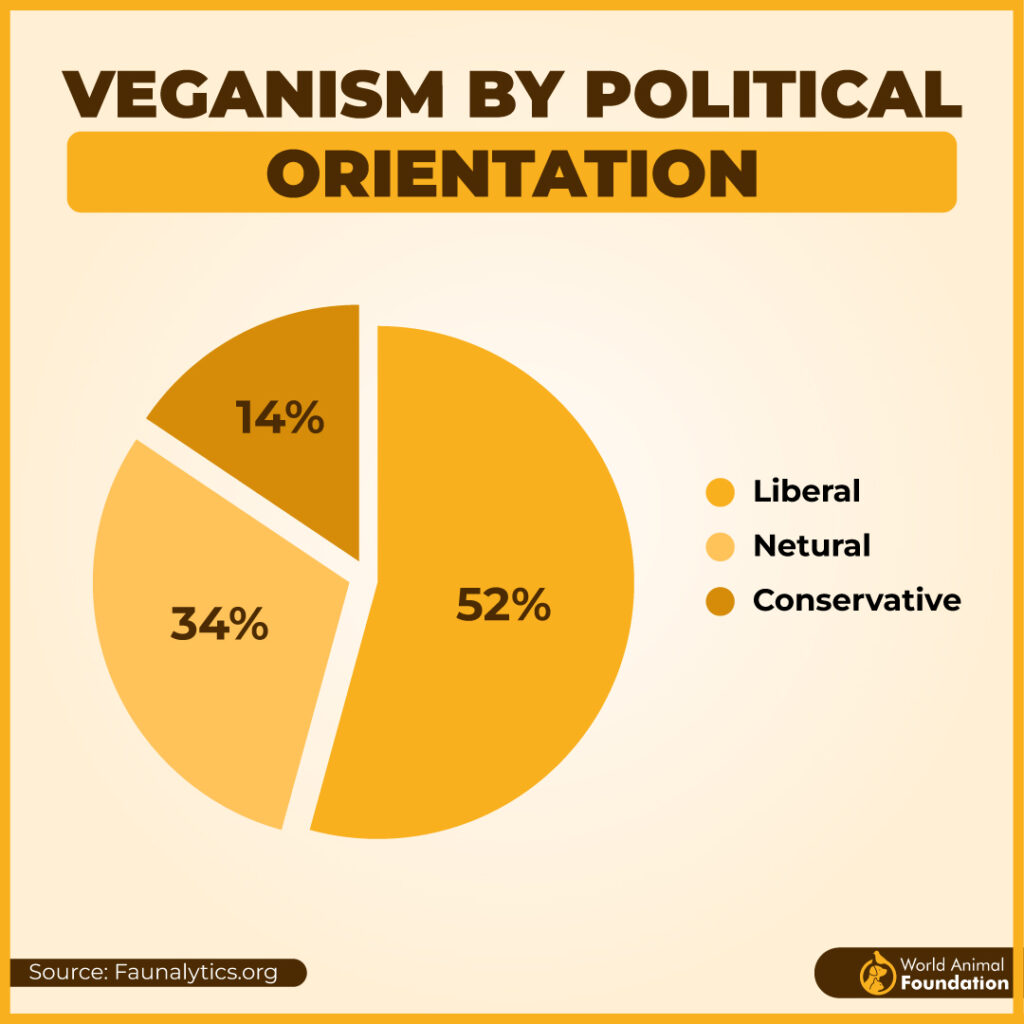
A touchy subject but interesting nonetheless… Climate change has long been a bedrock for those in the Progressive/Liberal party, translating into doing whatever it takes to stop it. If that’s veganism, so be it.
Note: There are those who choose veganism to save the Earth.
Veganism and Environmental Sustainability Statistics
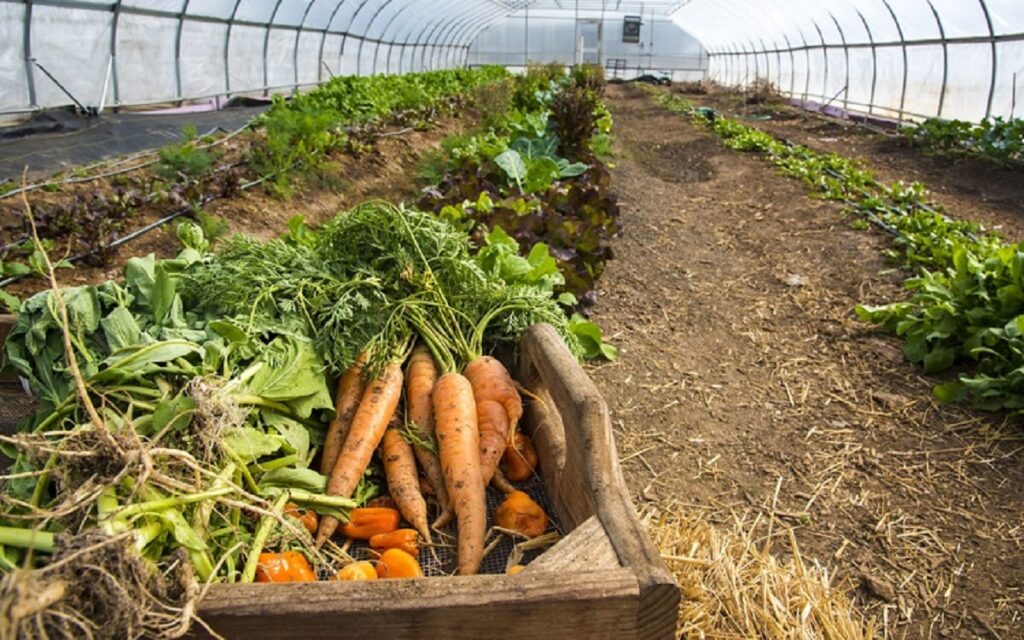
Below are more stats about how veganism can promote a sustainable environment.
Livestock Industry Contributes 14.5% to Global Anthropogenic GHG Emissions. (Taylor and Francis online)
Greenhouse gases are the main cause of global climate change. Raising animals for food produces about 14.5% of all human-made greenhouse gas emissions and around 70% of emissions from farming, forestry, and land use combined.
Animal agricultural farming not only betrays and abuses our farm animals but also is one of the largest contributors to greenhouse gas emissions, raising environmental concerns.
In 2022, Agriculture Contributed 9.4% of Total US Greenhouse Gas Emissions. (EPA)
The agriculture sector of the United States accounted for the release of approximately 593.4 million metric tons of CO2 equivalent, representing about 9.4 percent of the nation’s total greenhouse gas emissions.
80–90% of the US Water Consumption Is Attributed to Agriculture, From Which More Than Half Is Consumed by Farmed Animals Raised for Human Food. (USDA)
Globally, agriculture consumes approximately 70% of freshwater withdrawals, with industry using nearly 20% and domestic or municipal needs accounting for about 12%, as per a UNESCO report.
According to a USDA report, almost 80-90% of consumptive water is utilized by agriculture. Irrigation by agricultural farming accounted for 42% of the country’s total freshwater withdrawals in 2015. We’re not promised an unlimited supply of freshwater.
In the US, Almost 477 and 900 Gallons of Water Are Required To Produce 1 Pound of Dairy Eggs and Cheese, Respectively. (PETA)
This is such a jaw-dropping statistic, and every American should be shocked into action because of this alone. Factory farming has become entrenched in our culture to the point where its practices often go overlooked.

Livestock, a Major Cause of Global Warming (Due to Human Beings), Covers 45% of the Earth’s Total Land. (Cgspace.cgiar)
Since they’re raised at such ridiculous rates, to only be slaughtered, there are consistently this many livestock among us. They deserve so much better than this.
According to a 2018 Study by Oxford University, Avoiding Animal Products Is the Best Way To Reduce Environmental Impact. (University of Oxford)
Eating a plant-based diet can cut food-related greenhouse gas emissions by as much as 73%. For meat eaters, omitting meat, dairy, and animal products is the most significant method to lessen their environmental footprint.
Recycling is wonderful, but replacing animal products from your diet can produce positive changes for the Earth more quickly, along with numerous health benefits.
A UNO Report of 2010 Says a Plant-Based Diet Is Necessary To Save the World From Starvation. (UNO)
According to the World Health Organization, there were 828 million people in 2021 who were affected by hunger. This was 46 million people more than a year earlier and 150 million more in 2019. It has to change, and we must do our part.
Benefits of Eating Vegan Diet

Mentioned below are some more plant-based diet statistics.
Vegan and Plant-Based Diets Decrease the Risk of Developing Type 2 Diabetes by 23%. (Harvard)
Vegan and plant-based foods improve insulin sensitivity and blood pressure, as well as alleviate systemic inflammation. Both can contribute to having a risk of diabetes.
The chances of Hypertension in Meat Eaters Are Higher Than in Vegans. (NCBI)
The study showed that 5.8% of male vegans had high blood pressure, compared to 15% of male meat eaters. Among women, 7.7% of female vegans had hypertension, compared to 12.1% of female meat eaters.
Meat and cholesterol go hand in hand, which can lead to high blood pressure. This statistic shows that almost two out of ten people who eat meat could develop hypertension. Vegan diets reduce that.
Vegan Egg Has 0 mg of Cholesterol. (Utah Farm Bureau)
Vegan diets are extremely beneficial. JUST Egg (vegan egg) is a plant-based egg with no meat…This means no industrial chicken farms (where appalling and consistent abuse happens regularly) and no artificial flavors—just… egg.
A Slice of Vegan Cheese Has Almost 1-2g of Protein. (VRG)

Vegan cheese generally contains less protein than dairy cheese, partly because the serving size is usually smaller (often under 1 ounce). Most vegan cheese slices provide about 1–2 grams of protein, while a typical dairy cheese slice contains around 4 grams of protein.
There is a range of plant-based alternatives. With zero cholesterol plus protein – what’s not to like? If you have the choice, going vegan for health reasons is better for your mind and body.
A Vegan and Plant-Based Diet Lowers LDL Levels by 15 to 30%. (PCRM)
If someone were to hand you a bill of health that said your LDL levels would be fine when they previously weren’t, but you’ll need to eat vegan and plant-based foods, would you? We have remedies. We just need to use them.
Plant-Based Diet Can Assist in Preventing Cancers. (OAE Publish)
Can you count the health benefits of vegan food choices? Most of us know someone who has died from cancer. Could some have been saved? According to a WHO report on meat, incorporating plant foods into your diet could be the life-saving choice that makes all the difference.
A Study in 2019 revealed that Consuming Vegan Diets Decreases the Chance of Suffering From Heart Disease by 18-25%. (JAHA)
Research showed that plant-based foods lower the risk of heart disease by 18-25%. Almost 700,000 died from heart disease in 2020. That was one in every five deaths.
FAQ’s
What Percentage of the World’s Population Is Vegetarian?
Roughly 10% of the world’s population is vegetarian.
How Many People Are Vegan in the US?
Almost 17 million people (6%) in America are vegan. Note: Total US population used – 336,000,000 recorded by the Congressional Budget Office for 2023.
How Many People Are Vegan in the World?
There are between 75 and 85 million vegans in the world in 2023. It’s difficult to pin down since there are so many words used for a plant-based diet, but this is the best calculation.
Do Vegans Age Faster?
It is one of the myths that veganism ages a person faster. Even if it did, would you rather look older and be alive or look younger and die early? (That’s a joke. Mostly.)
On Average, Are Vegans Healthier?
There are no large, controlled studies of the health concerns of vegans vs. non-vegans. If you are eating a by-the-book vegan diet, which very few people do, chances are you’ll be healthier than the average person.
But you may also need to be taking B-12 supplements. There are many variables, such as age, genes, etc., but if you’re eating what you need in nutritional guidelines as a vegan, you have a great shot at being the healthiest person in the room. You will also help reduce greenhouse gas emissions. Just saying!
What Country Has the Most Vegans?
India, the UK, and Israel are all at the head of the class of vegan populations. An exact number would depend on ratios of people, areas, and places, as well as definitions of vegan, vegetarian, and plant-based diets.
Conclusion
You’ve seen the statistics. The numbers are real. People are practically running to the table to grab some pineapple and mushrooms all across the world.
Veganism has gone from being a fad to possibly being the finale. People’s lives, the safety of our animals, and our world are all at stake. In response, there appears to be a plant-based revolution going on across the globe. Don’t get left out.
Can you see yourself living a vegan lifestyle or eating a plant-based diet? Are the serious issues of animal abuse and climate change important to you? If you answered yes to both of these questions, congratulations… Here’s your ticket as a passenger on the vegan train.
