





Americans keep no secrets about their best friends. According to the American Pet Product Association, pet ownership is still rising, and the battle between dog owners and cat owners is one where all parties win. Dogs are wonderful companion animals.
The French Bulldog still rules, but the German Shepherd, Golden Retriever, and breeds like the Labrador Retriever are increasing the pet population.
Dog breeds are as unique as their dog owners, and our furry friends are a reflection that life is good for 89.7 million dogs in the U.S. It’s been a long-lasting friendship that started off as a necessity some 30,000 years ago.
First, we ate them; they ate some of us. Now they eat out of our hands. You have to wonder who the real winner is in this hooman-ex-wolf relationship.
Top 10 Statistics
- There Are Around 89.7 Million Dogs in the U.S
- In 2020, 63.4 Million Households in the U.S. Owned a Dog
- Almost 71% of the U.S. Population Owns a Pet, and Dogs Make Up a Total of 42.5%
- 30% of Millennials Own a Dog in the U.S
- French Bulldog, Labrador Retriever, and Golden Retriever Are the Most Popular Breeds
- The Average Dog Ownership per Household is 1.6
- Idaho and Montana have the Highest Percentage of Dog Owners
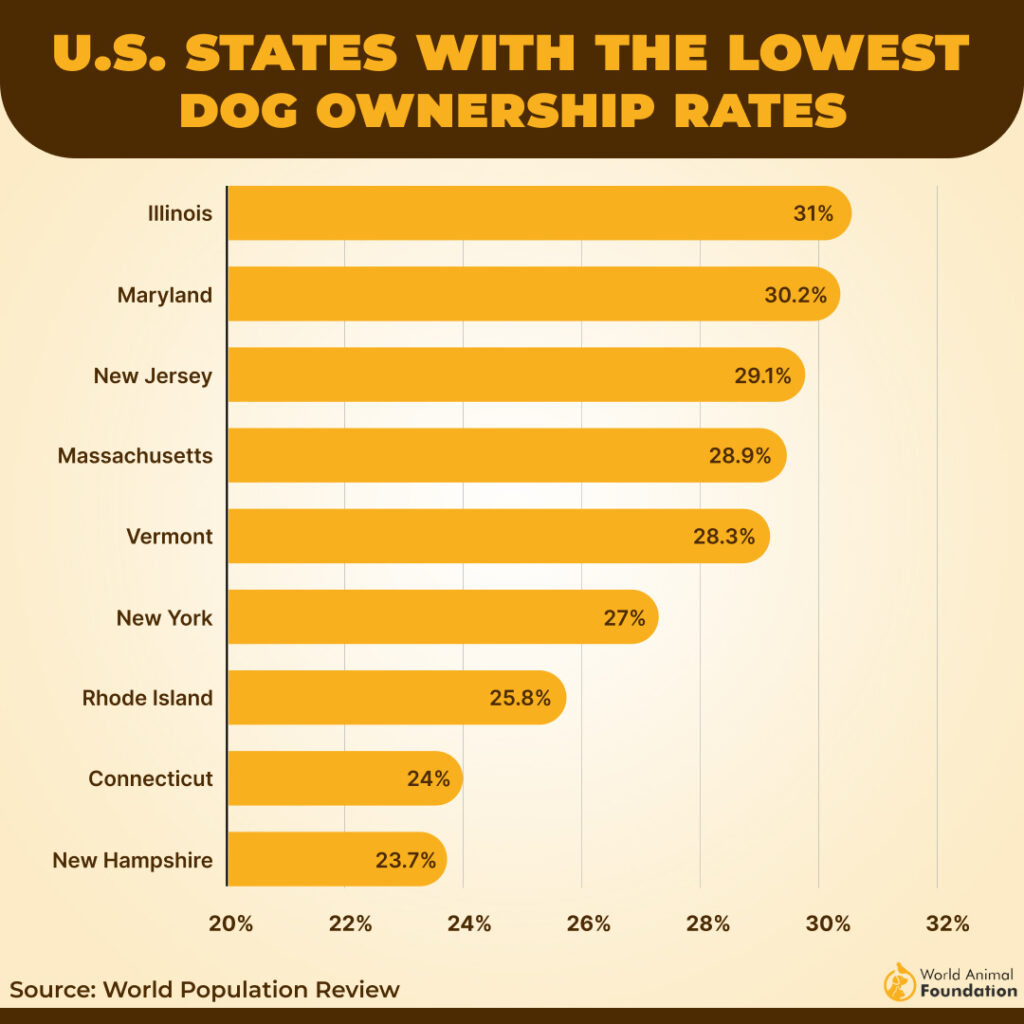
- The Lowest Number (23.7%) of dog owners is in New Hampshire
- There Are 900 Million Dogs in the World
- A Total of $2,500 Is Spent Yearly by Dog Owners
The Population of Dogs in the U.S.
Instead of counting sheep, perhaps it’s time to count dogs instead.
There are 89.7M dogs in the U.S. (World Population Review)
The United States has the largest dog population in the world, with around 89.7 million pet dogs—a number that has steadily grown since the late 1990s.
Because dogs are so popular, dog parks can now be found in almost every major city and town, and dog grooming services are widely available across the country.
According to the Pet Owners Survey of 2025, There Are 71 Million Pet Dogs in the U.S. (APPA)

We love our dogs, and 54% of households make room for at least one dog. To date, that number is still climbing and has reached 71 million homes. The American Pet Products Association survey started to track pet ownership in 1988, when only 56% of Americans were pet owners.
In 2020, 63.4 Million Households in the U.S. Owned a Dog (APPA)
Most American households have at least one dog; in 2020, 27 million households had more than one dog. Only two years, 2002 and 2015, saw a decline over the previous year.
The Number of Households Owning a Dog Is 56.3 million (AVMA)

According to the American Veterinary Medical Association, pet ownership demographics suggest that about 56.3 million U.S. households — equal to 42.6% of all households nationwide — own at least one dog, making dogs the most widely kept pets in the country. (source)
The American Pet Product Association pegs that number higher based on sales and pet statistics. The AVMA more than likely only uses data based on vet clinic stats and their unique formula.
As many as 14% don’t get yearly vet visits. Let’s hope they were all healthy.
The Total Number of Dogs in the U.S. Is 76,811,305 (AVMA)
Based on 2017 and 2018 pre-pandemic figures, the AVMA demographic sourcebook lists the number of dogs in American households at 76,811,305 dogs in pet-owning households. The APPA figures that number is 13 million higher.
The United States is home to about 87.3 million dogs, making them the most popular pets nationwide.
Almost 71% of the U.S. Population Owns a Pet, and Dogs Make Up a Total of 42.5% (APPA)
According to the American Pet Products Association’s 2025 report, about 95 million households in the U.S. have a pet, which is around 71% of all homes. Dogs make up 42.5% of these pets.
All generations, from boomers to millennials, agree that dogs make the best companion animal based on the number of dogs in our households. Two-thirds own at least one pet, and millennials helped drive dog population growth. The pandemic was another catalyst to grow pet ownership, products, and insurance.
In 2025, 9.1% of Dogs Entering the Shelter were euthanized, a slight improvement from 9.6% in 2024. (SAC)

Entering an animal rescue center is one of the most heartbreaking yet endearing experiences one can undergo. Those eyes that watch you walk past the pens will haunt you. Many of those will not find a forever home in time. Repeat that by 6.3 million.
The SAC and other rescue shelters deserve our gratitude. Although euthanization numbers are in decline and down from 2.6 million in 2011, 5.8 million companion animals still need a loving home yearly. That’s 37,000 dogs waiting in animal shelters. Imagine the tails wagging! (source)
30% of Millennials Own a Dog in the U.S. (APPA)
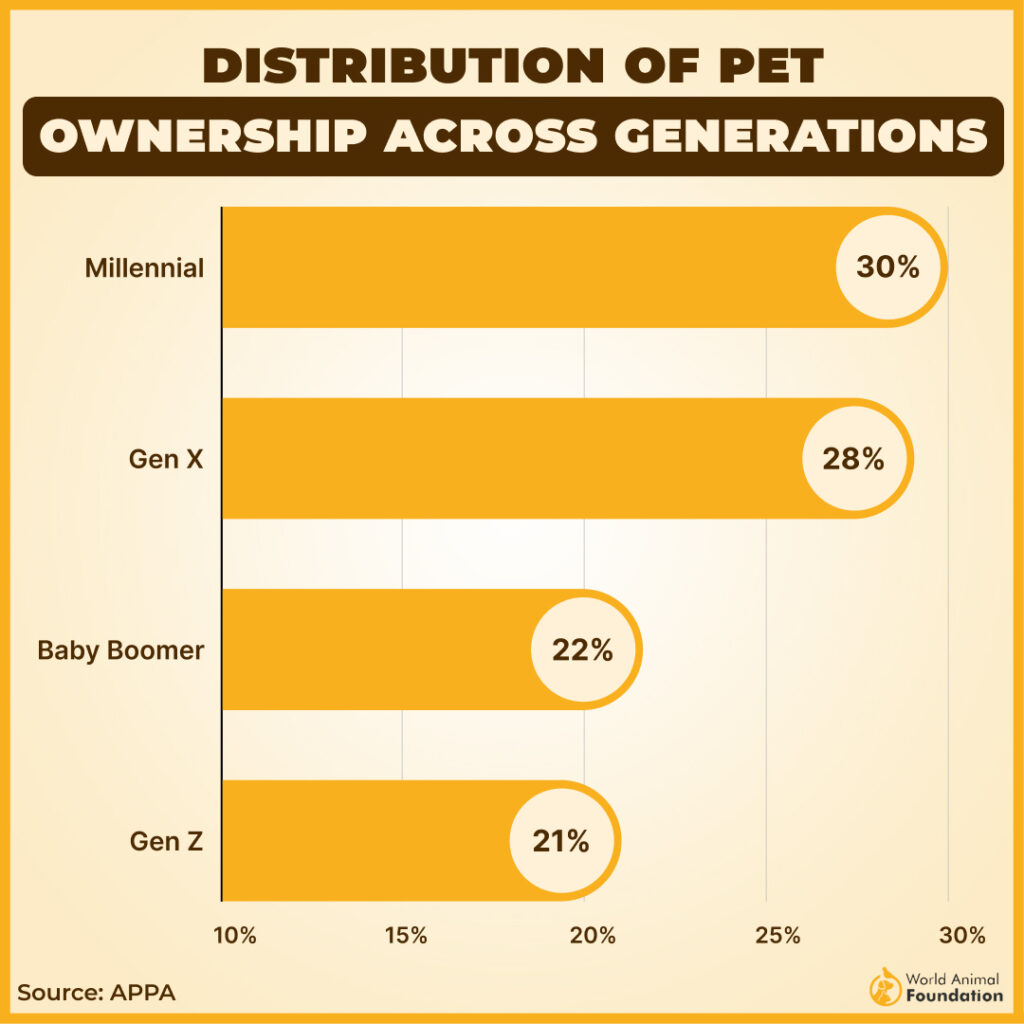
Millennials are good dog owners. They’re financially secure, are delaying parenthood, or have smaller families, but they help drive the dog ownership statistics. Boomers still have a fair grip on dog ownership, with 22% of the dog ownership pie.
14% of Americans acquired a Dog as a Pet During COVID-19 (Petfood Industry)

Pet shelters and welfare organizations saw a 14% increase in pet adoptions during the pandemic, according to Petfood Industry sales data. Way to go, people! Let’s make sure we don’t return them: all sales are final. (source)
French Bulldog, Labrador Retriever, and Golden Retriever Are the Top Three Most Popular Breeds in the U.S. (AKC)
America has gone to the dogs, and their number one choice is the French Bulldog as the most popular dog. Americans also like other designer breeds that the American Kennel Club doesn’t track. Designer dogs are mixed breeds, often of two purebred parents. (source)
German Shepherd, the Beagle, and the Catahoula Leopard Are the Other Famous Dog Breeds (AKC)

You’ll see a French Bulldog no matter what dog park you visit. Beagles are easy to recognize, though not as common. If you’ve never heard of a Catahoula Leopard, you’re not alone, though you’ll recognize the mottled coat and hound stance when you meet one. According to the AKC, Poodles are back in the top list after a long absence.
83% of households with a vet relationship made at least one visit during the year (AVMA)
There are more vets because there are more pets. On average, we take our household pets to the veterinary clinic twice each year.
In 2024, while 83.4% of pet owners reported having a regular veterinarian, only 69.4% actually visited a veterinary practice, meaning that roughly 83% of households with a vet relationship made at least one visit during the year.
In 2016, 27% didn’t visit the vet. Between 2016 and 2018, pet-owning households remained stable, shifting from 56.8% to 67, ending 2016. And then came the pandemic!
How Many People Own a Dog
It isn’t easy to imagine life without a dog or a cat. Humans get so much joy from animal companionship. And animals seem to like us, too, despite our sometimes questionable behavior.
The Percentage of Households Owning a Dog in the U.S. is 42.6% (AVMA)

Gaining accurate figures for dog ownership is difficult for many reasons. The AVMA keeps its own set of figures, and the APPA tracks another set based on money in the bank. Some web info is outdated or just fake news.
According to the most recent stats, the percentage of households owning a dog was 42.6% in 2025, according to the American Veterinary Medical Association (AVMA).
However, dog owner numbers fluctuate because there isn’t a tangible tracking method.
The Average Dog Ownership per Household is 1.6 (AVMA)
Survey companies devise mathematical formulas to predict semi-accurate numbers about pet ownership status. The average number of dogs owned in America is 1.6 (the .6 might be a Wiener dog) and 1.8 for cat ownership.
71% of Males and 60% of Females in the U.S. Own a Dog, According to 2016 Stats (Petfood Industry)
- 71% Male
- 60% Female
There are some conflicting stats about who owns what kind of pet. The main thing is to care for them. (source)
Idaho and Montana have the Highest Percentage of Dog Owners (World Population Review)
Idaho represented the biggest share of dog owners in the United States at 58.3%, followed by Montana with 51.9% and West Virginia with 51.6%. This shows they really do relish their companionship. (source)

The Lowest Number (23.7%) of dog owners is in New Hampshire (World Population Review)
Not sure why there would be such a significant difference between states. It makes sense that urban areas tend to have lower pet ownership than rural areas.
How Many Dogs Are In The World
There Are 900 Million Dogs in the World (Wild Earth)
How’d you like the job of official dog counter? Tough job since there are nearly a billion of them. It’s difficult to pinpoint the number because, in Asia, Africa, and South and Central America, many dogs are unaccounted for or strays.

Roughly 500 million dogs are classified as pets. America has about 87.9 million dogs, and Europe has 90 million. Russia is not so dog-friendly, maybe because it’s too cold to walk the dog and has only 12 million pet dogs.
China is home to over 54.29 million dogs (World Population Review)
Even with the one-dog-per-household rule in many major cities, China has over 54.29 million dogs. Popular breeds include the Pekingese, Chow Chow, Shar Pei, and Tibetan Mastiff.
Only makes sense since they have the population density. However, pet population statistics are difficult as many countries don’t have registration requirements. Beijing has an estimated million dogs.
75–85% of the Dog Population Includes Free-Range Dogs (World Atlas)
Free-range dogs are what Americans would call strays. The World Health Organization has grave concerns over overpopulation and animal shelter crowding, as 200 million dogs roam as free-range dogs.
In North America, strays are captured and sheltered and often adopted. In developing nations, free-range dogs are sometimes shared by communities. (source)
The Most Popular Dog Breed in the World Is the Bulldog (AKC)

That just startled every Labrador Retriever. Labs have held the number one spot since like forever. However, don’t let sleeping dogs lie; the French Bulldog is number one according to the AKC.
35 Species of Wild Dogs Are Known to the World (Active Wild)
Wild dogs fall under the Canidae umbrella, like our domesticated dogs, and are commonly known as canines. Wolves, foxes, jackals, coyotes, African wild dogs, and extinct dog species. Dogs and wolves share 99.9% of their DNA, but wolves are pure carnivores; the pooch on the sofa doesn’t mind hooman food.
In 2018, Global Dog Ownership Reached 471 Million (Statista)
Yes, the dogs have it, and this number is pre-pandemic, which saw a massive increase in overall pet ownership.
Cost Associated With Keeping a Dog

The cost of keeping a dog isn’t just a financial number. Being a pet parent takes massive amounts of time and attention. It’s vital, aside from having the finances to pay for food, shelter, vet visits, and toys (not to mention replacing chewed shoes and furniture), owners can commit to a lifetime of caring.
A Total of $2,500 Is Spent Yearly by Dog Owners (AKC)
A 2020 Harris Poll found that dog owners spend twice as much on their canines as their felines (that might explain your cat’s behavior toward your dog). Pet owners spend $2,500 on dogs annually for the dog’s food, grooming, veterinary care, pet-sitting fees, etc. (source)
New owners reported that owning a pet pooch was more expensive than they realized. Dogs are also more prevalent in 51% of households, while cats are in 37%.
About 11% of Millennials Can Spend More Than $10,000 if Their Dogs Get Sick (Ameritrade)
Millennials are generous pet parents and have no qualms about spending $2000 to $10,000 on a sick dog. Other stats suggest that they don’t have the funds in their bank account, and investing in a pet emergency fund or pet insurance is the way to go. (source)
Pet ownership statistics are interesting to interpret, and three sets of numbers stand out: Millennials spend more on clothing and accessories, and GenX buys premium pet food but doesn’t spend anything on training. Boomers walk their own dogs.
At year‑end 2024, the combined pet insurance premium volume for Canada and the U.S. was about $5.28 billion (NAPHIA)
Not only do Canadians and Americans love their dogs, but they’re also willing to spend to insure their health. At year‑end 2024, the combined pet insurance premium volume for Canada and the U.S. was about $5.28 billion, with $583.9 million (CAD) in Canada and $4.7 billion (USD) in the United States, according to NAPHIA and public filings. (source)

The U.S. market is still growing fast, but the growth has slowed slightly over the past two years. In 2024, it stayed steady with a 21.4% increase compared to the previous year.
On average, the market has grown by about 25% over the last five years. Here’s the yearly growth in a simple way:
- 2023 to 2024: 21.4% increase
- 2022 to 2023: 21.4% increase
- 2021 to 2022: 24.2% increase
- 2020 to 2021: 30.4% increase
The Canadian pet insurance market’s5-year average annual growth rate was 24.4%, slightly below the U.S. average annual growth rate of 25%.
The Average Veterinary Expenditure per Household per year is $200 (AVMA)
The average reported cost of the last veterinary visit was $200 as reported in 2025, $147 in 2024, and $190 in 2023. Dogs are more expensive than cats, with nearly half the cost of owning a dog for veterinary visits.
Vaccinations, food, and emergency visits are the brutal reality of being a pet owner that requires serious thought before entering a long-term relationship. Pet insurance with an average $62.40 monthly premium is a good investment.
Interesting Facts About Pet Dogs
We all choose our dogs because something about a specific breed or mixed breed speaks to us. Sometimes those notions go out the window when we have an unexpected encounter with a shelter animal. Regardless of the type, we fall in love with them.
Large Dogs Have a Shorter Lifespan Compared to Small Dogs (PetMD)

Everyone knows that one dog that always breaks the mold and outlives every other dog. Depending on the breed, larger dogs live between 9 and 12 healthy years, medium dogs average 10 to 13 years, and smaller dogs can live between 10 and 15 years. Older dogs develop arthritis, hip and joint problems, and cancer is a prevalent problem. (source)
The Average Life of Dogs Less Than 20 Pounds Is 11 Years (PetMD)
Dogs with a bit of help from over-the-counter supplements, a healthy diet, help with dental care, and routine checkups can live happy and productive lives. While the average is 11 years for smaller dogs, many exceptions exist.
On this day, Trixie, a favorite dog friend and rescue mutt, is going to the vet. She’s been with her family for over twenty years. Update: Trixie got a clean bill of health; she just needs medication to address her incontinence.
Smaller dogs live longer, but with today’s medical advances, premium dog food, and overall better living conditions and treatment, who is to say that we can’t impact the life expectancy of a large dog as much as a small dog?
The Dogs 90 Pounds and Above Live a Shorter Life of 8 Years (PetMD)
While stats suggest this is true, medical science can’t substantiate the reason other than that smaller mammals live longer than large ones. Older dogs develop medical conditions like incontinence and hip, joint, and mobility problems, and might face euthanasia sooner.
If a larger dog suffers, it’s only fair to help them by doing the right thing. That means doing the hard thing and taking them to the vet for that last visit ;( Dogs have dignity.
Bluey was the longest-living dog with an age of 29 Years and 5 Days (Guinness World Records)

Bluey, the famous Australian cattle dog, died in 1939. Bluey set the record for over 80 years until Bobi broke the spell with a new one. Bobi died on 21 October 2023, reportedly aged 31 years and 163 days. (source)
Rabies, Distemper, and Parvovirus Are the Most Common Dog Diseases (AVMA)
Please vaccinate your dog. Rabies is entirely preventable through routine vaccinations and has been pretty much eradicated in the U.S. and Canada. Human and dog deaths from rabies still occur in Asia and Africa.
Canine distemper is a virus that attacks dogs’ respiratory, gastrointestinal, and nervous systems through airborne contact, such as coughing or sneezing, or community dog bowls. It is often fatal.
Parvovirus is a contagious virus that is particularly dangerous for unvaccinated dogs. Parvo is transmissible through feces, surfaces, and people. Most deaths occur within 48 to 72 hours. Please vaccinate your dog.
Annually, around 2.8 million dogs enter shelters (SAC)

The good news is that the numbers are coming down, and the number of dogs is currently at 2.8 million, with a sharp decrease since 2011. We still euthanize 757,000 unwanted pets.
From 2.8 Million Dogs, 2 Million Find New Homes (SAC)
Charities like the ASPCA, SAC, and the Humane Society work relentlessly to save the lives of animals. Although not all dogs that enter the shelter system find a forever home immediately, many go on to live with foster parents.
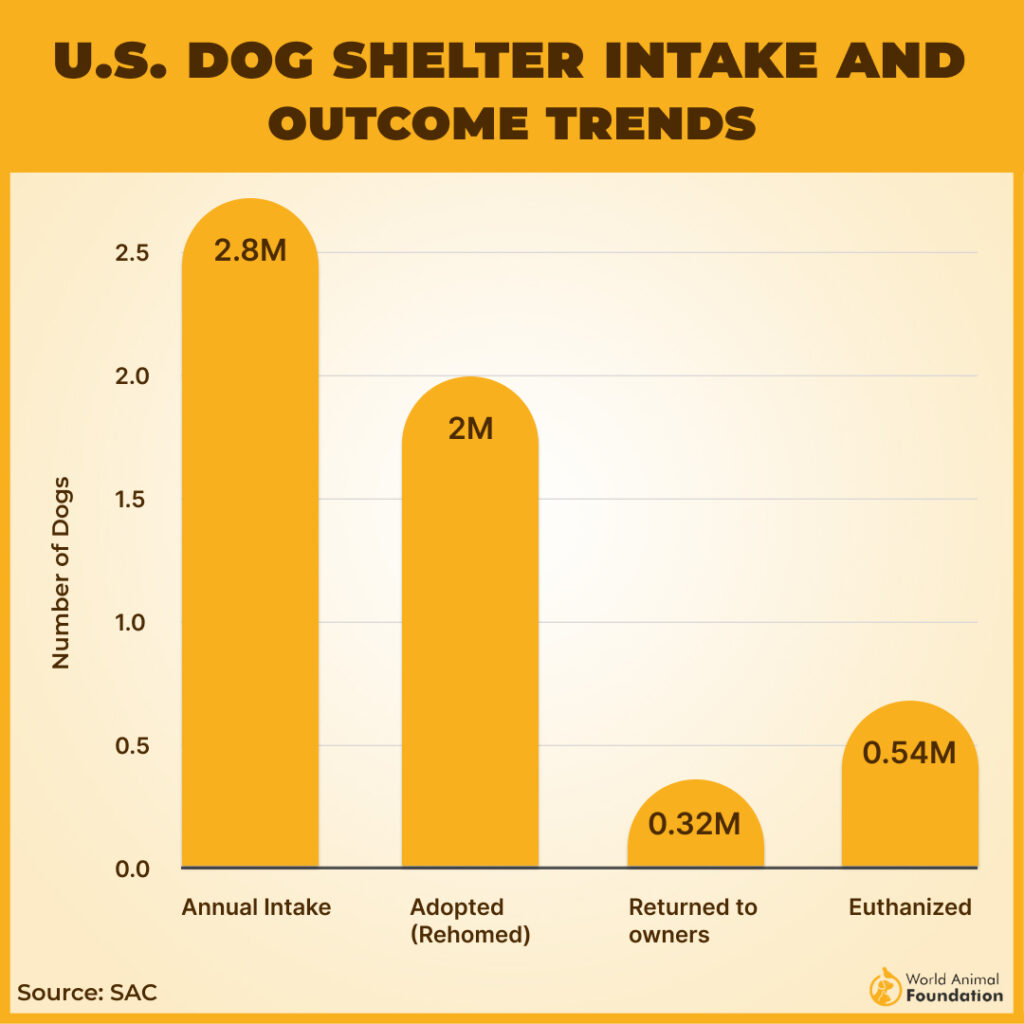
Campaigns and community involvement have helped reduce the number in shelters, and 4.2 million homeless animals are adopted annually.
The Number of Dogs Returned to Owners Is 542,000 Annually (ASPCA)

Undoubtedly, the SAC picks up where we fall down. They care for animals we lose accidentally or pets that we can no longer care for because our lives change drastically and force us to abandon our dogs.
The pandemic had people rushing out to get companion animals, and according to sources, the fallout is just starting to trickle in, and shelters are filling up again.
In 2025, around 320,000 dogs were euthanized. That same year, about 5.79 million dogs and cats entered shelters and rescue organizations across the country.
This is still much lower than in 2011, when about 3.9 million more animals entered shelters, showing a big improvement over time.
In 2024, around 5.8 million dogs and cats were taken in by shelters in United States. That was about 1.4% fewer (around 83,000 less) than in 2023.
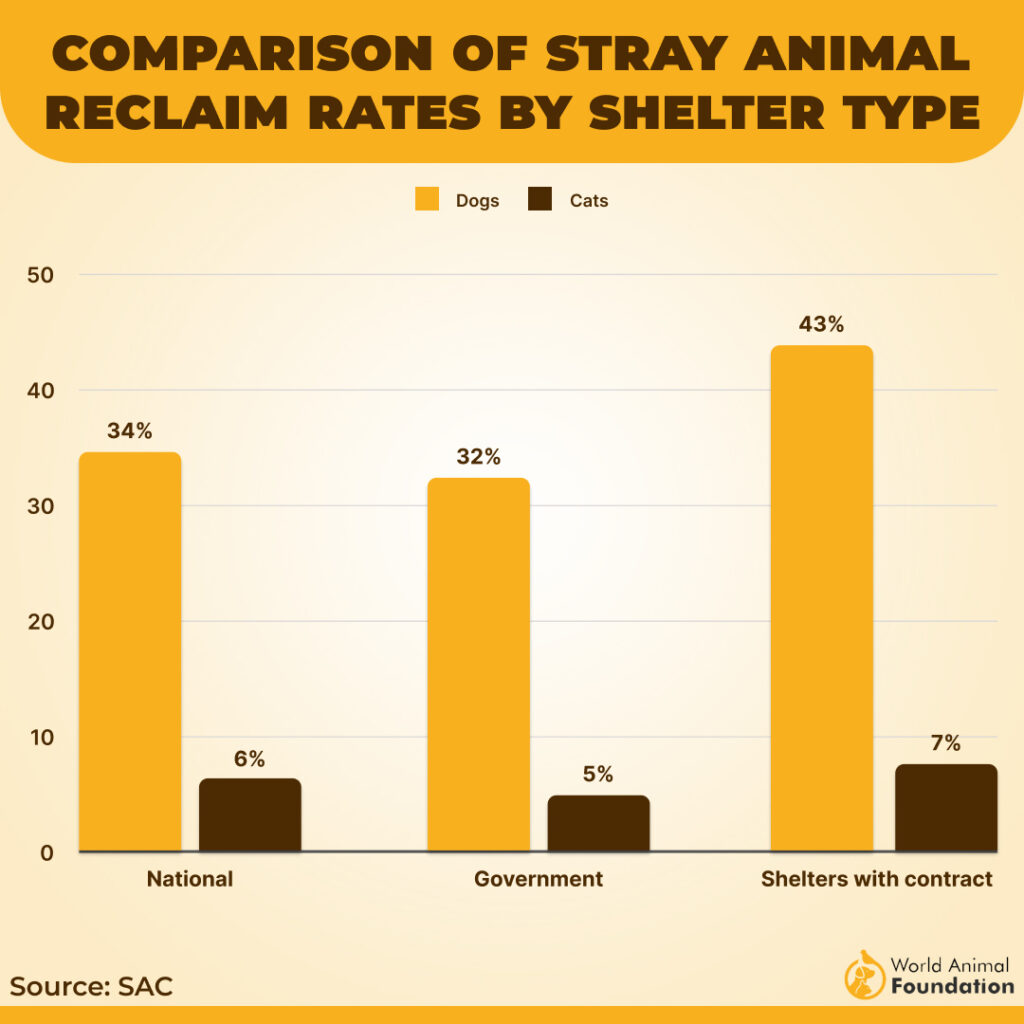
Stray dogs were about six times more likely to be returned to their owners compared to stray cats, and this trend has stayed the same in recent years. Overall, about 34% of stray dogs are reunited with their owners.
In 2019, Dogs named Arya rose by 21% after a character on the popular TV show Game of Thrones (Mental Floss)
Never saw one episode of Thrones, but the character Sansa had a dog named Funni that she adopted in real life. (source)
Astro, Baltro, Beethoven, and Blue are some names inspired by famous movies, TV, and Books (AKC)
Dogs have become a big part of pop culture over the years, appearing in news headlines, TV shows, movies, books, and more. Here are some of the most popular dog names.
- Clifford
- Comet
- Dogbert
- Dug
- Eddie
- Fang
- Fido
- Gibson
- Goofy
- Gromit
- Happy
- Hooch
- Hotdog
- Jo-Fi (source)
FAQs
Pet ownership statistics are a fascinating topic. Before you buy a dog, consider adoption.
Is There Any Country Without a Stray Dog?
Yes, the Netherlands doesn’t have stray dogs. There is also severe punishment for people who abuse an animal, with three years in prison or a €16,750 fine. That’s how it should be!
How Can the Number of Shelter Dogs in the U.S. Be Reduced?
Spaying and neutering is one way; educating people is another. Stop buying from puppy mills and adopt a rescue. If you commit to taking on a pet, take it seriously. It’s yours for life.
How Many Service Dogs Are There in the U.S.?
Service dogs are such remarkable animals. The USA has about half a million dogs in service.
How Many Dogs Are Born Per Day in the U.S.?
It’s impossible to answer that question accurately because dog births are not registered like human births. National estimates suggest around 30,000, but since puppy mills don’t have to disclose any numbers, they produce 1.3 million puppies yearly.
Wrap Up
Having a dog or a cat is a privilege and not a right. It takes 100% commitment on our part to make sure that these animals receive the best care. Bringing a pet into the family is a joyous occasion, but make sure you can afford all the costs associated with owning a pet.
A great way to experience dog companionship is through volunteering and fostering. Both are rewarding. Another way is through pet sitting or dog walking. You get to have all the frisbee-throwing fun without the cost.
