




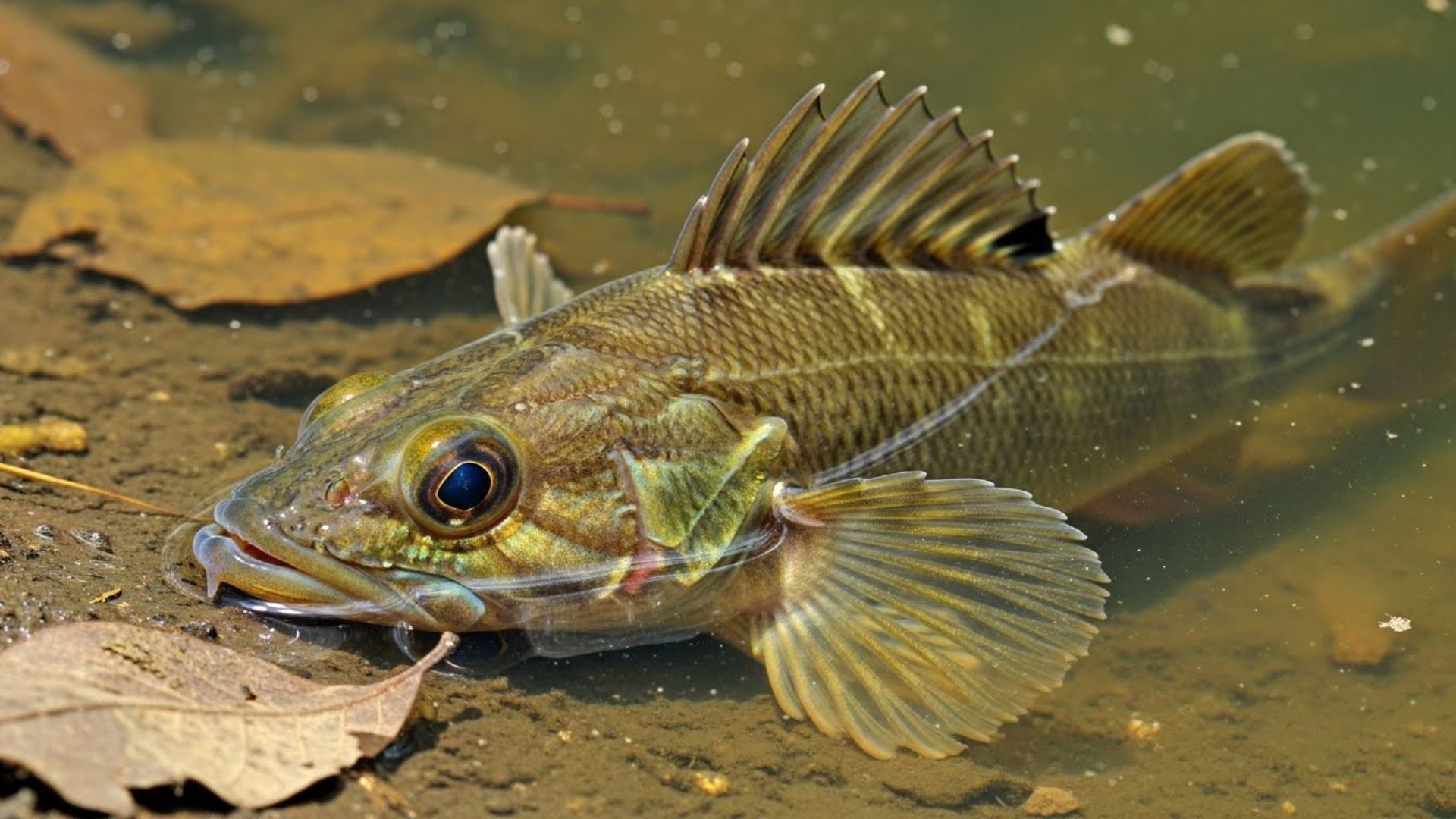
Ever held your breath underwater, feeling that burning need for air? For us, it’s a matter of minutes, if we’re lucky. But in the vast, mysterious world of water, some fish have evolved superpowers that would make any free-diver jealous.
They live and thrive in places where oxygen is a luxury, not a guarantee. These are the ultimate survivors, the masters of adaptation.
We’re diving deep into the world of fish that can live in low-oxygen territories. These aren’t just your average swimmers; they are biological marvels that have developed extraordinary ways to breathe when the dissolved oxygen in the water drops to dangerously low levels.
From gulping air at the surface to literally walking on land to find a new home, their stories are a testament to life’s sheer will to continue.
Get ready to meet the incredible fish that laugh in the face of low oxygen!
Fish That Thrive in Low Oxygen Waters
1. Betta Fish

Hailing from the stagnant rice paddies of Southeast Asia, these fish are tougher than they look. Their native home is often a warm, shallow puddle with incredibly low oxygen, a death sentence for most other fish species.
So, what’s their secret?
Bettas possess a biological superpower called the labyrinth organ. Think of it as a built-in snorkel or a primitive lung. This complex, maze-like organ, located in their head, is filled with tiny blood vessels that can absorb oxygen directly from the air.
This incredible adaptation evolved from necessity. In their natural environment, the water is often crowded with plants, and the heat reduces the amount of oxygen the water can hold. The labyrinth organ gave them a massive advantage.
They could breathe when others couldn’t, giving them access to food and territory that was off-limits to other fish. It’s a perfect example of nature finding a way.
However, just because a betta can survive in a puddle doesn’t mean it should. In an aquarium, these fish still rely on their gills to absorb oxygen and thrive in clean, well-filtered water.
2. Climbing Perch

Found in the swamps and ponds of Asia, this hardy creature can handle some of the most challenging low-oxygen conditions imaginable. When the water quality drops and oxygen becomes scarce, the Climbing Perch doesn’t panic; it just goes to the surface for a breath.
Britannica says the Climbing Perch has a labyrinth organ, which is its ticket to air-breathing. This organ allows it to supplement the work of its gills, performing gas exchange with atmospheric air. This dual-breathing system makes it incredibly versatile. It can hang out in stagnant, muddy water that would suffocate other fish, patiently waiting for conditions to improve or for an unsuspecting meal to swim by.
But the Climbing Perch’s most famous trick is its “walking” ability. When its pond begins to dry up, or the environment becomes completely unlivable, it doesn’t just give up. Using its spiny pectoral fins as makeshift legs and flaring its gill covers for leverage, it can awkwardly wiggle and drag itself across dry land! It’s on a mission: to find a new body of water with better living conditions.
This terrestrial adventure can last for hours, as long as the fish stays moist. This incredible feat of survival allows it to move between isolated pools, expanding its territory and escaping drought.
3. Walking Catfish

This species, Clarias batrachus, is another master of survival in low-oxygen atmospheres. It’s so good at it, in fact, that it has become an invasive pest in some areas, like Florida, where it outcompetes native fish that can’t handle the same harsh conditions.
The Walking Catfish doesn’t have a labyrinth organ. Instead, it has something called a suprabranchial organ, a tree-like structure of tissues located above its gills. This organ functions like a primitive lung, allowing the catfish to gulp air from the surface and absorb oxygen directly.
True to its name, this catfish is famous for its ability to travel over land. Using its strong pectoral fins as a pivot, it moves its body in a snake-like motion to wriggle across wet ground.
This isn’t just a desperate, last-ditch effort; it’s a primary mode of transportation, especially during rainy seasons when it moves between ponds to breed and find new food sources. It can survive for many hours out of water as long as it stays damp.
This combination of air breathing and land-walking makes the Walking Catfish one of the most successful survivors on this list. Its adaptations give it a massive advantage in the constant struggle for resources.
4. West African Lungfish
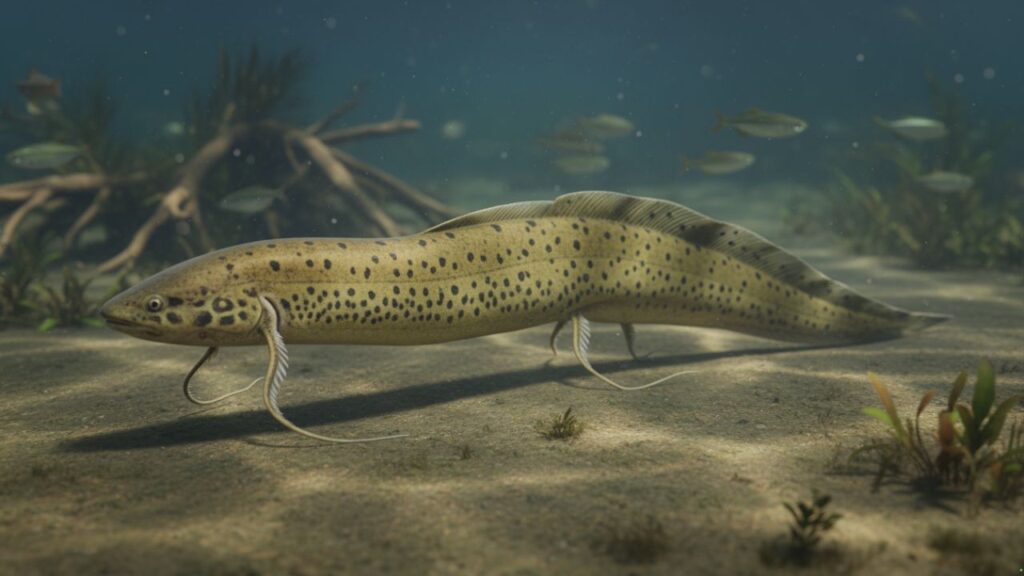
Lungfish are considered “living fossils” because they have changed very little in millions of years. Their secret to longevity? They possess one of the most extreme adaptations for surviving low oxygen and drought found anywhere in the animal kingdom.
Unlike the other fish on this list that have accessory breathing organs, National Geographic suggests that the lungfish has true, primitive lungs, very similar to our own. While it still has gills, it gets most of its oxygen from air at the surface.
In the slow-moving, often oxygen-depleted rivers and swamps of Africa, this ability is essential. But what it does when the water disappears entirely is what makes it a legend.
When the dry season arrives, and its riverbed home turns to cracked mud, the lungfish burrows down. It then secretes a mucus cocoon around its body, which hardens and protects it from drying out. It leaves a tiny tube open to the surface to breathe.
In this state of suspended animation, called aestivation, its metabolic rate plummets. To get energy, it slowly digests its own muscle tissue, often from its tail.
This is not a short nap. A lungfish can remain in this dormant state for months, and in some cases, for several years, waiting for the rains to return. When the water finally comes back, it awakens from its slumber, breaks free of its cocoon, and resumes its life as if nothing happened.
5. Mudskipper

These amphibious fish are the undisputed kings of the intertidal zone, living their lives in the muddy, brackish water of mangrove swamps. This is an environment of constant change, with fluctuating water levels and often very little oxygen content, but the mudskipper is perfectly designed for this challenge.
Mudskippers have a whole toolkit of adaptations to breathe outside of water. First, they can absorb oxygen directly through their skin and the lining of their mouth, a process known as cutaneous respiration.
To do this, they must stay moist, which is why you’ll see them constantly rolling in the mud or taking a quick dip. They are essentially wearing a “scuba suit” of moisture.
Second, they have modified their gills for life on the go. They can hold a bubble of water in their large gill chambers, which keeps their gills wet and functional even when they’re on land.
This acts like a personal oxygen tank they can carry. When that runs low, they go to a puddle to trap a new bubble and continue their terrestrial adventures.
6. Saddled Bichir

With its long, serpentine body and armored scales, the Bichir is another “living fossil” that has perfected the art of survival in low-oxygen habitats across Africa. Its breathing method is as ancient as its appearance.
The Saddled Bichir has a pair of lungs.
Yes, lungs!
While they are more primitive than ours, these organs function in much the same way. Bichirs are obligate air breathers, meaning they must have access to the surface to gulp air. Their gills alone are not efficient enough to provide all the oxygen they need, especially in the warm, stagnant waters they prefer.
Their hypoxia tolerance leads to a fascinating and critical fact about keeping Bichirs: if you prevent them from reaching the surface, they will actually drown. This dependency on atmospheric air is a core component of their biology.
They will regularly swim to the top, take a quick breath, and then sink back down to lurk near the bottom, waiting for prey. This behavior is a constant, rhythmic reminder of their unique dual-breathing system.
These incredible adaptations allow the Bichir to thrive where other fish falter. In a swamp with low dissolved oxygen, the Bichir is perfectly at home, calmly using its lungs while other species struggle.
7. Northern Snakehead

Few fish have a reputation as fearsome as the Northern Snakehead. Dubbed “Frankenfish” by the media, this species is notorious for its voracious appetite and its shocking ability to survive out of water. All of this is made possible by its remarkable ability to breathe air, which makes it a formidable competitor in any environment.
The Snakehead possesses a suprabranchial organ, similar to that of the Walking Catfish, which acts as a primitive lung. This allows it to gulp air from the surface, a behavior essential to its survival in the often stagnant, muddy, and low-oxygen ponds and rivers it inhabits.
This air-breathing capability is the source of its most infamous trait: its ability to survive on land for several days, as long as it stays moist. Combined with its ability to wriggle, the Snakehead can move between different bodies of water, dramatically increasing its invasive potential. It can colonize new lakes and rivers that would otherwise be unreachable.
The Northern Snakehead is a stark example of how a fish that can live in low-oxygen environments can disrupt ecosystems. Its hardiness, predatory nature, and unique respiratory adaptations make it a top-tier survivor.
8. Dwarf Gourami

Dwarf Gouami come from the slow-moving, heavily vegetated waters of India and Pakistan, where dissolved oxygen levels can naturally be low.
The Dwarf Gourami’s labyrinth organ is its lifeline. This organ allows it to breathe atmospheric oxygen by sipping air from the surface. You will often see these shy fish make a quick, quiet trip to the top for a breath before retreating into the cover of plants. This is an entirely normal and essential behavior for their health and survival.
This adaptation is a marvel of evolution, allowing them to thrive in habitats that are less than ideal for many other fish species. The dense vegetation and slow water flow in their native region can cause oxygen levels to fluctuate, but the Gourami is always prepared. Its ability to tap into the unlimited supply of oxygen above the water gives it a reliable backup.
Just like with Bettas, aquarium keepers need to remember that, while they are tolerant of low oxygen levels, they are happiest and healthiest in a well-maintained tank. A gentle filter to keep the water clean and provide some circulation is ideal.
9. Mozambique Tilapia

Mozambique Tilapia is a champion of aquaculture and, unfortunately, an invasive problem in many parts of the world, all because it can handle conditions that would be lethal to most other fish. Its ability to cope with low oxygen concentration is a significant part of its success story.
The Mozambique Tilapia can survive in water with dissolved oxygen levels that are shockingly low—sometimes below what scientific instruments can reliably measure. When oxygen levels plummet, it has a simple but effective strategy: it swims to the surface and gulps air, a behavior known as “piping.” This allows it to utilize atmospheric oxygen to supplement what its gills can extract from the water.
In their natural environment, factors like high water temperature and dense vegetation reduce the amount of oxygen the water can hold.
This tolerance allows Tilapia to flourish across a wide range of habitats, from clean rivers to polluted lagoons and stagnant farm ponds. Its ability to withstand lower oxygen, high ammonia, and varying pH makes it almost indestructible. It can colonize new areas quickly, often out-competing native species for food and space.
Conclusion
From the dazzling Betta to the tenacious Tilapia, the world is full of fish that can live in low-oxygen environments. These creatures are more than just biological curiosities; they are living proof of evolution’s incredible power to solve the most difficult challenges.
Their unique adaptations—labyrinth organs, primitive lungs, and the ability to breathe through their skin—allow them to conquer habitats that are off-limits to their less-equipped neighbors.
Their stories teach us about resilience, ingenuity, and the endless diversity of life on our planet. Whether they are walking across land, sleeping in a cocoon for years, or simply taking a quiet gulp of air from the surface, these fish redefine what it means to survive.
