




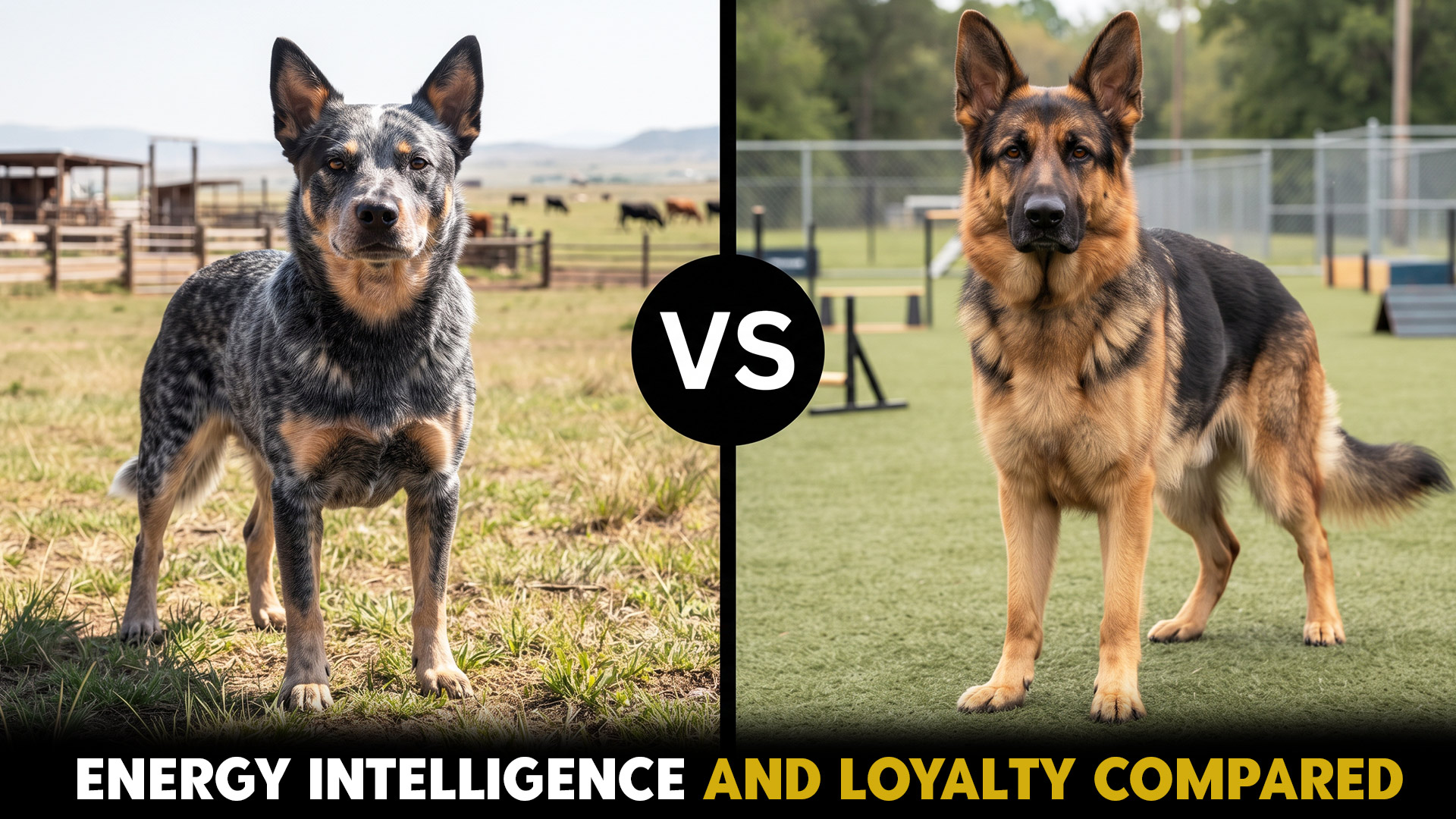
The Blue Heeler and German Shepherd are two highly capable working dogs that are often described in overly simple terms. One is frequently portrayed as an unstoppable cattle dog, while the other is commonly viewed as a naturally protective guard dog. Although both breeds possess impressive working instincts, these descriptions do not tell the whole story.
The Blue Heeler, officially known as the Australian Cattle Dog, was developed to manage cattle in Australia’s demanding conditions.
The German Shepherd originated as a versatile sheep-herding dog in Germany before becoming widely known for service, police, military, search-and-rescue, and family roles. Their histories explain many of their traits, but they do not mean every individual behaves in the same way.
Several popular assumptions deserve a closer look. Blue Heelers are not simply “small German Shepherds.” German Shepherds are not automatically aggressive, and neither breed becomes a well-behaved companion merely because it is intelligent.
Looking at their physical structure, behavior, exercise needs, learning styles, coat care, longevity, and household suitability provides a much more realistic picture.
Blue Heeler vs. German Shepherd: Common Myths Busted
1. Breed Origins & Functional Background
Blue Heeler’s Cattle-Driving Heritage
The Blue Heeler, officially known as the Australian Cattle Dog, was developed in Australia to help manage cattle across large properties and challenging terrain. Its development involved several working breeds and contributed to a dog capable of enduring heat, distance, and physically demanding livestock work.
Its job required more than simply following commands. The dog needed confidence, stamina, agility, and enough independence to influence cattle effectively while remaining responsive to its handler.
German Shepherd’s Versatile Herding Heritage
The German Shepherd originated from German sheep-herding dogs selected for working ability, intelligence, athleticism, and sound temperament. Captain Max von Stephanitz played a major role in establishing the modern breed, emphasizing functional qualities rather than appearance alone.
Although the German Shepherd later became famous for police, military, protection, and service work, those roles developed from its broader working abilities. Its original identity was that of a versatile herding and utility dog rather than a dedicated guard dog.
Myth busted: The Blue Heeler and German Shepherd were not developed for the same purpose. Both are working breeds, but the Blue Heeler was specialized for cattle handling in Australia, while the German Shepherd was developed as a versatile herding and utility dog.
2. Physical Characteristics & Body Structure
Blue Heeler’s Compact Athletic Design
The Blue Heeler has a compact, muscular body built for endurance rather than sheer size. Adult Australian Cattle Dogs generally stand around 17–20 inches tall and weigh approximately 35–50 pounds. Their sturdy frame, strong legs, and balanced proportions allow them to remain active for long periods without carrying unnecessary bulk.
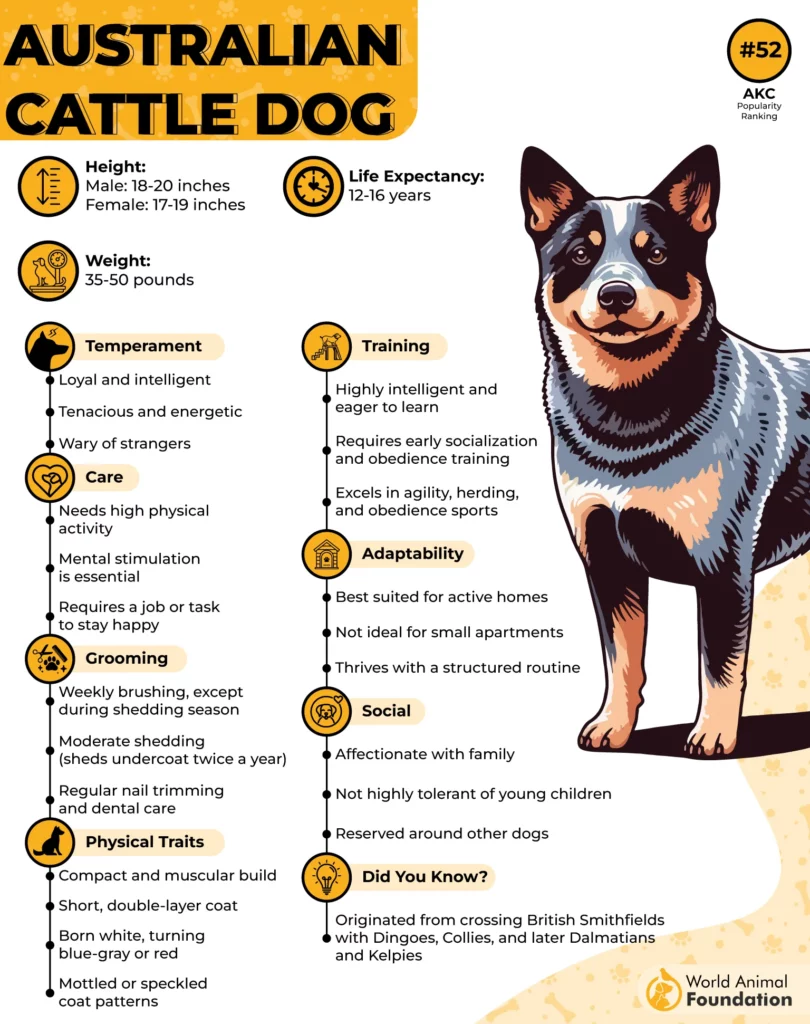
Its physical design reflects its original purpose as a cattle-working dog in Australia’s demanding environment. The breed needed efficient movement, physical resilience, and agility rather than the larger stature associated with heavier working breeds.
German Shepherd’s Larger Working Frame
The German Shepherd is noticeably more substantial, with a muscular body, longer limbs, a deep chest, and an efficient gait, with a height of around 22-26 inches and weighing approx 50–90 pounds. Its structure allows it to cover considerable ground while performing demanding activities such as herding, tracking, obedience, and service work.
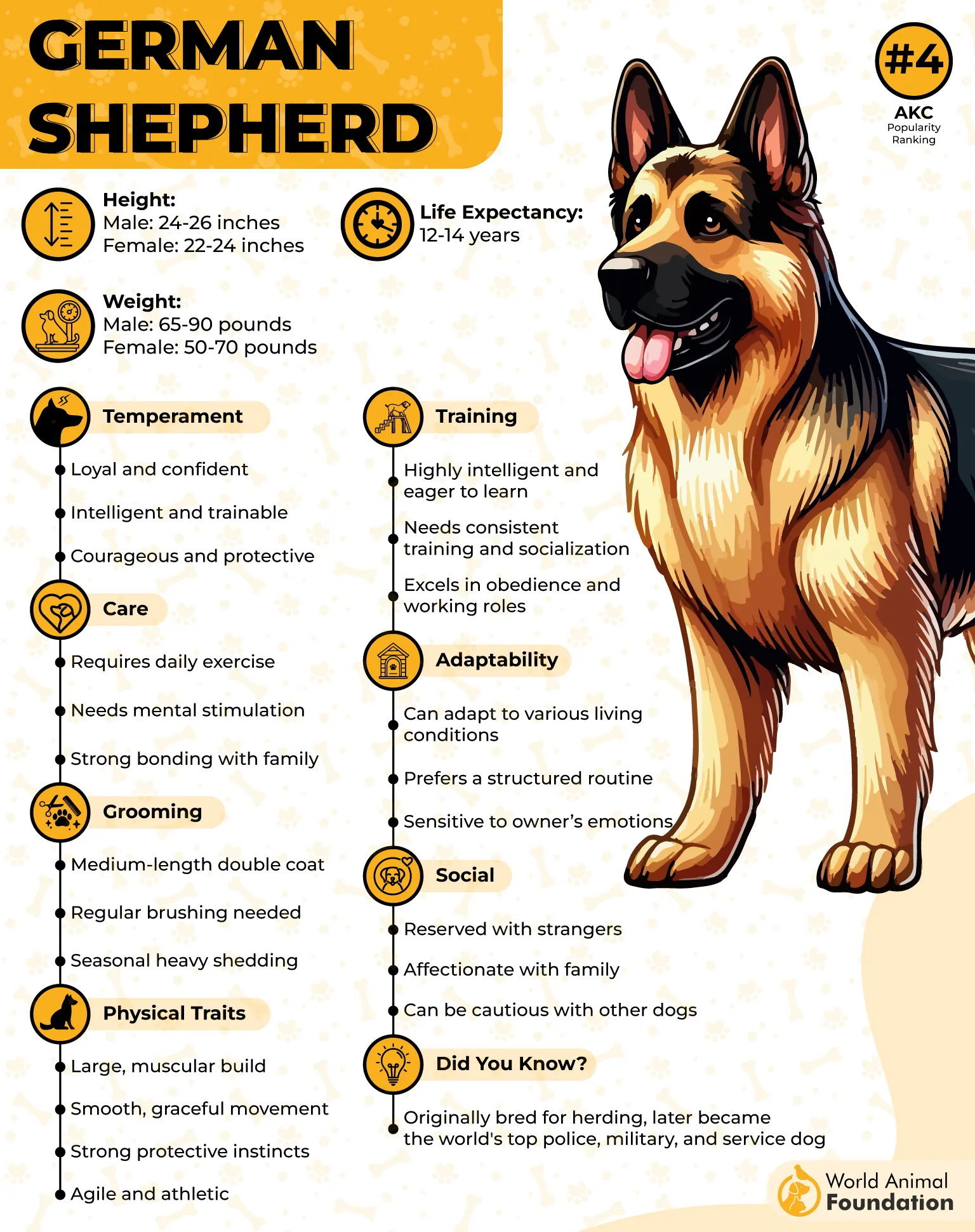
The difference in size influences how the two breeds are handled in everyday life. A German Shepherd has greater height, reach, and physical presence, while the smaller Blue Heeler can be easier to accommodate but remains remarkably powerful and athletic for its size.
Myth busted: A larger body does not automatically make one breed tougher or more capable. The Blue Heeler’s compact build provides impressive stamina and agility, while the German Shepherd’s greater size offers more physical presence without making it superior at every type of work.
3. Temperament & Behavioral Profile
Blue Heeler’s Alert Herding Personality
The Blue Heeler is typically energetic, observant, loyal, and strongly connected to its family. Its cattle-working background can produce a natural desire to control movement, which may appear as chasing, circling, or heel-nipping when the dog has not been properly trained.
These tendencies are instinctive working behaviors rather than proof of an inherently aggressive personality. With appropriate socialization and guidance, a Blue Heeler can be affectionate and highly engaging with the people it trusts.
German Shepherd’s Confident and Watchful Nature
The German Shepherd is generally loyal, intelligent, confident, and attentive to its surroundings, as per Britannica. Many individuals are reserved around unfamiliar people, but that reserve should not automatically be interpreted as hostility.
Their close attachment to their families can make them naturally watchful, while proper socialization helps them understand which situations require attention and which do not. A stable German Shepherd should be controllable rather than unpredictably reactive.
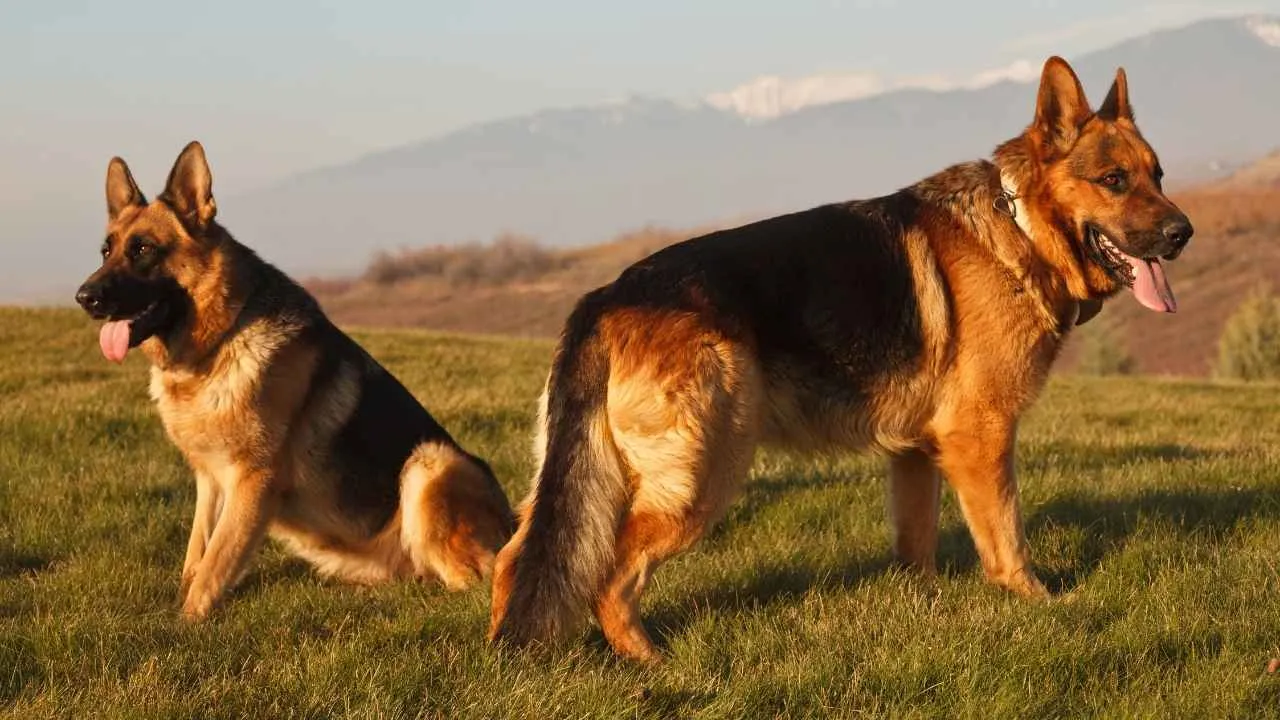
Myth busted: Neither breed is automatically aggressive. The Blue Heeler’s herding behavior and the German Shepherd’s protective awareness can be mistaken for aggression, but temperament is influenced by genetics, socialization, training, and individual personality.
4. Activity Requirements & Energy Levels
Blue Heeler’s Relentless Need for Engagement
The Blue Heeler may be a medium-sized dog, but its exercise requirements can surprise owners expecting a manageable household companion. It was bred to work for extended periods and generally enjoys activities that combine movement with purpose.

Long walks, hiking, running, obedience practice, scent games, agility, and interactive play can help channel its energy. Simply allowing it to roam around a yard may not provide enough physical or mental stimulation.
German Shepherd’s Powerful Combination of Exercise and Mental Needs
German Shepherds also require an active lifestyle. Their large bodies and working instincts make regular exercise important, but physical activity is only one part of their routine. Training, tracking, scent work, retrieving, obedience, and other purposeful activities can help keep their minds occupied.
A German Shepherd that receives little interaction may become frustrated or develop undesirable behaviors despite having plenty of physical space available.
Myth busted: A backyard is not an adequate exercise plan for either breed. The Blue Heeler often brings remarkable intensity in a compact body, while the German Shepherd combines high energy with greater size and physical strength.
5. Trainability, Intelligence & Learning Ability
Blue Heeler’s Independent Problem-Solving Ability
Blue Heelers are highly intelligent dogs capable of learning quickly, but their intelligence does not always translate into automatic obedience. Their cattle-working background encouraged independent decision-making, meaning they can sometimes evaluate a situation rather than blindly follow instructions.
Training is most effective when it provides structure, variety, and a clear purpose. Repetitive exercises without meaningful engagement can encourage a clever Blue Heeler to find its own activities.
German Shepherd’s Responsive Working Intelligence
German Shepherds have earned a strong reputation for trainability because they can learn complex behaviors and work closely with handlers. Their abilities have made them useful in obedience, tracking, service work, detection, search and rescue, and many other demanding fields.
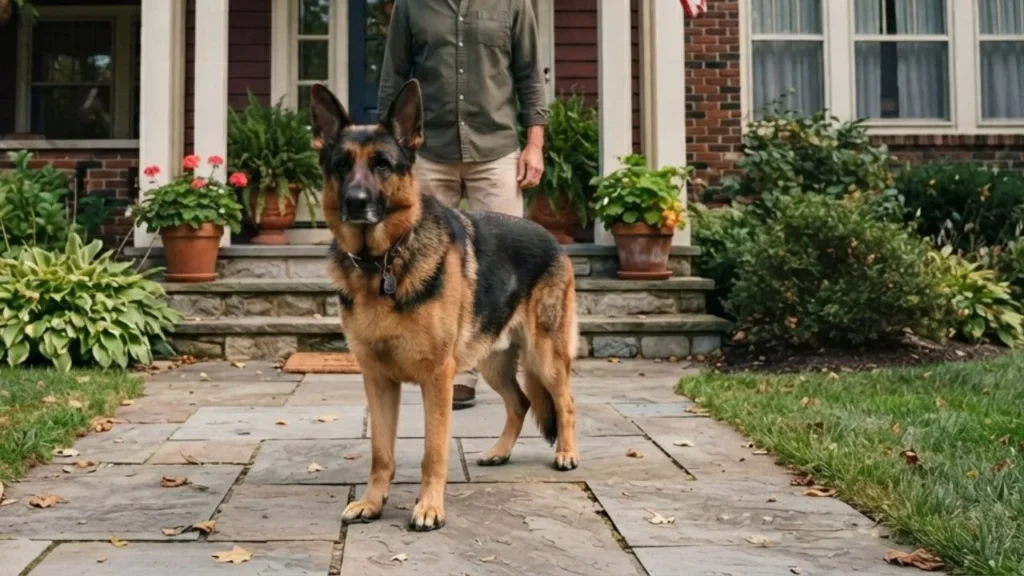
However, their intelligence still requires responsible direction. Without consistent training and appropriate stimulation, a clever German Shepherd can become difficult to manage despite its reputation for obedience.
Myth busted: Intelligence does not mean effortless training. The Blue Heeler often demonstrates independent problem-solving, while the German Shepherd tends to excel at responsive teamwork, but both require consistency, motivation, and continued mental stimulation.
6. Coat Maintenance & Grooming Needs
Blue Heeler’s Low-Fuss Double Coat
The Blue Heeler has a short, dense double coat designed to protect while working outdoors. Its coat generally requires straightforward maintenance, with regular brushing helping remove loose hair and keep the skin and coat healthy, as per PetMD.
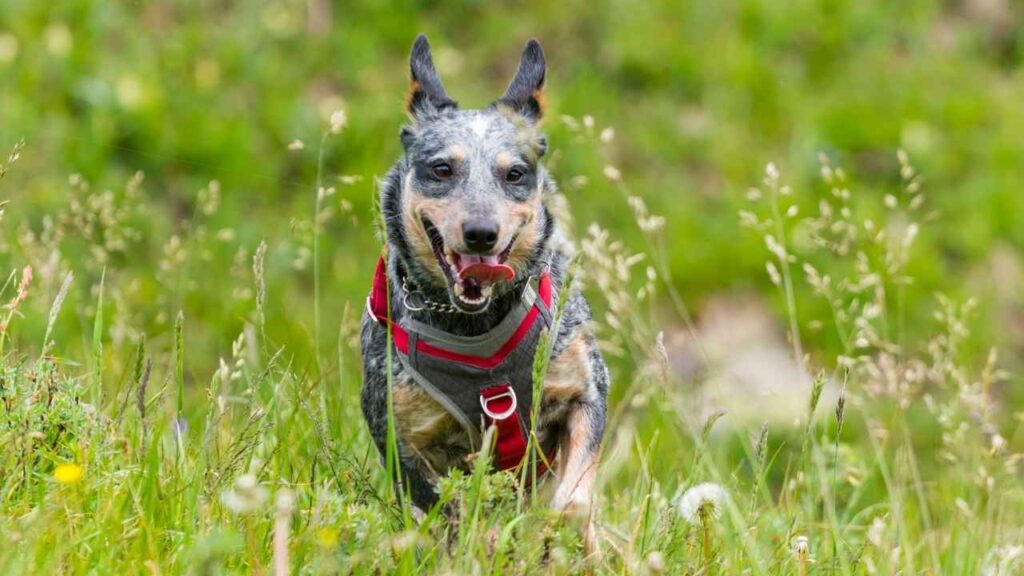
Seasonal shedding can increase the amount of hair around the home, so brushing frequency may need to increase during heavier shedding periods. Routine nail trimming, dental care, and ear checks should also remain part of its grooming routine.
German Shepherd’s Heavier Shedding Coat
The German Shepherd also has a protective double coat, but its more abundant hair generally makes shedding more noticeable. Regular brushing can help remove loose undercoat and reduce the accumulation of fur on household surfaces.
Although grooming needs vary between individuals and coat types, German Shepherd owners should expect considerably more hair than they might encounter with a short-coated Blue Heeler.
Myth busted: Neither working breed is completely maintenance-free. The Blue Heeler generally has the simpler coat to manage, while the German Shepherd requires more brushing and preparation for substantial shedding.
7. Average Lifespan & Longevity
Blue Heeler’s Generally Longer Lifespan
Blue Heelers are often considered a relatively long-lived breed, with many healthy individuals reaching their early or mid-teens. Their longevity can be supported through appropriate nutrition, veterinary care, responsible breeding, dental maintenance, and keeping them at a healthy body condition.
A longer average lifespan does not mean the breed is immune to health problems. Individual genetics and overall care remain important factors in determining how long a particular dog lives.
German Shepherd’s Moderate Working-Dog Lifespan
German Shepherds generally have a shorter average lifespan than Blue Heelers, with many living into their late single digits or early teens, as per PDSA. Their larger body size is one factor associated with lifespan differences, although individual health can vary considerably.
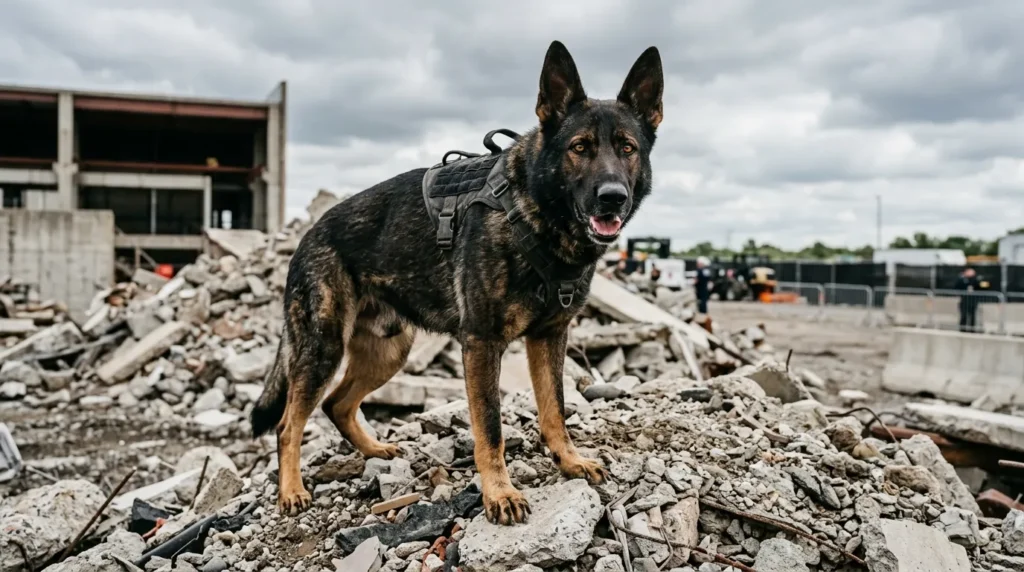
Responsible breeding, preventive healthcare, weight management, appropriate exercise, and early attention to health concerns can all contribute to a better quality of life.
Myth busted: Breed lifespan figures are averages rather than guarantees. Blue Heelers generally have the longevity advantage, but an individual German Shepherd can live a healthy and active life well into its senior years.
8. Suitability for Family Life vs. Guard Duties
Blue Heeler’s Fit for Active Families
The Blue Heeler can be an excellent family companion for households that genuinely enjoy an active lifestyle. Its loyalty, intelligence, and enthusiasm can make it rewarding for owners who want a dog to accompany them on outdoor adventures and participate in training or dog sports.
Families should understand its herding instincts, particularly around children who run, play, or move unpredictably. Consistent training and supervision can help prevent natural behaviors such as chasing or heel-nipping from becoming household problems.
German Shepherd’s Combination of Companionship and Watchfulness
The German Shepherd can combine affection toward its family with a naturally observant personality. Its size, confidence, and alertness can make it an effective watchdog, while its trainability allows it to learn household boundaries and controlled responses.
However, choosing one solely because it appears intimidating is a poor reason to own the breed. A well-adjusted German Shepherd should be capable of distinguishing ordinary visitors and situations from genuine threats rather than reacting aggressively to everything unfamiliar.
Myth busted: Neither breed should be selected simply because someone wants a “protection dog.” The Blue Heeler can be a devoted active-family companion, while the German Shepherd may be naturally more suited to watchdog and working roles, but both need stable temperaments, socialization, training, and responsible ownership.
Conclusion
The Blue Heeler and German Shepherd are both exceptional working dogs, but their reputations can make them appear more extreme than they really are. The Blue Heeler is a compact and exceptionally energetic cattle dog with strong herding instincts, while the German Shepherd is a larger, versatile working breed known for intelligence, athleticism, and responsiveness.
Their differences become clearer when their original purposes are considered. The Blue Heeler was shaped by the demands of cattle work in Australia, whereas the German Shepherd developed from European herding stock and eventually became capable of a remarkably broad range of working roles.
The common myths surrounding these breeds often come from confusing instinct with temperament. A Blue Heeler’s tendency to control movement does not automatically make it aggressive, and a German Shepherd’s protective awareness does not mean it is naturally dangerous.
Likewise, intelligence does not eliminate the need for training, and high energy cannot be satisfied simply by providing a backyard.
