




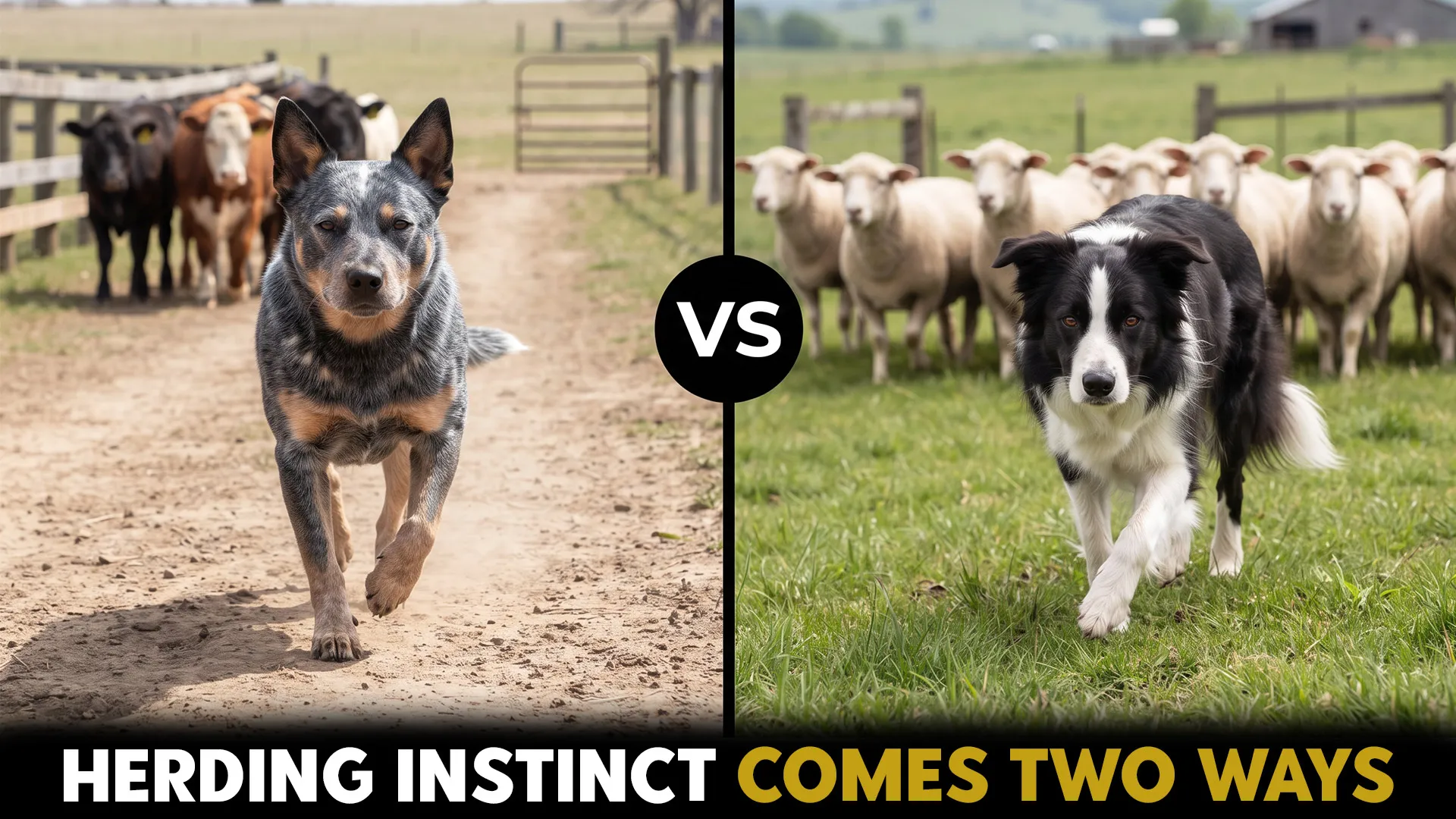
Australian Cattle Dogs and Border Collies can both herd livestock like seasoned pros, but they do not work from the same playbook. One is a tough little cattle mover built for dusty miles and stubborn animals. The other is a sharp-eyed sheep specialist that can seem to read a handler’s mind.
Think of the Cattle Dog as the no-nonsense ranch foreman and the Border Collie as the brilliant strategist that already solved the problem before breakfast. Both are smart, loyal, and wildly energetic, so neither is a “quick walk around the block and chill” kind of dog.
The real question is not which breed is better. It is which working style, personality, and daily routine fit your life without turning your living room into a furry rodeo.
Australian Cattle Dog vs. Border Collie: Key Herding Differences
1. Origins & Purpose
While both were bred as herding dogs, both breeds have different types of livestock, origins, histories, and geographical factors.
Australian Cattle Dog: This medium-sized herding dog was developed to drive cattle over long distances across rough terrain. Thomas Simpson Hall is credited with developing the breed in the 19th century by crossing local British dogs with the Dingo in Australia, according to Wikipedia.
Border Collie: The herding breed was bred in Britain and is descended from the sheepdogs once found in the British Isles. Another theory suggests the breed has its roots in the Old Hemp. Today, it is widely kept as a family pet and a companion dog. It first appeared in the show ring in the mid-19th century.
2. Size & Physical Build
The Border Collie is taller, leaner, and more aerodynamic, while the Australian Cattle Dog is shorter, thicker, and more muscular.
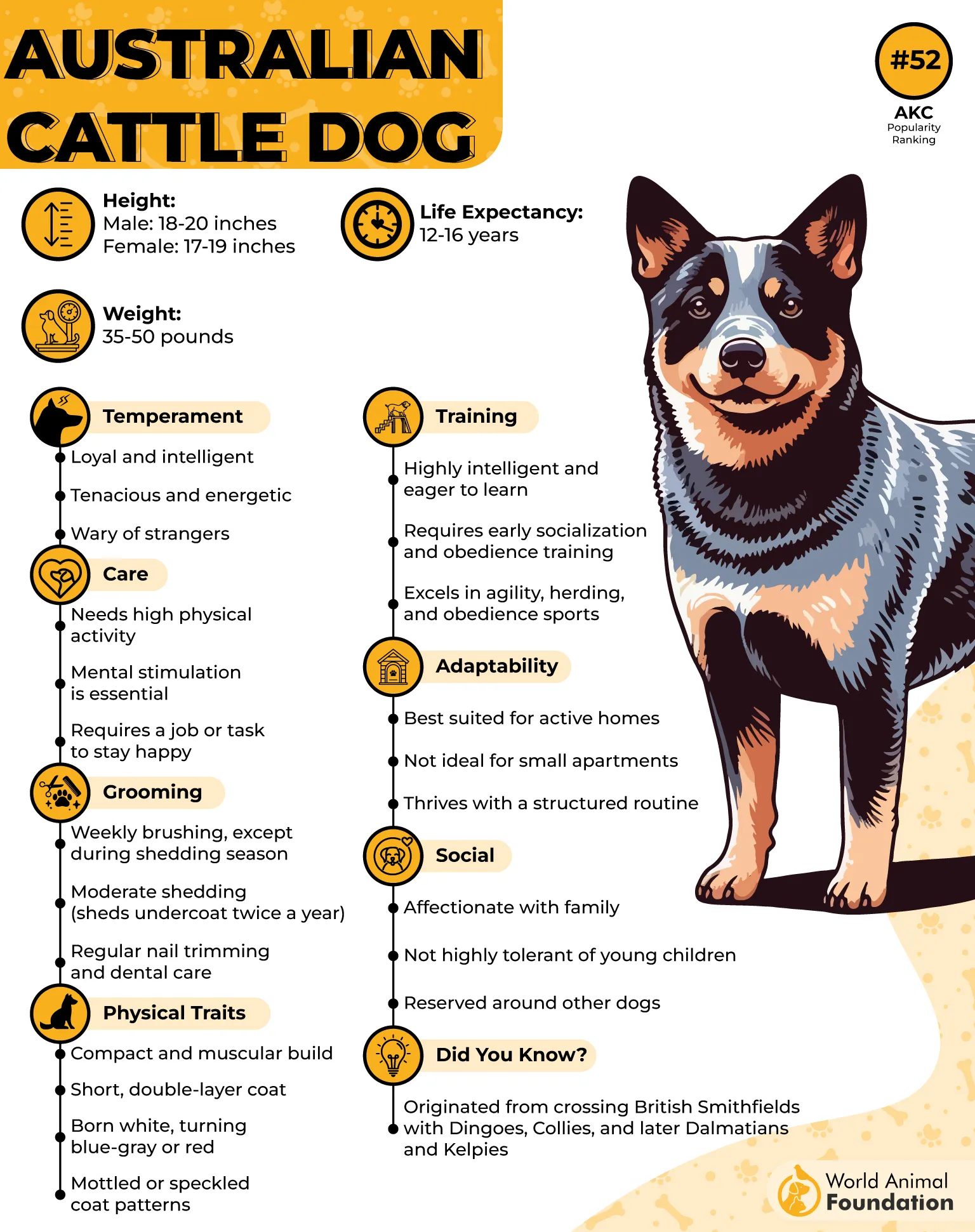
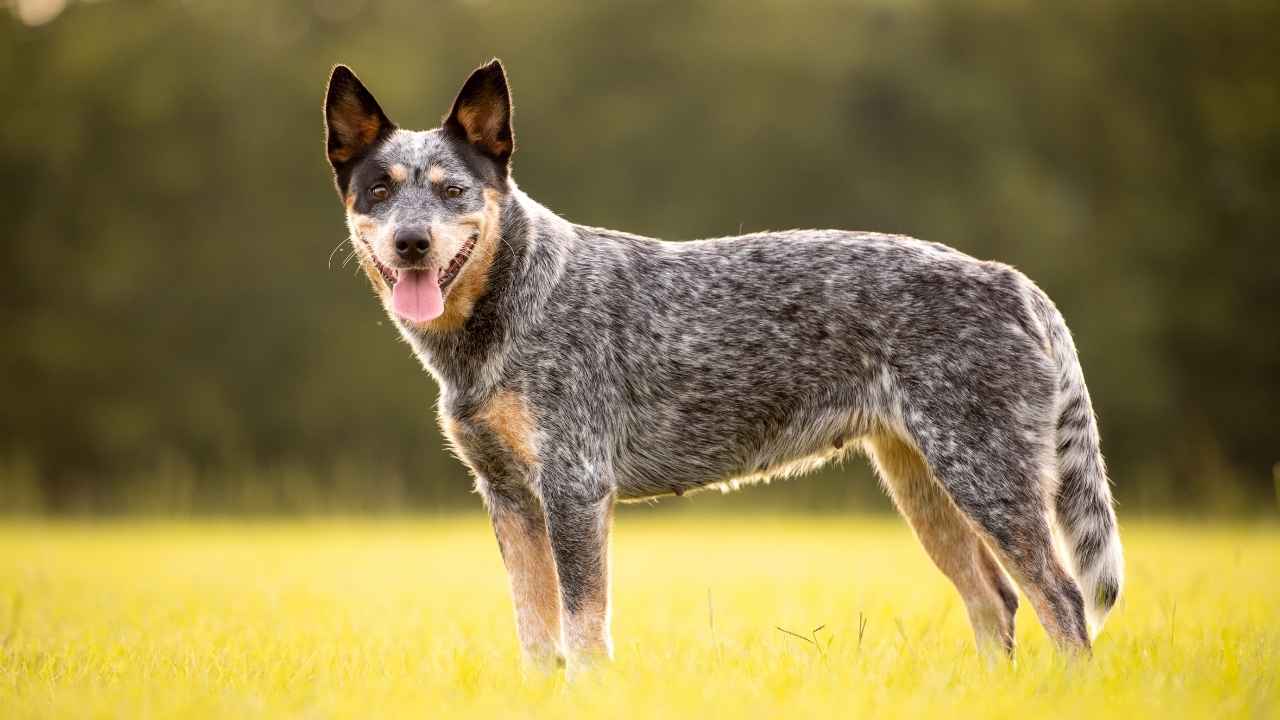
Australian Cattle Dog: Also known as the Blue/Red Heeler, the herding breed stands 17-20 inches tall and weighs around 35-50 pounds. It has a rectangular physique (body length-to-height ratio of 10:9). The broad skull is curved between the ears. The sloping shoulders and well-angulated back allow swift directional changes.
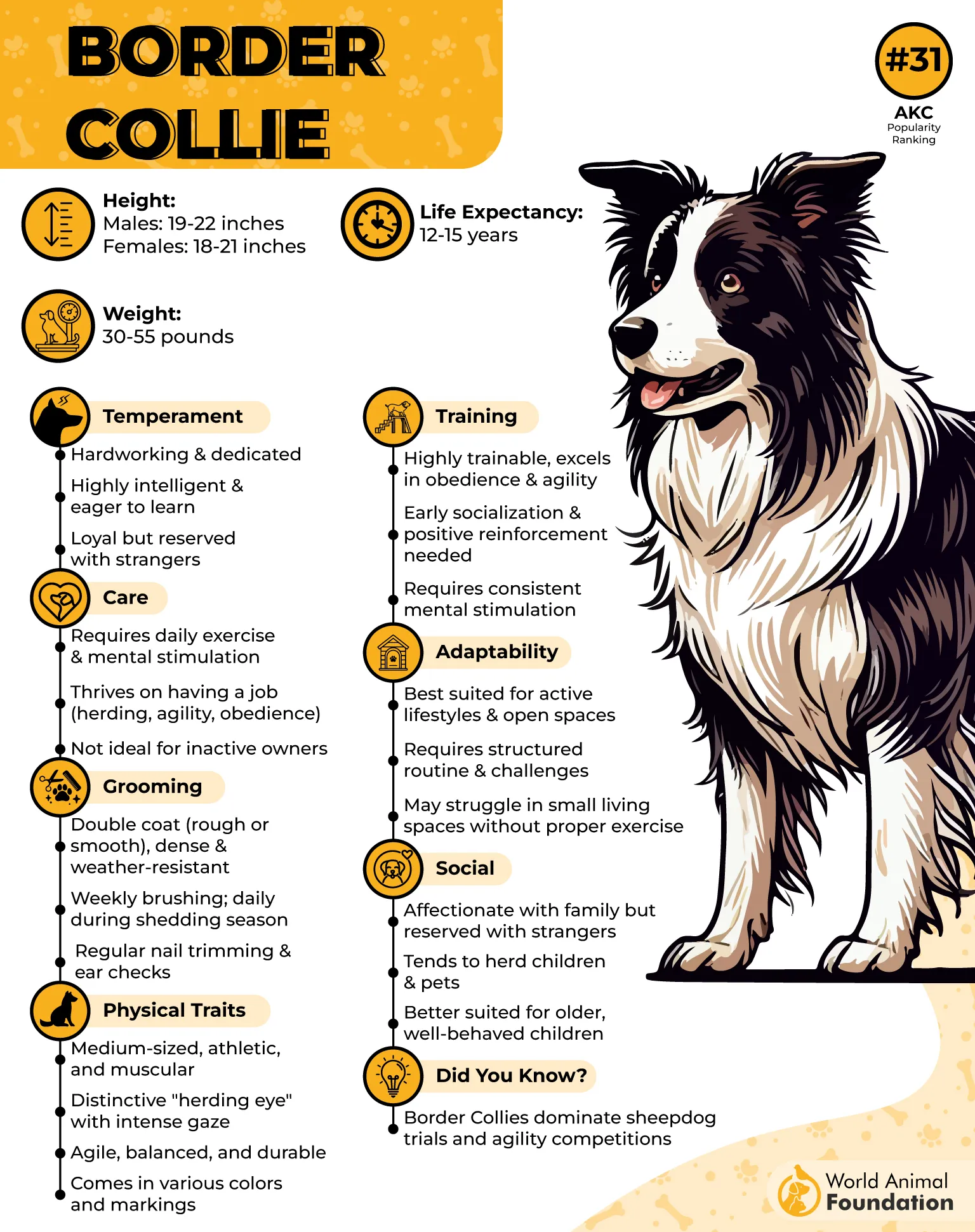
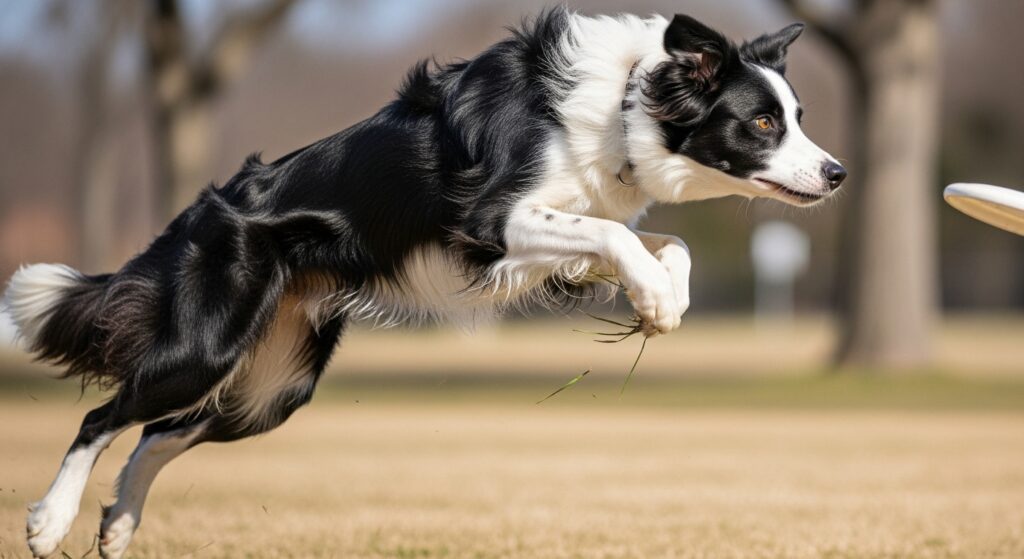
Border Collie: The breed stands 18-22 inches tall and weighs around 30-55 pounds. The body proportions are the same as the ACD. However, the broad skull is flat between the ears and has a moderate stop. Forelegs are straight and parallel, and the wrists have a slight slope for shock absorption.
3. Temperament & Personality
Both breeds have their specific working origins with sheep versus cattle, making the high-energy working breeds distinct from each other.
Australian Cattle Dog: The vigilant nature makes it constantly scan its surroundings. The breed has a fearless and intimidating disposition since it was bred to tackle aggressive livestock. It is naturally aloof toward strangers and tends to protect the family without activating unprovoked aggression. Despite having an independent nature, it forms strong bonds with the primary owner.
Border Collie: The working dog has an intense stare that is used to direct and command livestock. High intelligence makes it highly trainable, says the AKC. The great dog is generally good with children and other pets. The breed is highly prone to motion-triggered reactivity.
4. Exercise & Energy Levels
Both are high-energy working breeds and need a constant job to prevent boredom and destructive behaviors.
Australian Cattle Dog: With its high energy level, it requires at least 1.5-2 hours of daily exercise and mental stimulation: running, swimming, intense hiking, agility courses, flyball, tracking, rally obedience, puzzle toys, and scent work.
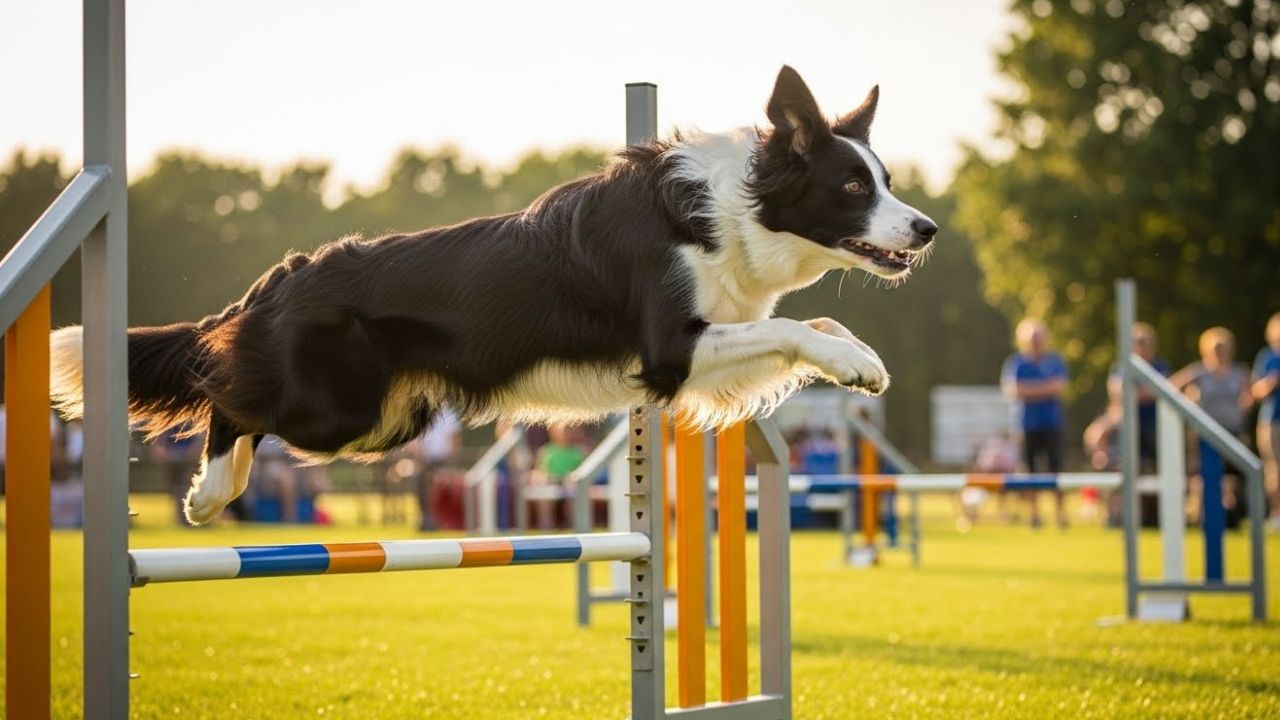
Border Collie: The velcro dog has boundless energy and needs intense exercise for at least 1-3 hours daily: running, fetching, swimming, problem-solving puzzle toys, obedience training, scent work, and flyball. 30 minutes of physical and mental activity is enough for senior dogs.
5. Training & Intelligence
The ACD has an independent streak and works best when closer to the family, while the Border Collie is the most intelligent breed in the canine kingdom and works by wide-eyed gathering.
Australian Cattle Dog: It is ranked at 10th place in terms of obedience and intelligence. It tends to retain long-term memory of people, environment, and routines, as reported by PetMD. Early socialization is required from week 8. Positive reinforcement with reward training is suggested. Keep the sessions short (5-10 minutes) and non-repetitive.
Border Collie: The right breed can understand over 1,000 object names and learn complex commands within a few repetitions. Impulse control training through reliable recall and prevention of nipping through obedience training are highly recommended. It can read human emotions and act accordingly.
6. Coat Maintenance
The Australian Cattle Dog has a short double coat that requires low maintenance, while the Border Collie has a medium-length, high-maintenance coat.
Australian Cattle Dog: The smooth and water-resistant coat grows up to 1-1.5 inches. The hair is shorter on the head and on the front of the legs, but longer under the body. Use a slicker brush or a rubber curry brush for weekly brushing. Bathing every 6-8 weeks is highly recommended.
Border Collie: The coat comes in two types: The rough coat with feathering on the chest, undersides, forelegs, haunches, and tail, and the short coat that lies close to the skin. Use the line brushing technique to brush the coat weekly using a pin brush and a slicker brush. Pay close attention to the following areas: behind the ears, the armpits, the groin, and the feathered sections of the thighs.
7. Health & Lifespan
The ACD lives longer than the Border Collie. However, both are prone to distinct genetic health issues.
Australian Cattle Dog: The average lifespan is 12-16 years; even the longest-lived dog also belongs to this breed, Bluey, that lived for almost 29 years. It is prone to eye disorders, congenital deafness, orthopedic issues, and drug sensitivity. Regular vet checkups and contacting a reputable breeder may affect the lifespan of the breed.
Border Collie: A healthy dog lives up to 12-15 years, provided they receive proper care, nutrition, and regular veterinary monitoring. Common health risks include: hip dysplasia, PRA, epilepsy, Neuronal Ceroid Lipofuscinosis, Trapped Neutrophil Syndrome, and collie eye anomaly.
8. Suitability as Family Pets vs. Guard Dogs
The ACD can be a great protection dog, while the Border Collie makes a good dog for families.
|
Features |
Australian Cattle Dog |
Border Collie |
|
Temperament |
Protective, independent, and fearless. It forms strong bonds with one person. |
Eager to please, analytical, and forms close bonds with the family. |
|
Family Fit |
An experienced owner is recommended, since it can be pushy or reactive towards other dogs. |
Well suited for active families who can commit to a structured exercise routine. |
|
With Children |
It can nip at the heels of the running children. Thus, consistent training is needed. |
Gentle and patient with kids, it may develop destructive behaviors when under-stimulated. |
Conclusion
Choosing between an Australian Cattle Dog and a Border Collie comes down to more than looks or intelligence. The Cattle Dog is often sturdier, more independent, and more protective, with a practical, hard-working attitude. The Border Collie is usually more responsive, sensitive, and focused on teamwork with its person. Both need movement, training, structure, and a real outlet for their busy brains.
A bored dog from either breed can become a tiny chaos manager, and nobody wants that gig. Pick the Australian Cattle Dog if you enjoy a bold, durable partner with grit. Choose the Border Collie if you want a highly tuned teammate that loves learning. In the right home, either dog can be unforgettable.
