




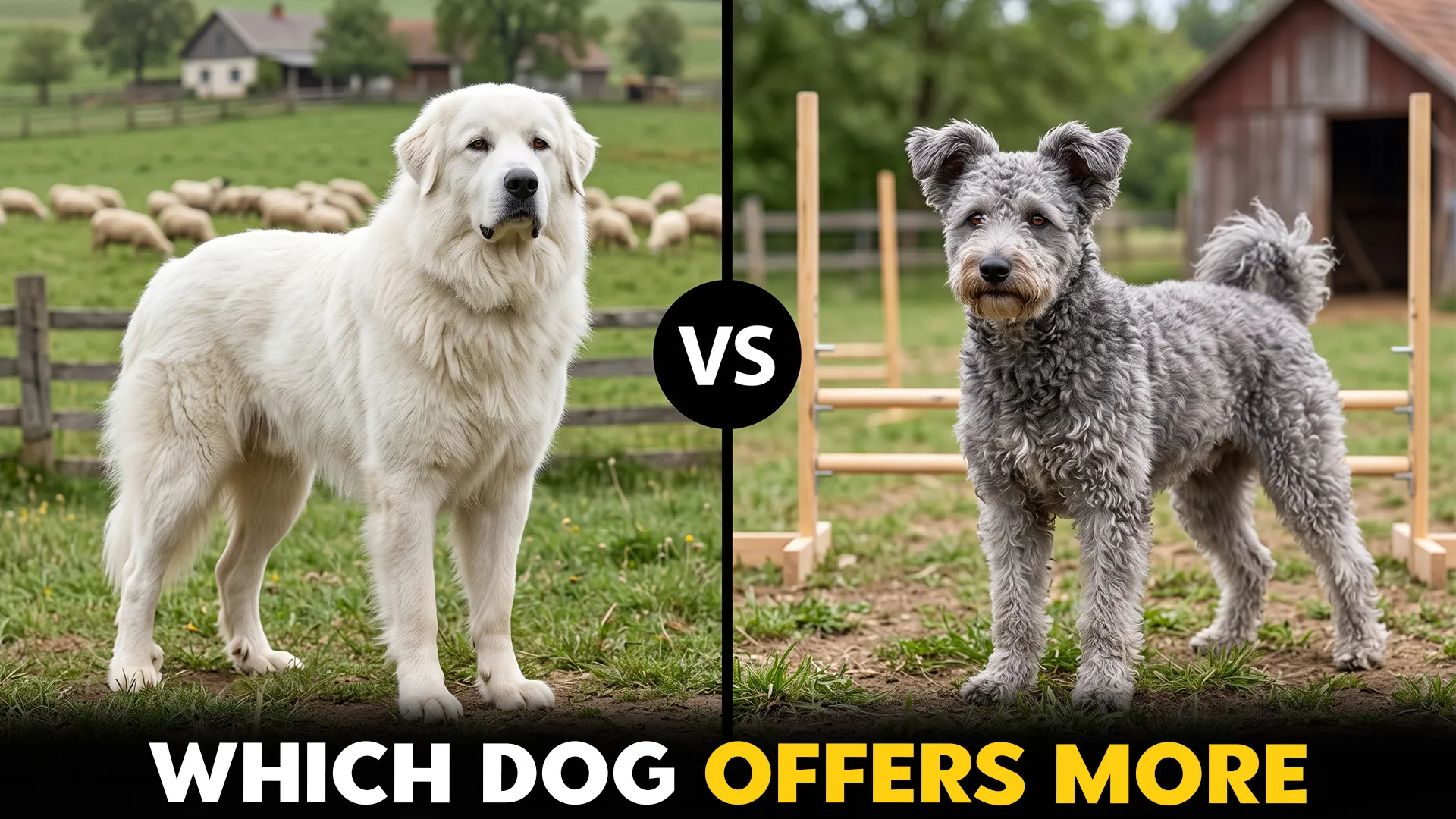
Some dogs win your heart with endless energy. Others earn it by standing quietly beside you when it matters most. That is the greatest difference in the Great Pyrenees vs Pumi debate.
As actor Roger Caras once said, “Dogs are not our whole life, but they make our lives whole.” Both breeds are intelligent and devoted, yet they were bred for very different jobs.
The lively Pumi thrives on constant action, while the Great Pyrenees was built to calmly protect livestock against serious predators.
If you are looking for a dependable family guardian with a gentle soul, the Great Pyrenees often comes out ahead.
Let us see why the giant, fluffy protector wins over many dog lovers.
Great Pyrenees vs. Pumi: Reasons Why Great Pyrenees Beats Pumi Dog Breeds
Origins & Purpose
These are two distinct European dogs with different historical backgrounds, temperament, and purposes. While both were developed to work alongside shepherds, they have different approaches.
Great Pyrenees: The Pyrenean Mountain Dog was originally bred in France (French side of the Pyrenees Mountains) as a Livestock Guardian Dog (LGD). It is widely used in the French Alps and Pyrenees to protect livestock from wild boars, bears, and wolves. The breed was also used to smuggle contraband between Spain and France, says Wikipedia.
Pumi: This small-to-medium sheep dog was developed in Hungary. It tends to work closely with the farm stock (especially sheep). It was bred by crossing the Hungarian Puli with the French and German herding dogs in the 17th century. It is sometimes referred to as a ‘Hungarian herding terrier’ because of terrier-like attributes.
Size & Physical Build
Both are entirely different breeds when it comes to size and build. While the Great Pyrenees is a giant breed, the Pumi dog is either small or medium in size.
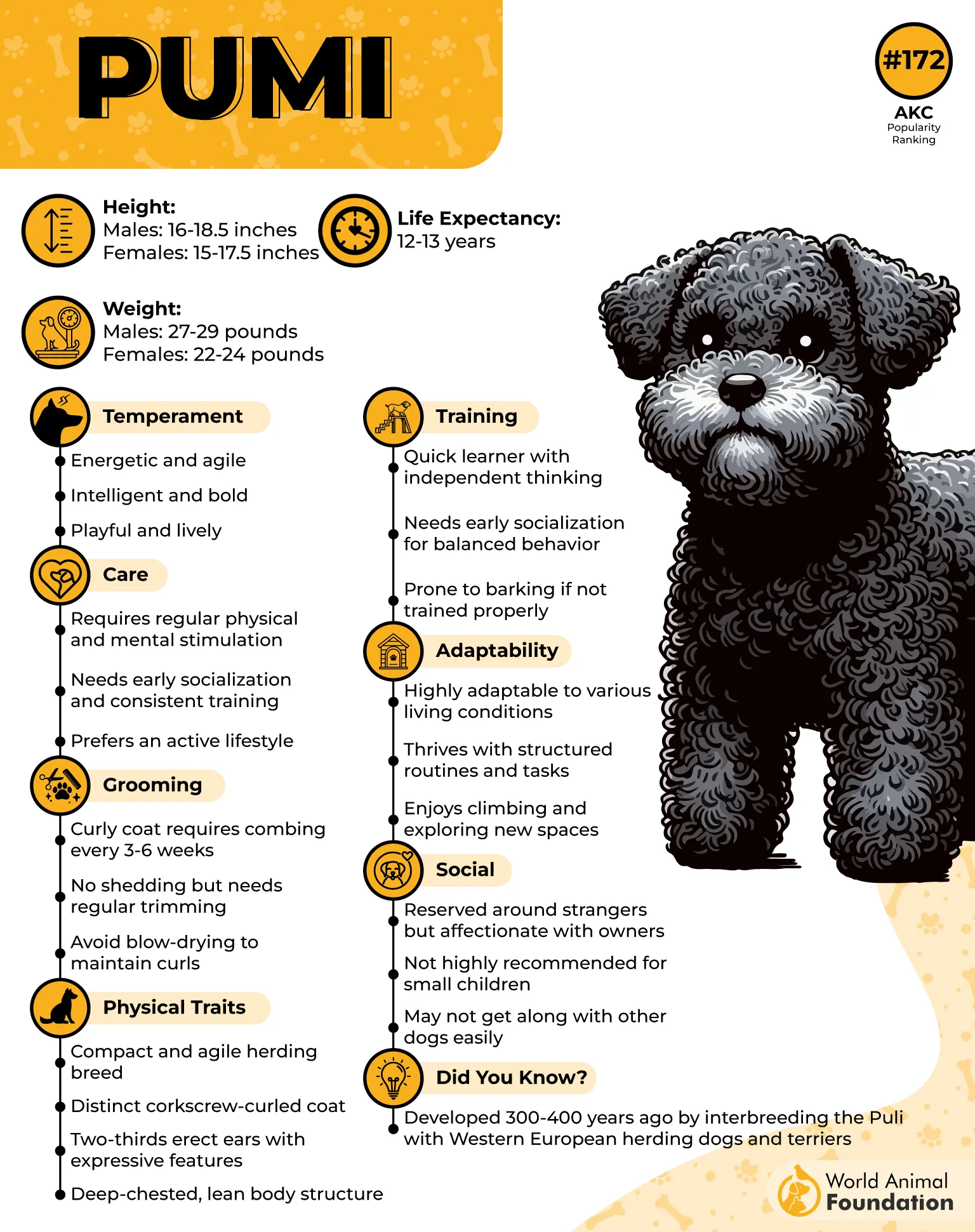
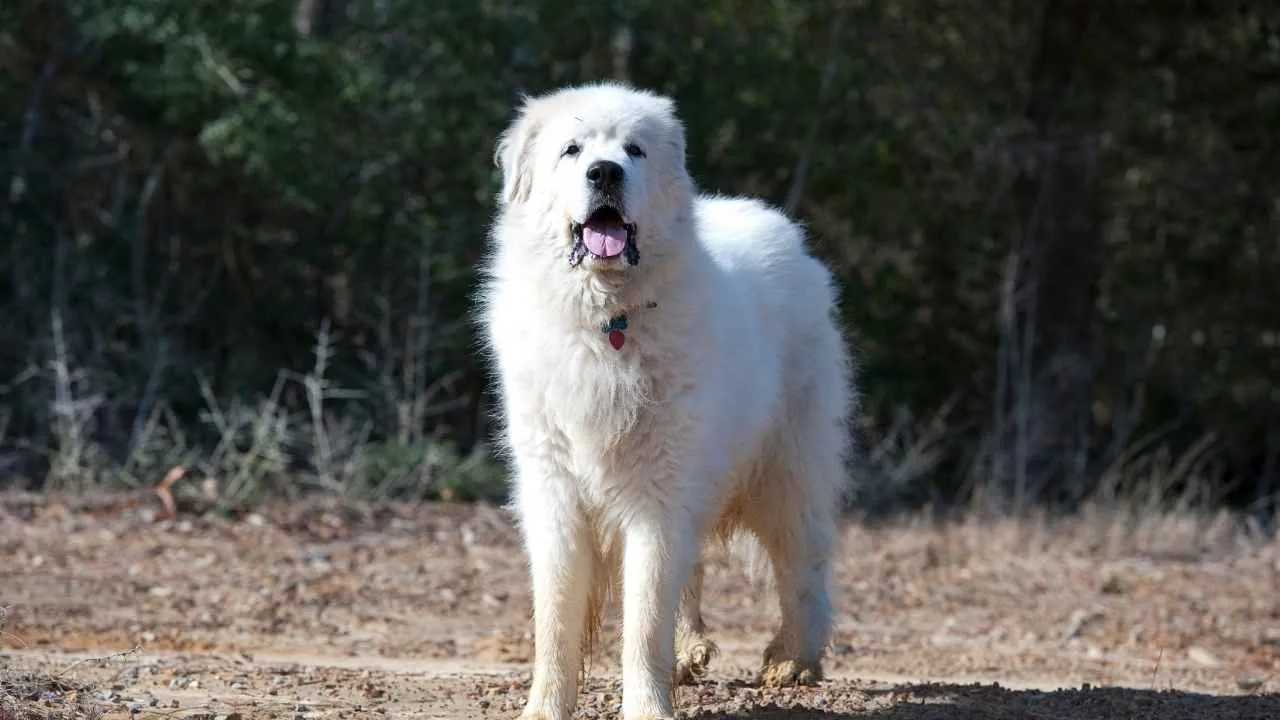
Great Pyrenees: To protect livestock from large predators, the Great Pyrenees tends to be a massive breed. It weighs around 85 pounds (for females) and 100 pounds (for males). It stands 25-32 inches tall to the shoulder. It has a short and strong neck, a deep chest, a thick double coat, a wedge-shaped head, and triangular ears.
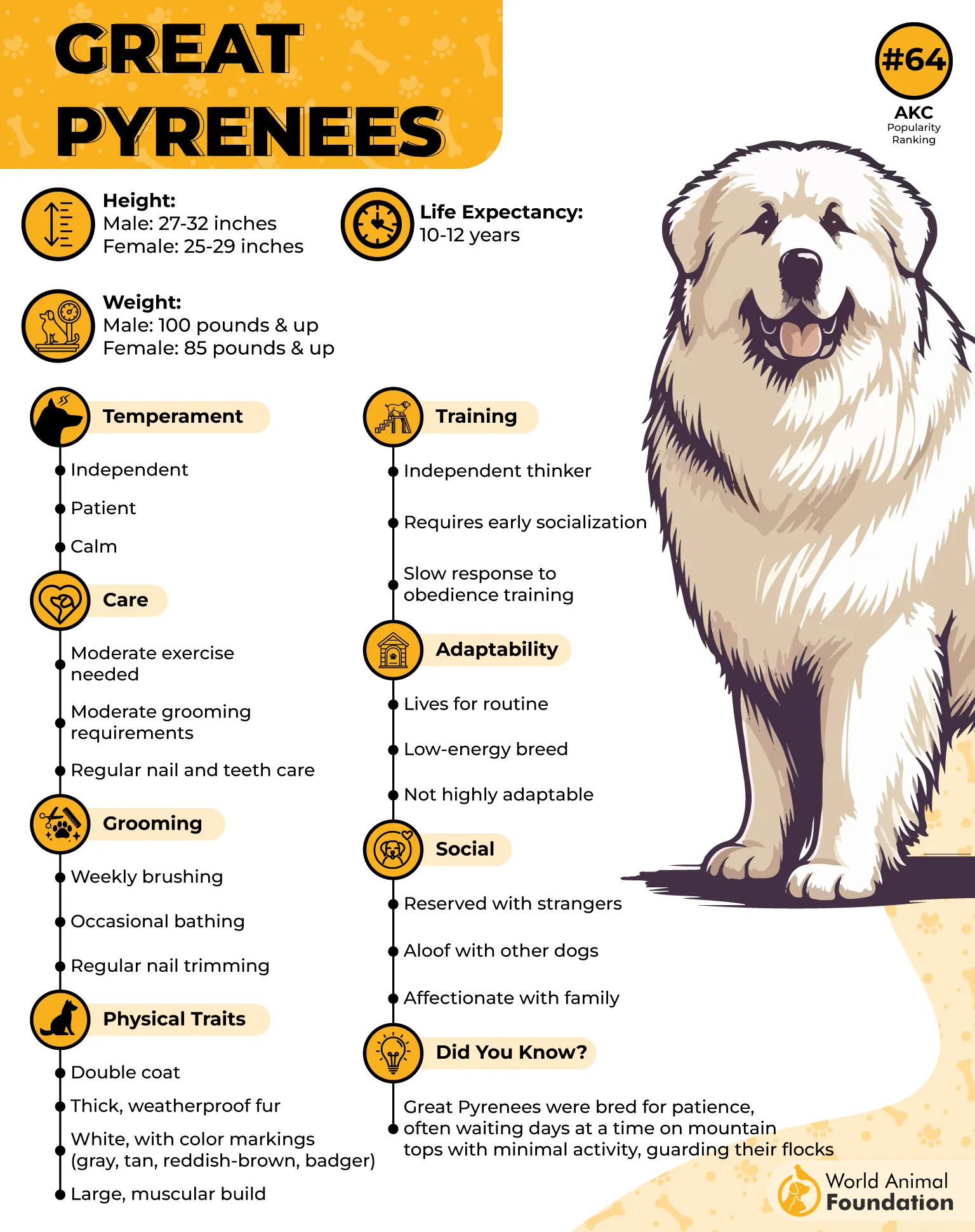
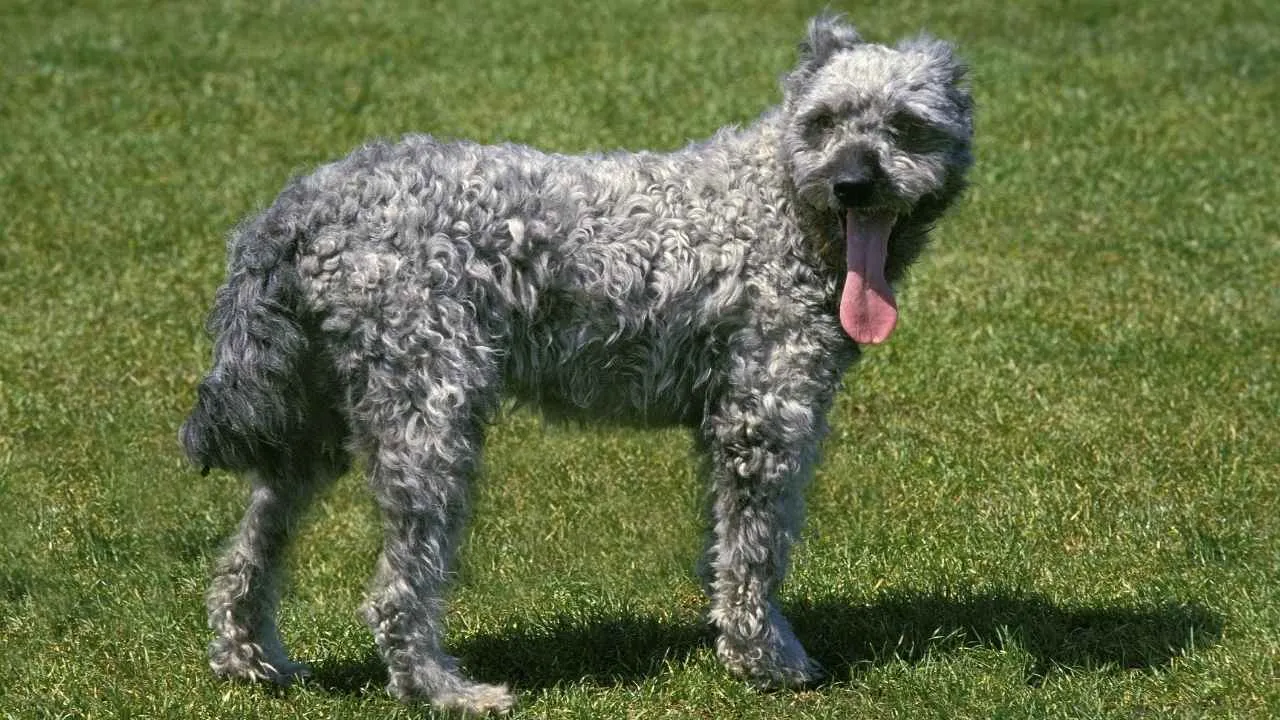
Pumi: The breed has a curved tail, signature corkscrew curls on the double coat, and an athletic body. As it was responsible for controlling moving flocks on narrow roads, it was selectively bred to be a smaller breed. It stands 15-18.5 inches tall and weighs 22-29 pounds.
Temperament & Personality
While both breeds are protective guardians and form strong bonds with the family, each has a different personality. The Pyr is a gentle giant with an independent nature, while the Pumi is an active and energetic breed.
Great Pyrenees: The Great Pyrenees dog is a nocturnal breed and tends to conserve its energy during the day. It has an independent streak and works without its owner’s instructions. It is aloof from strangers and makes good friends with children, other pets, and family members, as per PetMD.
Pumi: It is a quick learner and makes fast decisions. Being an active breed that needs a constant ‘job,’ this guarding livestock breed barks to alert the owner of unusual sounds. It may naturally try to herd humans by nipping their tips.
Exercise & Energy Levels
Both dogs have entirely different energy levels. The Great Pyr is relatively calmer and a low-energy breed, while the Pumi dog is an active and agile herding dog.
Great Pyrenees: The large breed is likely to curl up on the softest bed once its physical needs are met. It does not need excessive exercise, and 20-30 minutes of daily physical and mental stimulation are enough. It is temperature sensitive and cannot endure hot weather. Patrolling, drawn-out sprints, sniff work, and fenced outdoor activities are suggested with early socialization and positive reinforcement.
Pumi: The American Kennel Club writes that the dog is highly energetic and loves to climb over or under things. It chooses a vantage point to sit on and watch its surroundings. It needs vigorous exercise for 1-2 hours daily: flyball, chase-and-fetching games, herding trials, agility, and obedience training.
Training & Intelligence
While both are highly intelligent, the Pyr is an independent breed that needs alone time, and the Pumi is an eager-to-please breed that loves to work closer to the owner.
Great Pyrenees: Since it was bred to be left alone with the herd in the mountains, it is independent and highly intelligent. This may lead to stubborn behavior. Thus, obedience training with patience is a must. It can also develop an excessive barking problem. This makes early training non-negotiable.
Pumi: Being an intelligent dog, it has an independent streak but thrives more with human companionship. If it is not given a task, it may develop destructive behaviors, such as chewing and digging. Use positive reinforcement and reward training to train the breed.
Coat Maintenance
The Pyr is a heavy shedder and requires regular brushing, while the Pumi dog is a low-shedding breed that needs less frequent grooming.
Great Pyrenees: An undercoat rake, a large and curved slicker brush, a wooden comb, and a deshedding tool are recommended for its grooming. The grooming needs to be done before bathing. Check the double dewclaws and trim the claws carefully. Over-bathing can minimize the dirt-shedding qualities.
Pumi: Since the coat is a combination of curly and wavy hair, it traps hair inside the coat, making it a hypoallergenic breed that requires weekly brushing. Use a coarse-toothed comb to remove loose hair and untangle knots. It requires trimming and hand plucking after every 2-4 months.
Health & Lifespan
The Great Pyrenees is a large breed and tends to live 10-12 years, while the Pumi is a small breed and tends to live longer (12-16 years).
Great Pyrenees: It is prone to specific health conditions, and a responsible breeder would look for these medical conditions: hip and elbow dysplasia, bloating, eye conditions, and cancer. Weight management, routine vet care, and regular grooming may lead to a healthier life.
Pumi: The breed may even live longer with proper care, diet, and regular veterinary check-ups. However, it is prone to certain health concerns (not life-threatening conditions): luxating patella, dysplasia, eye disorders, Degenerative Myelopathy, and dental issues.
Great Pyrenees vs. Pumi: Suitability as Family Pets vs. Guard Dogs
|
Features |
Great Pyrenees |
Pumi |
|
Behavior |
Calm, tolerant with kids, and a couch potato indoors. |
People pleaser, good with kids. However, can nip at the heels if not properly trained. |
|
Training |
Not ideal for first-time dog owners because of its independent nature. |
It has high energy needs and is ideal for families with an active lifestyle. It is a quick learner. |
|
Guard Dog |
It is LGD and designed to work against large animals. |
It was developed as a herding dog and a watchdog. |
|
Strategy |
It uses its imposing size and loud bark to deter attackers. |
It prevents the herd from straying by nipping at the feet of the cattle. |
Conclusion
Choosing between the Great Pyrenees and the Pumi comes down to your lifestyle, but the Great Pyrenees stands out for people who value calm confidence, loyalty, and natural protection. It is patient with children, devoted to its family, and capable of watching over both people and property without acting recklessly.
The Pumi is a fantastic choice for active owners who enjoy training and dog sports, yet its high energy is not the right fit for every home. The Great Pyrenees offers a steadier presence that many families appreciate.
If you want a gentle giant that combines affection with dependable guardian instincts, the Great Pyrenees is often the more rewarding companion for everyday family life.
