




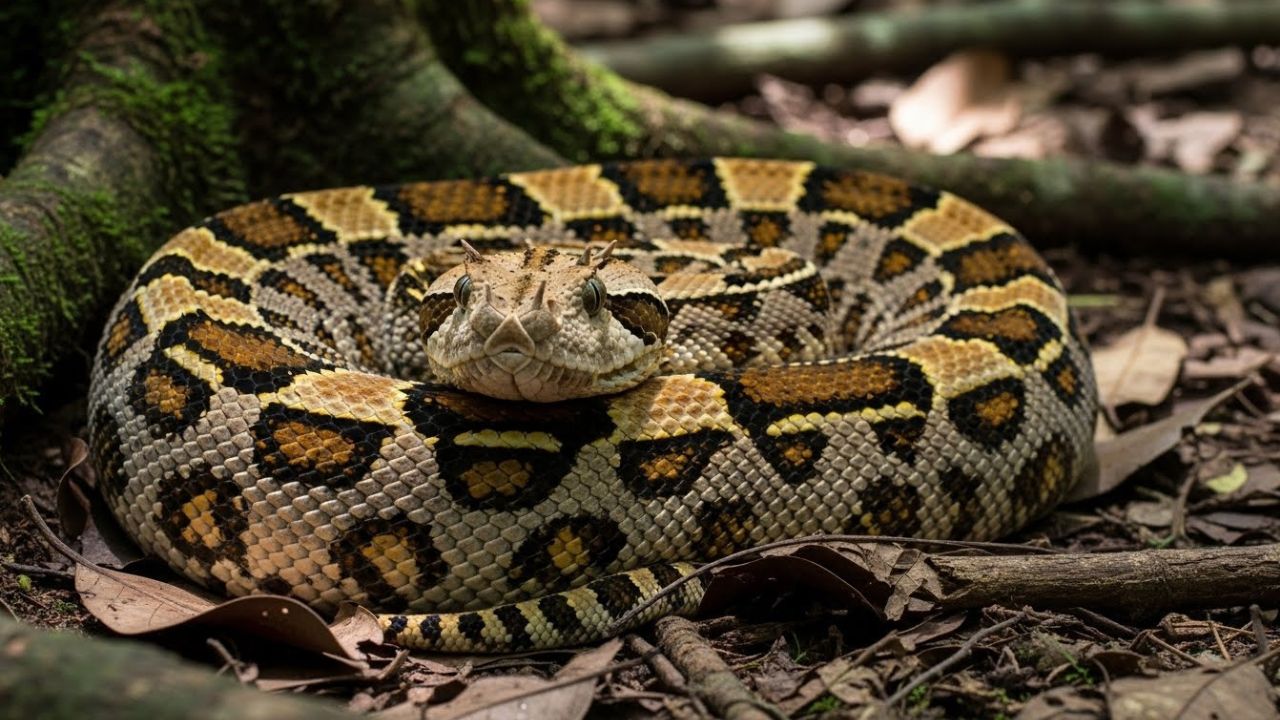
In the animal kingdom, survival often comes down to one powerful skill: the ability to disappear. While some creatures run, fight, or climb their way out of danger, many snakes rely on something far more subtle—their own skin.
With patterns that mimic fallen leaves, rough bark, shifting sand, or even shadows on the forest floor, these reptiles turn the art of camouflage into a life-saving performance.
Some snakes even flatten their bodies or coil in specific shapes to enhance the illusion, ensuring they stay hidden not only from predators but also from potential prey.
This silent strategy is a testament to the power of natural selection. Over thousands of years, skin colors and patterns evolved to match the environments these snakes call home. Instead of relying on speed or aggression, they let invisibility be their shield.
In a world full of threats, fading into the background becomes one of nature’s most effective defenses—and these snakes have mastered it beautifully.
Fact: Some snakes are true experts at staying unseen. Species like the Gaboon viper have intricately patterned skin that blends perfectly with leaves, branches, or forest floor debris. Their camouflage helps them avoid predators and ambush prey—a perfect mix of defense and offense.
9 Snakes That Use Their Skin to Hide from Predators
1. Bushmaster
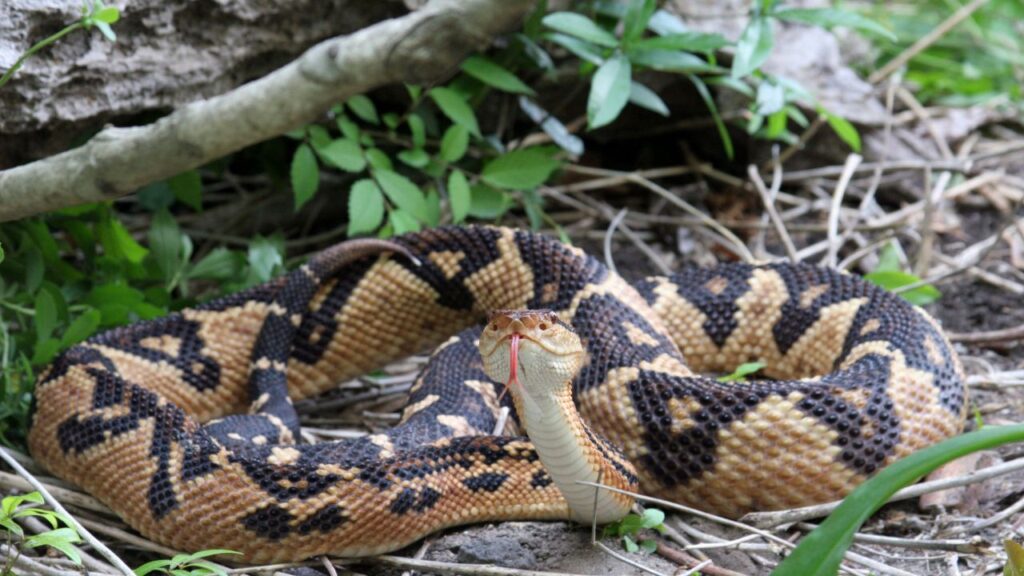
This Amazonian pitviper has perfected the art of going unseen—so much so that legendary herpetologist Raymond Ditmars spent decades trying to find one. Imagine trying to chase down a snake that’s practically a living magic trick!
The bushmaster isn’t just any snake—it’s the largest pitviper in the Americas, reaching a casual seven to ten feet long. Some rare individuals stretch an impressive 13 feet, which is roughly the length of a canoe… a very cranky, venomous canoe.
What really sets this snake apart is its stunning pattern. With warm brown-to-orange tones overlaid by dark geometric saddle markings, the bushmaster looks like it’s been hand-beaded by an artisan from deep in the rainforest. It’s basically runway-ready.
And yet—plot twist!—these beautiful beads serve as top-tier camouflage. The pattern blends flawlessly into leaf litter, roots, logs, and the general chaos of the jungle floor.
Despite their size and intimidating reputation, bushmasters are famously shy and reclusive. Spotting one in the wild is like finding a four-leaf clover—if the clover were ten feet long and could definitely ruin your day.
Their secretive nature and ninja-level camouflage keep them hidden from predators, prey, and curious humans alike.
2. Twig Snake
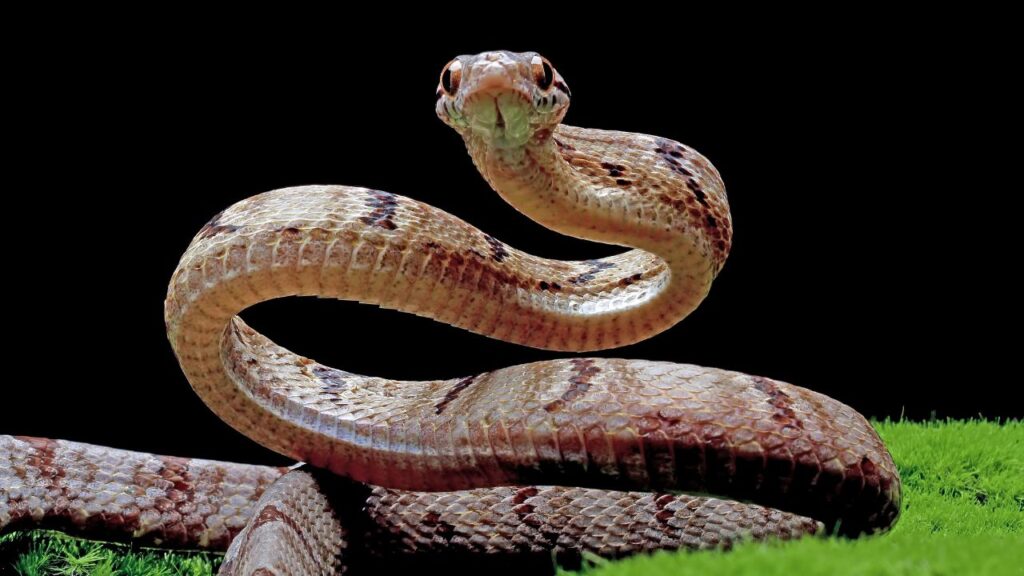
If the bushmaster is the champion of jungle camouflage, the twig snake is the reigning Master of Disguise with a capital M. These snakes from the genus Thelotornis—also known as bird snakes or vine snakes—have taken “blending in” to comedic extremes.
Their entire life philosophy seems to be: If I look like a stick, nobody will bother me. Honestly? A solid strategy. As per Wikipedia, Twig snakes are part of the rear-fanged colubrid club, but unlike most of their cousins, these guys mean business.
Their hemotoxic venom is potent and slow-acting, and while bites are rare, they can be serious. There’s no antivenom, which makes them one more example of nature saying, “Look, just… don’t poke the wildlife, okay?”
What makes the twig snake so unforgettable—assuming you actually see one—is its look. Its slender form and long, pointed head are so distinct that once you know what a twig snake looks like, you’ll never confuse it with anything else.
A leaf? A stick? A ghost of your dehydrated imagination? Nope—could be a twig snake giving you the side-eye while deciding if it should continue its impersonation of a twig or finally go grab lunch.
They sit perfectly motionless for hours—seriously, this snake has the patience of a monk—waiting for the perfect moment to snatch up an unsuspecting lizard or small rodent.
3. Emerald Tree Boa
Native to the Amazon Basin and nearby regions, this brilliantly colored snake is one of the most sedentary hunters in the rainforest. While other snakes slither, stalk, or sprint after their meals, the emerald tree boa basically says, “Nah… my food can come to me.”
They spend hours—sometimes entire afternoons—dangling gracefully from branches, waiting for some unsuspecting critter to wander into striking distance. And let’s talk about that strike.
These snakes have massive jaw muscles and some of the longest teeth relative to head size of any non-venomous snake on the planet. Think tiny green dragon with a dental overachiever’s grin. Those long teeth help them snag furry, feathered, and sometimes overconfident prey right out of the air.
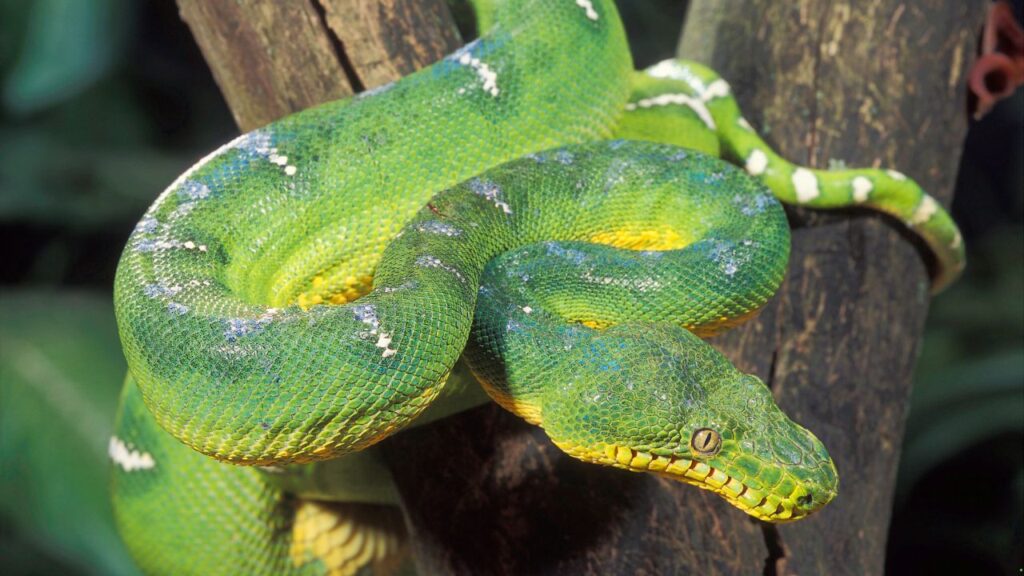
Of course, their biggest superpower is camouflage. You’d think a bright, jewel-tone green body decorated with bold white streaks would make them stand out like a neon sign in the rainforest. But nope!
The white markings actually mimic sunlight filtering through leaves, allowing them to melt into the canopy like they’re part of the décor. If your interior design theme is “tropical jungle but also mildly terrifying,” they’d fit right in.
When they coil themselves over branches, they look like fluffy green spirals of serenity—until you remember they’re coiled for launch mode.
But don’t worry: emerald tree boas aren’t interested in people. They just want to enjoy their leafy lounge life and wait for dinner to walk under them… preferably on legs much smaller than yours.
4. Garden Tree Boa
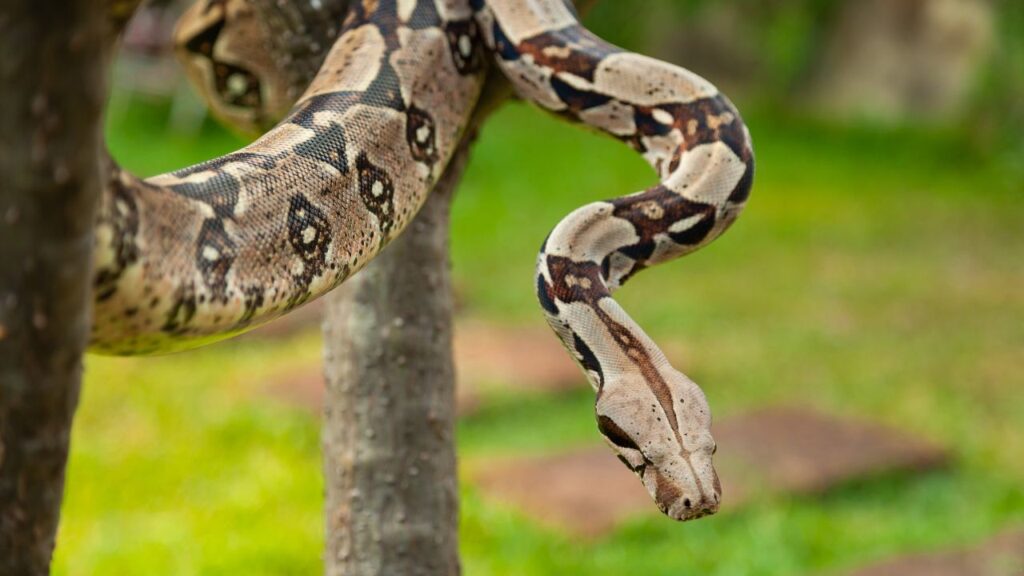
Meet the garden tree boa — the chameleon of the treetops, or more appropriately, the “moodiest shoelace” of the branch world. Depending on where they live, these snakes can wear wildly different outfits: some glow with bright, striking colors, while others sport muted, earthy tones.
With their slender, agile bodies, garden tree boas glide through the canopy almost unnoticed, weaving through branches like secretive green ribbons. Whether they’re basking in dappled sunlight or lounging under dense leaves, they know how to disappear when it matters most.
Because of their stealthy, arboreal lifestyle, people sometimes keep them as pets — and yes, many owners do describe them as a bit cranky. The analogy that gets thrown around a lot is “angry shoelaces.” Imagine trying to pick up a shoelace that decided it had a bad hair-day and a serious attitude.
Speaking of which: garden tree boas tend to have a strong feed response — meaning when meal time comes, they’re all business. That hunger-driven intensity might explain why they seem moody. After all, imagine being hangry and stuck coiled around a branch for hours.
All in all, garden tree boas are elegant, elusive, and a little bit moody — but in their world, that cocktail makes them one of the forest’s most effective, low-key predators. They don’t need to roar, they just blend in… then strike.
5. Rhinoceros Viper
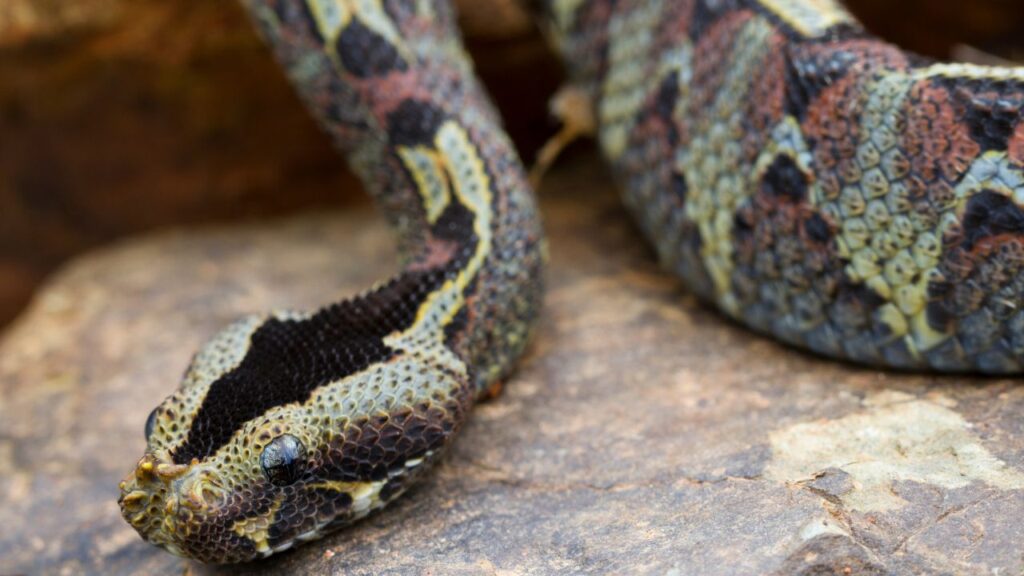
When does a viper look like a rhino? Pretty much never… unless you’re talking about the rhinoceros viper, which sports two jaunty little horn-like scales on its snout, as if it woke up one morning and said, “You know what my look needs? Accessories.”
A proud member of the Bitis genus, the rhinoceros viper is every bit as impressive as its relatives—deadly if provoked, lightning-fast when striking, yet surprisingly chill most of the time. These snakes aren’t out to pick fights; they just want to be left alone to vibe in their natural habitat.
What really makes this species shine—figuratively, not literally, or else the camouflage would be ruined—is its disruptive coloration. Imagine a snake painted by a modern artist who loves bold patterns and chaos. The rhinoceros viper’s skin uses bright blues, yellows, greens, and blacks in jagged geometric shapes that break up its outline so effectively that it becomes practically invisible in leaf litter.
Just like its cousin, the Gaboon viper, this species is a master of staying put. It’s a sedentary ambush predator, which is a polite way of saying it doesn’t move much unless it absolutely has to.
Unfortunately, this ability to vanish into the undergrowth sometimes leads to trouble. Most people who are bitten by rhinoceros vipers do so because they stepped on one—an offense the snake, understandably, takes very personally. It’s not the snake’s fault… it’s just too good at hiding.
6. Worm Snake
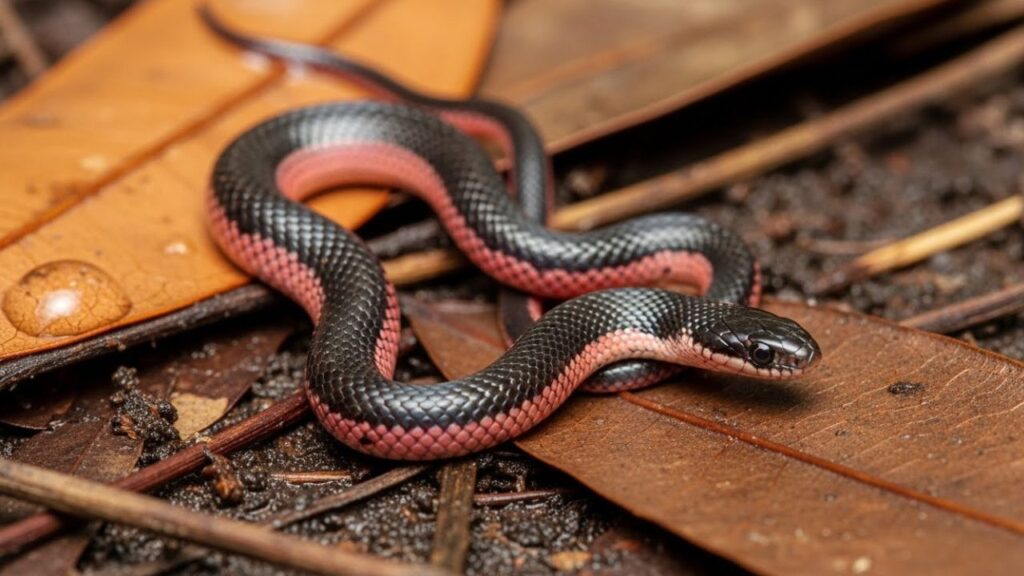
The worm snake is the reptile world’s biggest identity crisis. Is it a worm? Is it a snake? Technically, yes—it’s absolutely a snake… it just doesn’t bother looking like one. Its name is spot on: most people don’t realize they’re holding a snake until it politely wiggles out of their hands and slips back underground like, “Excuse me, human, but I have dirt to be in.”
According to Britannica, “worm snake” is a name often applied to various harmless burrowing species, especially the blind snakes of the family Typhlopidae. And “wormlike appearance” is an understatement.
These snakes are small, shiny, smooth, pinkish or brownish, and about as threatening as a spaghetti noodle. In fact, if noodles could dig and hunt earthworms, they’d basically be worm snakes.
These little reptiles are fully fossorial, meaning they spend almost their entire lives underground. They have no interest in the sunlight, the scenery, or being spotted by people.
Their ideal day is spent tunneling through soft soil in search of worms and other tiny invertebrates, ruling their miniature subterranean kingdom. The only time they surface is when their tunnels flood from rain—essentially, when Mother Nature says, “Out you go!”
Now, does this count as camouflage? Well… sort of. The worm snake’s main survival strategy is simply not being seen ever. But if you’re shaped like a worm, colored like a worm, and hiding in places where only worms go, then yes—it’s fair to say you’re blending in spectacularly.
Whether you consider them disguised, cryptic, or just doing their best worm impression, one thing is certain: worm snakes are adorable, quirky, and proof that not all snakes need fangs, venom, or attitude to be fascinating.
7. California Kingsnake
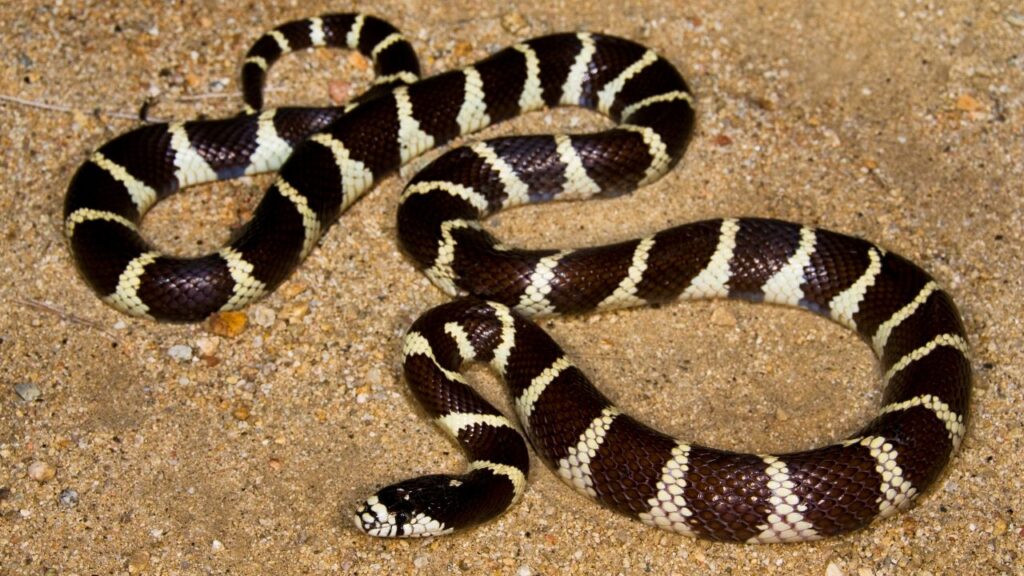
If snakes had a fashion magazine, the California kingsnake would definitely be featured on the cover. These reptiles show off an impressive wardrobe in the wild—everything from bold black-and-white bands to soft brown-and-cream patterns.
Despite their stylish looks, California kingsnakes aren’t trying to stand out. In fact, their alternating light and dark patterns work like natural camouflage, helping them blend smoothly into the rocks, leaf litter, and tangled vegetation of their habitat. To the untrained eye, they’re just another shadow in the landscape.
These snakes are also surprisingly famous for their role as rattlesnake control in the wild. Yes, you read that right: this nonvenomous constrictor will eat venomous rattlesnakes. Why? Because the kingsnake is immune to rattlesnake venom and apparently enjoys proving it.
Although they’re active hunters, kingsnakes are generally shy and will slither away before confrontation. Still, they’re not exactly easy to spot unless you’ve got a good eye. Most hikers walk right past them without ever realizing they’ve stepped over royalty.
Their calm temperaments and wide variety of patterns have made them popular pets, too. But in the wild, the California kingsnake is a master of stealth, style, and occasional rattlesnake domination.
8. Sidewinder Rattlesnake
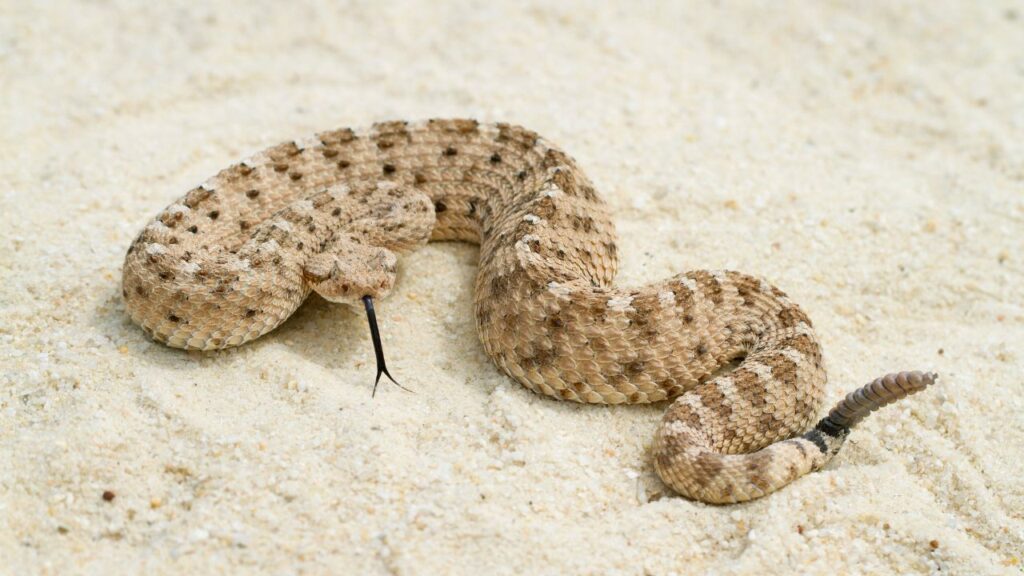
If snakes had signature dance moves, the sidewinder rattlesnake would be on every desert dance floor. This little rattler is famous for its peculiar way of moving—sliding sideways across the sand like it’s moonwalking in slow motion.
Sidewinders call the deserts of the American Southwest and parts of Mexico home, where camouflage is a must. Luckily, sidewinders come in gorgeous sandy shades that match their environment perfectly—tans, browns, and grays sprinkled with darker blotches.
When one curls up beneath a creosote bush or half-buries itself in the sand, it becomes practically invisible. Desert ninjas couldn’t do it better.
Of course, we can’t forget their other iconic feature: the little horn-like scales above their eyes. These give them a permanently skeptical expression, as though they’re judging both your life choices and your sunscreen habits. The “horns” also help protect their eyes from blowing sand, proving that even in reptiles, good accessories serve a purpose.
Despite being rattlesnakes, sidewinders are on the smaller side—usually under two feet long—and are far from aggressive. Most bites happen because someone steps too close or doesn’t notice the snake camouflaged in the sand.
They’re ambush predators, waiting motionless under the sand with only their horns peeking out. When an unsuspecting lizard or mouse strolls by—bam!—they strike faster than you can say, “Who kicked sand in my shoe?”
9. Gaboon Viper
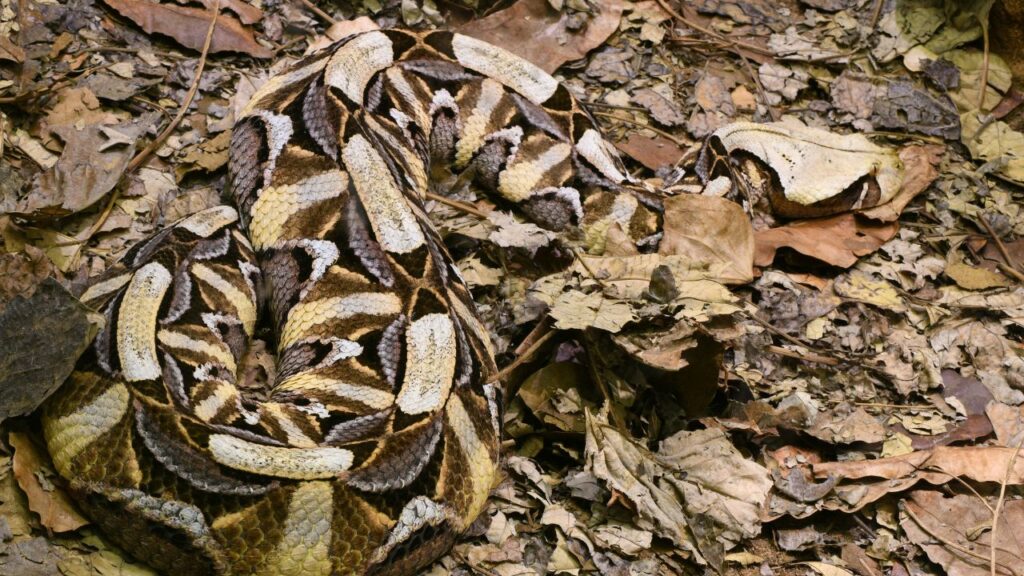
If the rhinoceros viper is a forest ninja, the Gaboon viper is a rainforest tank in disguise. This magnificent snake is one of the heaviest and longest vipers in Africa, and it carries an arsenal to match: the longest fangs of any venomous snake—up to 2 inches—and venom powerful enough to stop prey almost instantly.
Yet, despite its fearsome reputation, the Gaboon viper is a master of patience, not aggression. Most bites happen only when people step on or harass it, which, let’s be honest, is asking for trouble.
What really makes the Gaboon viper a showstopper is its camouflage. Its intricate pattern of browns, yellows, purples, and blacks looks like a walking mosaic of fallen leaves. When coiled in the leaf litter of African forests, it’s practically invisible, perfectly blending into the jungle floor. You could be standing right above one and not notice it—until it decides it’s hungry.
Unlike some snakes, the Gaboon viper doesn’t need to move much. It’s a sedentary ambush predator, waiting quietly for rodents, birds, or other small animals to wander into striking distance.
Gaboon viper is a masterpiece of evolution: beautifully patterned, perfectly camouflaged, lethally equipped, and surprisingly low-maintenance. It’s the rainforest’s ultimate combination of “look but don’t touch” and “I could destroy you, but I’d rather nap.”
Conclusion
Snakes that use their skin to hide from predators demonstrate remarkable adaptations in mimicry and camouflage. Snake species such as the Kapuas Mud Snake and Chameleon Snake can change color and display different patterns or bright colors to resemble their surroundings, from grass and ground to complex textures that mimic octopus-like movement. These ambush predators use behaviors like adjusting tail position, movement, and subtle changes in light to avoid potential predators while waiting to catch unsuspecting prey.
Researchers have heard reports and observed how these snakes create deceptive patterns that blend seamlessly, providing both military-like stealth and survival advantage. By mastering the interplay of color, texture, and movement, these snakes exemplify nature’s ingenuity in using skin for concealment and protection.
