




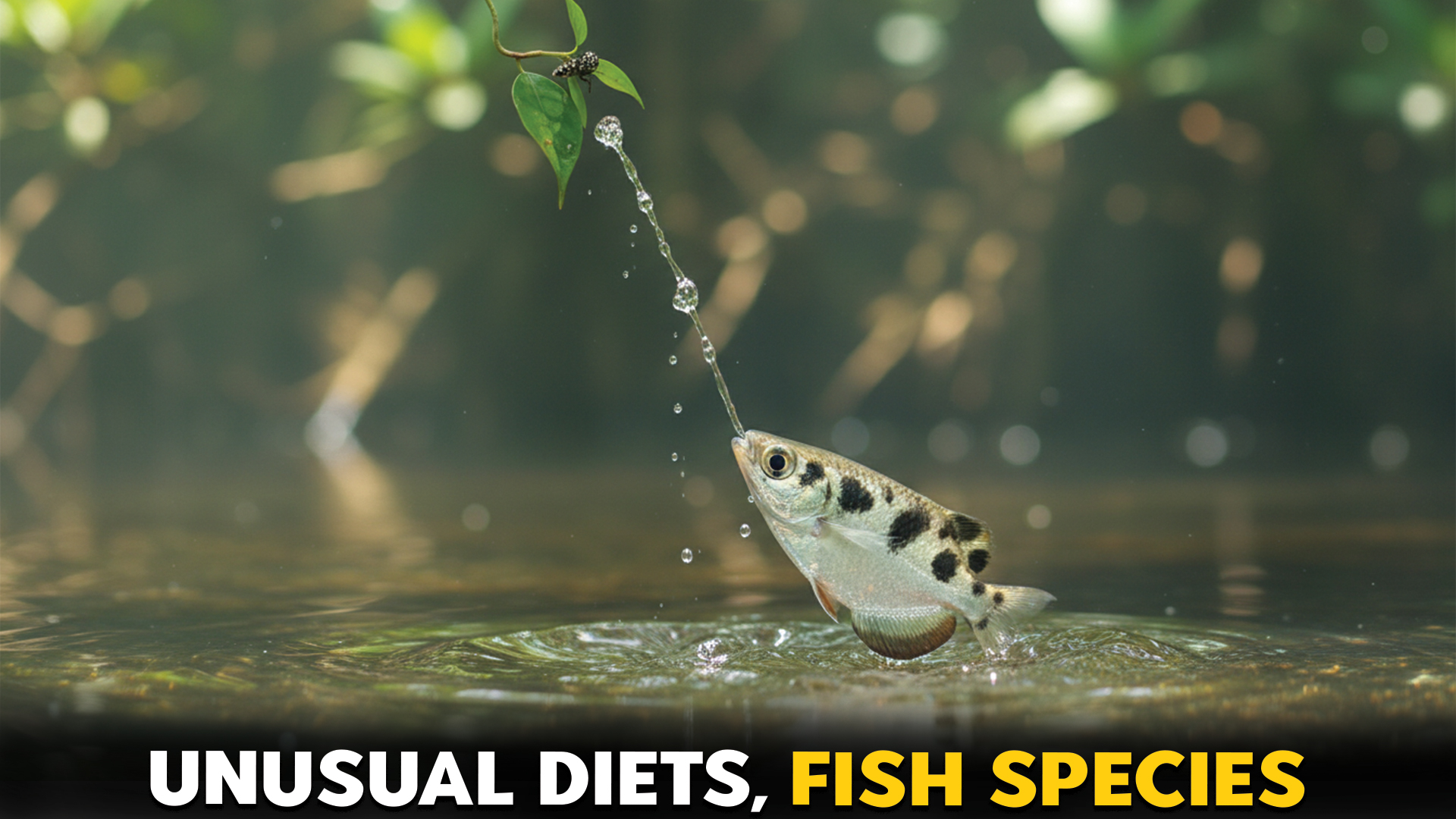
When you think about what a fish might eat, your mind probably goes to worms, smaller aquatic life, decaying organic matter, or maybe some algae. Pretty standard stuff, right? Well, buckle up, because the underwater kingdom is home to some of the most bizarre and brilliant dining strategies you could ever imagine.
We’re not just talking about picky eaters; we’re talking about fish that have turned the act of consuming into a high-stakes art form. From spitting sharpshooters to professional spa attendants and even a few legitimate vampires of the deep, the ways these fish get their fill will make you rethink everything you thought you knew.
This is a far cry from the straightforward migratory feeding patterns of fish like salmon, which travel thousands of miles to feast in rich ocean grounds.
Get ready to dive into the weird and wonderful world of the most unusual eaters swimming in our planet’s waters. It’s going to be a wild ride!
Fish with the Most Unusual Eating Habits
1. Deep-Sea Anglerfish

With a gaping maw full of needle-like teeth and a face only a mother could love (maybe), Seep-Sea Anglerfish has perfected the art of patience. It doesn’t waste energy chasing things down; instead, it makes dinner come to it. This is a fish that has evolved to be the ultimate deep-sea trap, a floating beacon of doom for any curious critter that swims too close.
This is a classic predatory fish. It doesn’t chase its food. Instead, it uses a specialized tool—a glowing lure—to attract prey (fish and squid) in the dark depths.
The anglerfish’s claim to fame is its built-in fishing rod. Protruding from its head is a modified dorsal spine that acts as a lure, and at the tip of this rod is a glowing bulb. This light is produced by a colony of bioluminescent bacteria that the anglerfish cultivates. In the absolute blackness of its habitat, this tiny light is an irresistible beacon.
When a curious fish or squid gets close enough to investigate the light, the anglerfish strikes with incredible speed. Its jaws are massive and can open wide enough to engulf a being nearly its own size. Its entire anatomy is built for this one moment.
2. Scale-Eating Cichlid
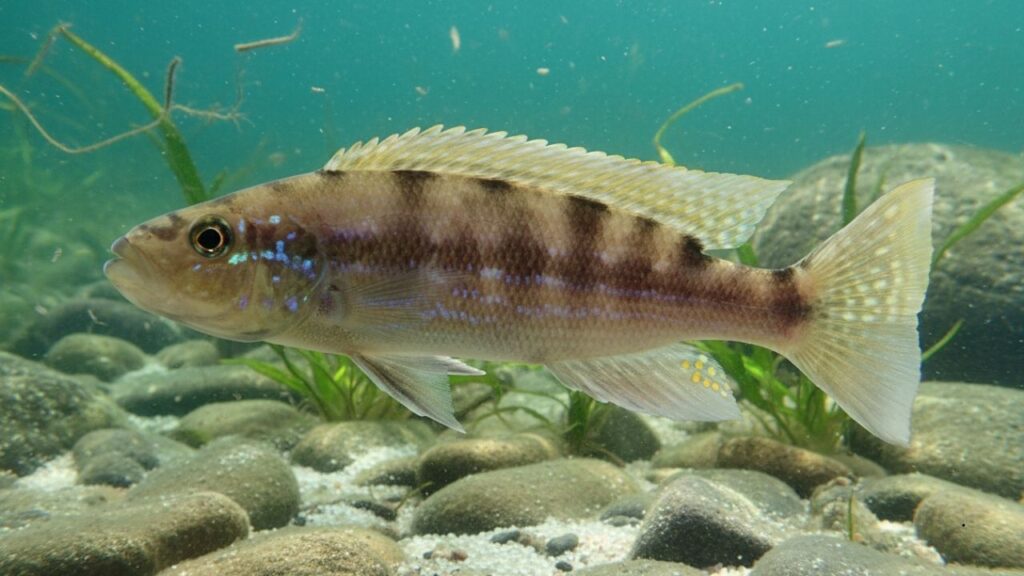
At first glance, this fish doesn’t look particularly menacing. It’s not huge, it’s not covered in spikes, but its dietary preferences are among the most specialized and unusual. As its name suggests, this cichlid has a taste for the scales of other fish. It’s the aquatic equivalent of a drive-by chip thief.
Compared to other animals living under the water, this one is a master of the surprise attack. It will lurk and wait for an unsuspecting fish to swim by. Then, with a burst of speed, it rushes in from the side or behind and rips off a mouthful of scales before darting away. What’s truly fascinating is that these cichlids are specialized for attacking from one side.
You might wonder if scales are even worth the effort. It turns out they are a surprisingly good source of protein and calcium. Better yet, for the cichlid, they are a renewable resource. A fish that has its scales scraped off can regrow them, meaning the scale-eater doesn’t permanently harm its source of nourishment.
It’s a sustainable, if somewhat rude, way to make a living. According to Nature, the cichlid can continue to get what it needs from the local population without wiping out the local population.
To make their job easier, these clever fish are also masters of deception. Some have been observed mimicking the appearance and behavior of harmless, non-threatening fish. They blend in with a group, getting close to their targets without raising any alarms.
3. Candiru
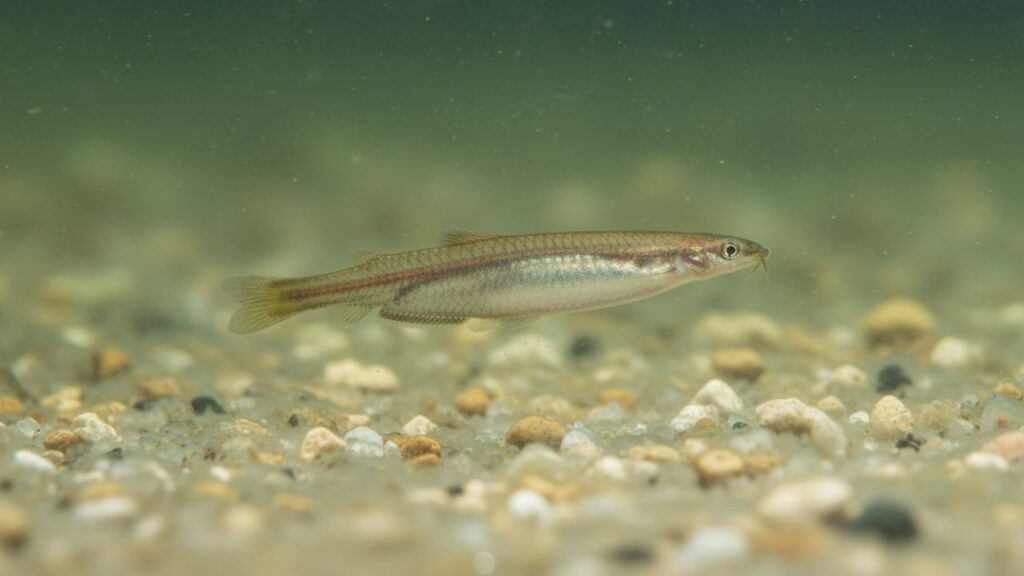
This tiny, translucent catfish, commonly found in the freshwater rivers of the Amazon basin, has earned a horrifying reputation. Deep in the Amazon River basin, a tiny, translucent catfish has earned a horrific reputation. This is the Candiru, or Vandellia cirrhosa, a fish that proves terror doesn’t have to be big.
Often called the “vampire fish of the Amazon,” this slender, eel-like being has one of the most gruesome feeding habits known to science. It is a parasite that seeks out a specific, highly vulnerable part of its host to obtain what it wants: blood.
The Candiru’s primary targets are the gills of the much bigger catfish and other aquatic residents of the Amazon. It has an incredible ability to detect chemical traces, such as ammonia, released by a fish’s gills. It follows these chemical trails upstream directly to the source.
For the Candiru, the gills of a large fish are the perfect place to find a flowing, easily accessible source of blood. It’s a tiny heat-seeking missile on a mission for a crimson drink.
Once it locates a suitable host, the Candiru swims into the gill cavity with astonishing speed. To ensure it isn’t washed away or shaken off, it erects a set of short, sharp spines on its gill covers that anchor it firmly into the host’s delicate tissues. From this secure position, it uses its needle-like teeth to make an incision in an artery and begins to drink its fill of blood.
4. Archerfish
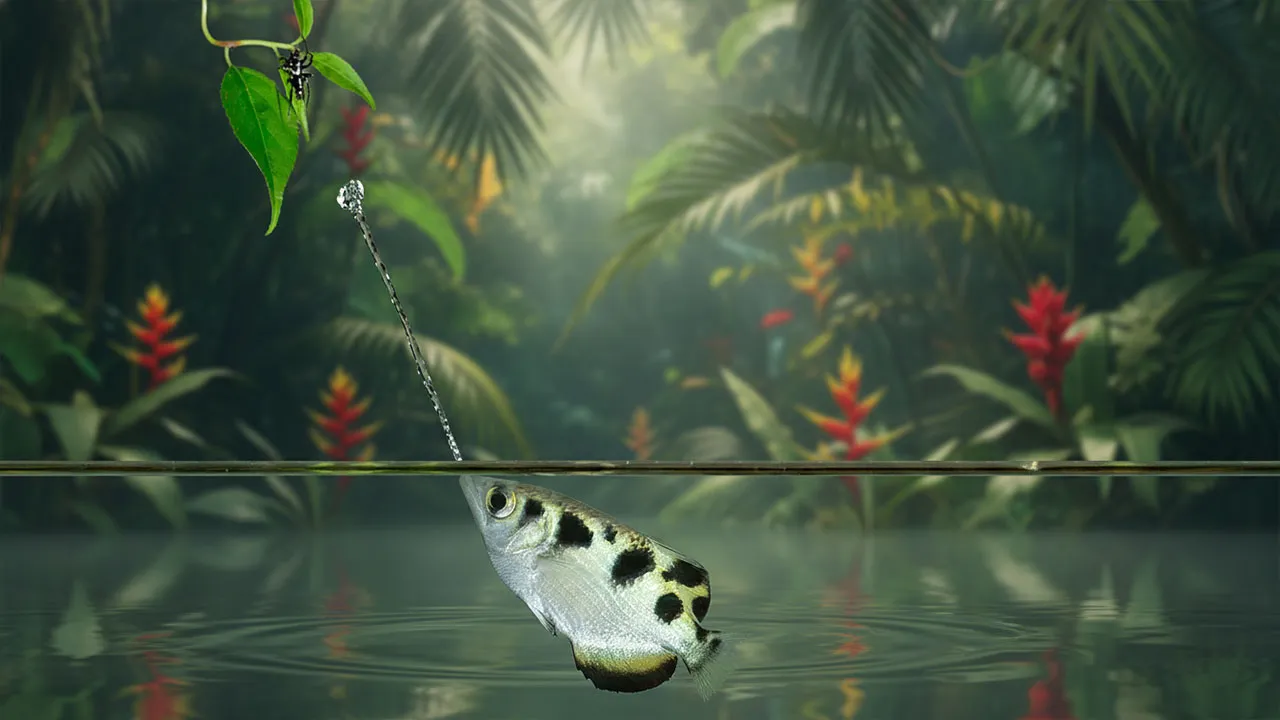
Found in mangrove swamps and estuaries from India to the Philippines, this clever fish has developed a hunting technique that seems almost impossible: it spits. But it doesn’t just spit randomly; it shoots powerful, incredibly accurate jets of water to knock its quarry from the world above into the water below.
The archerfish patrols near the water’s edge, keeping a keen eye on the leaves and branches hanging overhead. When it spots a tasty-looking bug or a small lizard resting on a leaf, it positions itself directly below. By pressing its tongue against a groove in the roof of its mouth, it forms a narrow tube, like the barrel of a water pistol.
With a powerful compression of its gill covers, it forces a stream of water out with enough force and precision to dislodge its target, which then falls helplessly into the water.
What makes this feat truly remarkable is that the archerfish has to account for the physics of light refraction. When looking up from the water, the apparent position of an object in the air is distorted. The archerfish’s brain can instantly calculate the proper position of its target and adjust its aim accordingly.
It can hit targets from several feet away, a display of cognitive power and accuracy that is astonishing for any being, let alone a fish.
5. Gulper Eel
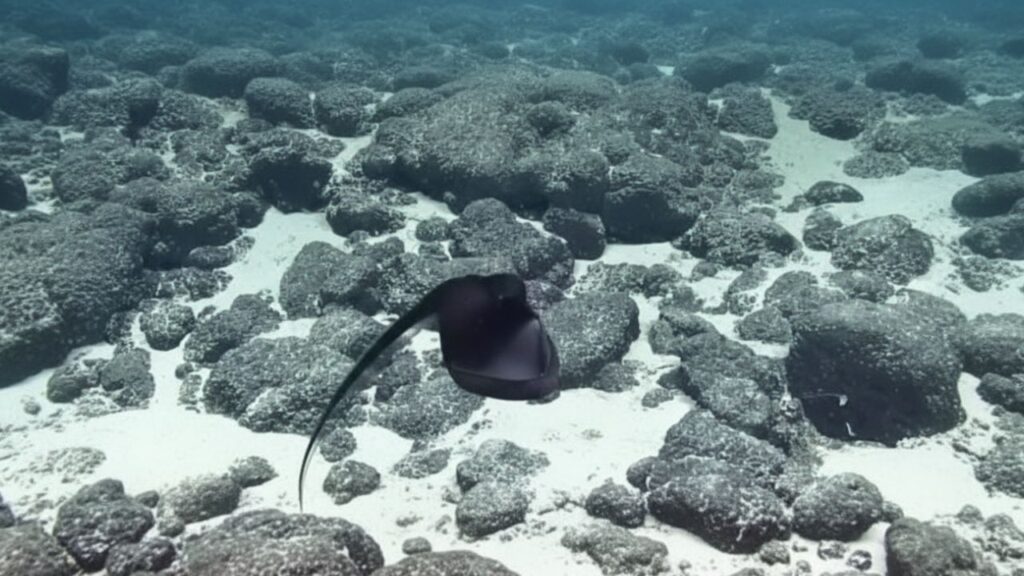
Returning to the mysterious deep, we encounter another bizarre creature: the Gulper Eel. Also known as the Pelican Eel, this being is less of a fish and more of a swimming mouth. Its most striking feature is its ridiculously oversized, pouch-like jaw, which is far larger than its own body. The rest of the eel is little more than a long, whip-like tail.
Discover Wildlife says it’s a living, drifting net, perfectly adapted for a place where you can’t be picky about what you eat.
This allows it to consume soft-bodied prey that other predators, which might need powerful claws to crush a lobster’s hard shell, would have to pass up.
The Gulper Eel’s strategy is all about maximizing its chances of engulfing anything that comes its way. Its enormous mouth can be hinged open incredibly wide, and the lower jaw is so loosely constructed that it can balloon outwards, forming a massive scoop.
This isn’t for chewing; it’s for swallowing. The eel drifts slowly through the dark, waiting for a group of small crustaceans or a single, larger fish to swim by.
When something gets close, it opens its gigantic maw and engulfs its dinner, water and all.
6. Bluestreak Cleaner Wrasse

This small, vibrant fish runs what can only be described as a mobile spa and health clinic for other, much bigger fish. It sets up shop at a “cleaning station,” usually a prominent piece of coral, and advertises its services to the neighborhood. Its clients include some of the reef’s top voracious predators, who will patiently line up for their turn.
Oceana states that its diet consists of parasites, dead skin, and mucus it removes from its ‘clients’—a list that can include hundreds of different fish species on a busy reef.
The cleaner wrasse performs a special, hypnotic “dance” to signal that it’s open for business. A potential client—perhaps a big grouper or a moray eel—will approach and adopt a passive pose, often opening its mouth and flaring its gills.
This is a sign of trust. The tiny wrasse then gets to work, swimming all over the larger fish’s body. It fearlessly enters the client’s mouth and gill chambers, places that would typically mean certain doom.
This fish is a symbiotic cleaner. It engages in a mutually beneficial relationship with other fish. It doesn’t hunt and eat fish; it cleans them. Its diet consists of parasites, dead skin, and mucus it removes from its “clients.’
7. Vampire Fish
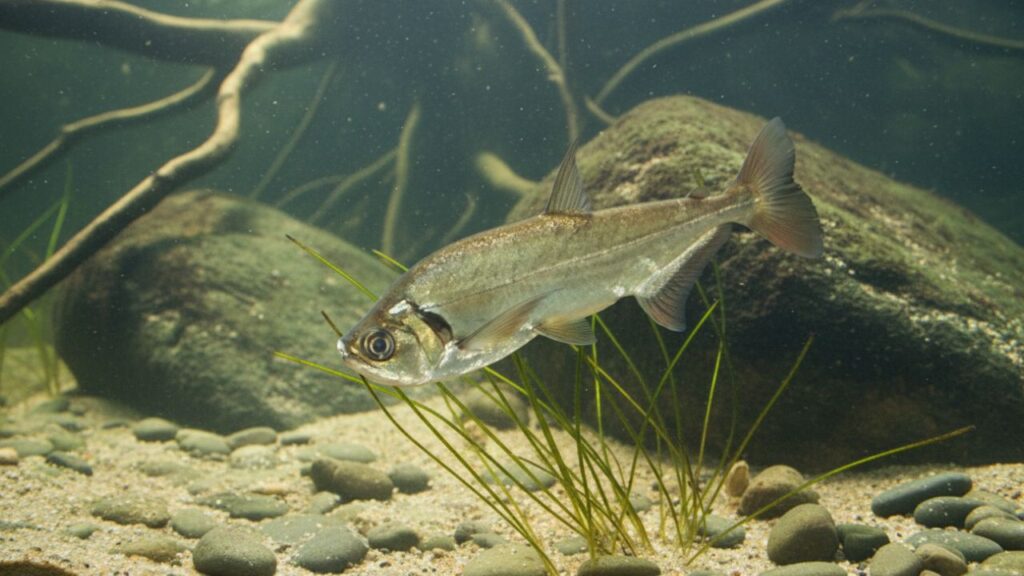
This is a mighty, silver-colored hunter that is famous for one terrifying feature: a pair of enormous, saber-like fangs protruding from its lower jaw. These fangs are so long—sometimes reaching several inches—that the fish has two corresponding holes in its upper jaw to sheathe them when its mouth is closed.
Instead, it uses its incredible speed, rivaling that of an open-ocean tuna or other smaller fish, to swim up from beneath its target and impale it with its two massive fangs.
The Payara is an aggressive and formidable hunter, and its primary method of attack is as dramatic as its appearance. It doesn’t nibble or chew. Instead, it uses its incredible speed to swim up from beneath its target and impale it with its two massive fangs.
These fangs are sharp enough to pierce straight through the scales and into the vital organs of its quarry, which often includes the notoriously tricky piranha.
The sheer power and aggression of the Payara make it an apex hunter in its environment. Its entire anatomy is built around this single, brutal method of securing a meal, making it a specialist of the highest order.
In the world of powerful strikers, it is rivaled perhaps only by the mantis shrimp, a crustacean that can shatter aquarium glass with its club-like appendages.
Conclusion
From the dark, lonely depths to the sunlit shallows of a mangrove swamp, the aquatic realm is home to an absolutely stunning array of survival strategies.
As we’ve seen, the simple act of eating can take on forms that are clever, bizarre, cooperative, or downright terrifying. Whether it’s a fish that spits with pinpoint accuracy, a tiny parasite that drinks blood, or a helpful cleaner that runs a mobile spa, these fish have pushed the boundaries of what it means to find and consume sustenance.
They remind us that beneath the waves lies a universe of incredible adaptations and that there are always more strange and wonderful stories waiting to be told.
