




The ocean looks calm on the surface, but scroll down far enough, and things get… unhinged. We’re talking midnight-level dark, bone-crushing pressure, and creatures that look like they escaped a horror film casting call. These are fish that live in the darkest depths, thriving where sunlight never shows up and vibes are permanently spooky.
Down in the deep sea, survival is a full-time grind. Food is scarce, pressure is wild, and everything is either trying to eat you or avoid being eaten. That’s why deep-sea fish evolved next-level adaptations like glowing lights, stretchy bodies, and highly questionable dental choices. Sharp teeth are basically a personality trait down here.
This world beneath the surface covers most of planet Earth, yet humans have explored less of it than outer space. Marine science keeps revealing new deep-sea organisms that rewrite what we thought life could look like.
So buckle up. We’re diving into the depths of the ocean to meet some of the most iconic, unsettling, and strangely fascinating deep-sea animals ever discovered.
Fish That Live in the Darkest Depths
1. Anglerfish

The anglerfish is basically the mascot of “do not judge a book by its cover,” except the cover is pure nightmare fuel. National Geographic states that this deep-sea anglerfish lives in extreme darkness, often near the ocean floor, where it uses a glowing bioluminescent lure dangling from its head to attract prey. Yes, it’s fishing… while being a fish.
That glowing lure isn’t just for aesthetics. It helps attract prey such as small fish and squid in deep, lightless waters. Once dinner gets close, the anglerfish opens its large mouth, showing off powerful jaws and teeth that curve inward. Escape is not part of the menu.
Now let’s talk about dating, because anglerfish relationships are wild. The tiny males literally fuse to the female’s body for life. This adaptation helps ensure reproduction in the vast darkness of the deep ocean.
Unlike the cartoon version people imagine, the real angler fish is a highly specialized predator built to survive extreme pressure, total darkness, and long gaps between meals.
With their weird body, massive heads, and terrifying mouths, anglerfish prove that surviving the deep isn’t about looking cute. It’s about thriving in pressure-heavy conditions where food is rare and every meal counts.
2. Common Fangtooth

The common fangtooth holds the unofficial record for scariest teeth-to-body ratio in the ocean. These sharp teeth are so long that they don’t even fit inside its mouth. The fish just said, “We’ll deal with storage later.”
Living in deep water across the Atlantic and Pacific, this fierce predator survives by eating small prey like crabs and other animals drifting through the darkness. Despite their ferocious appearance, fangtooths are actually pretty small. Size does not equal menace down here.
They are adapted to insane pressure, and their metabolism runs slowly to conserve energy. In the sea, efficiency is everything. Miss one meal, and it’s a long wait until the next snack floats by.
Fangtooths remind us that in the darkest parts of the ocean, evolution favors function over vibes. They’re proof that these creatures don’t need size to be terrifying. Teeth will do just fine.
3. Viperfish

If the ocean had villains, the viperfish would be a top-tier boss. With needle-like teeth, glowing bioluminescent spots, and a permanent evil grin, this fish is built for jump scares.
Viperfish use light-producing organs to lure prey closer, then strike with lightning speed. Their mouth opens wide enough to swallow prey larger than their own body, which is honestly impressive and unhinged. Feeding time is pure chaos.
They live thousands of feet below the surface, where pressure is intense, and darkness is absolute. Large eyes help them spot movement, while their long bodies allow them to swim smoothly through the deep.
Despite their terrifying appearance, viperfish are a reminder that the deep ocean is home to specialized predators perfectly adapted to hunt in total darkness.
4. Frilled Shark

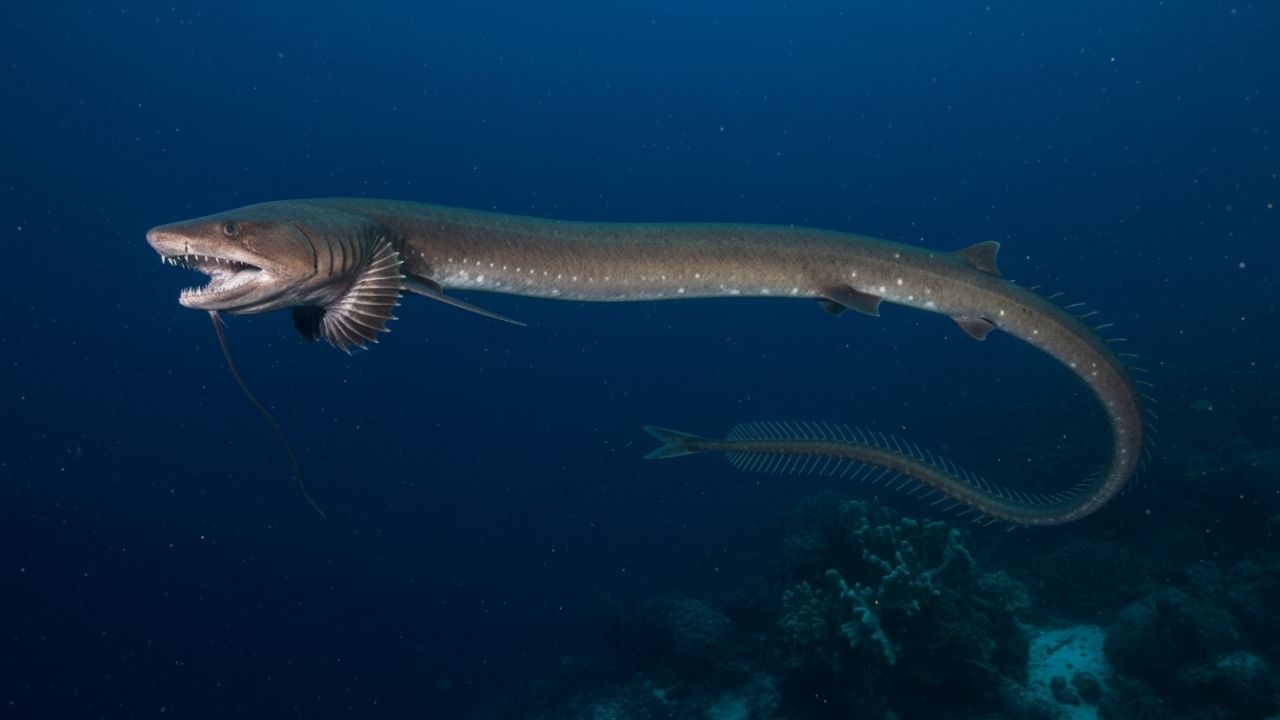
The frilled shark looks like an ancient eel had beef with evolution and refused to update. This shark species has been around for millions of years, cruising the ocean like a living fossil.
With rows of sharp teeth and a snake-like structure, the frilled shark feeds on squid and small fish, often swallowing prey whole. It lives near the ocean bottom, sometimes rising into shallower water at night to hunt.
Unlike fast swimmers, this shark relies on stealth and flexible jaws. It’s not chasing you; it’s waiting for you to mess up. Scientists think this slow, deliberate feeding style helps conserve energy in a low-food environment.
The frilled shark proves that sometimes these designs are the best. Nature tested it, and it still works.
5. Black Dragonfish

The black dragonfish is one of the most metal deep-sea creatures ever discovered. It produces red light, which most fish can’t see. That means it’s basically using night-vision goggles while everyone else is blind.
This trick helps it hunt small prey without being detected. FishBase notes that its long body, large mouth, and sharp teeth make it an efficient predator in the darkest depths of the ocean.
Living in extreme pressure, this fish has adapted skin and organs that function without sunlight. Its body absorbs almost all light, making it nearly invisible. Stealth level: elite.
The black dragonfish is proof that evolution gets creative when the environment demands it.
6. Oarfish

Oarfish are the longest bony fish in the world, and yes, they look like sea serpents. These ribbon-like creatures live deep in the ocean but sometimes wash up near the surface, causing internet meltdowns.
Despite their size, oarfish feed on small fish, plankton, and squid. They’re not predators in the scary sense, just gentle giants drifting through plunging water.
Their silver bodies reflect light, possibly helping them stay hidden from predators. Swimming vertically, they look like something straight out of myth.
Oarfish remind us that not everything in the deep is aggressive. Some creatures are just vibing.
7. Lanternfish

Lanternfish might be small, but they’re everywhere. These deep-sea fish are among the most abundant vertebrates on Earth. Yes, there are billions of them.
They use bioluminescence to communicate in their habitat, avoid predators, and confuse anything trying to eat them. Talk about multitasking. Their light patterns are like underwater emojis. Britannica describes it as an elongated fish with large mouths and eyes.
Lanternfish migrate daily, swimming up toward the surface at night to feed, then sinking back into the deep by day. This movement helps transport energy through the ocean ecosystem.
Without them, many sea animals wouldn’t survive.
Conclusion
The deep sea is one of the most extreme environments on the planet, yet life thrives in ways that feel almost unreal. From glowing lures to impossible teeth, these fish that live in the filmiest depths show how adaptable life can be. In the Pacific Ocean, many deep-sea fish drift above the ocean bottom, sharing the ecosystem with strange deep-sea creatures that most humans will never see in real life.
Every deep-sea fish on this list proves that evolution has a sense of humor and zero fear. The darkness isn’t empty; it’s crowded with creatures perfectly built to survive pressure, hunt prey, and thrive without sunlight.
As scientists continue to explore the deep ocean, we’ll keep discovering new species that challenge our ideas of what life looks like. The sea still has secrets, and honestly, we love that for it.
So next time you look at the sea, remember: beneath the waves is a whole world of weird, wonderful, and wildly adapted life doing just fine without us.
