




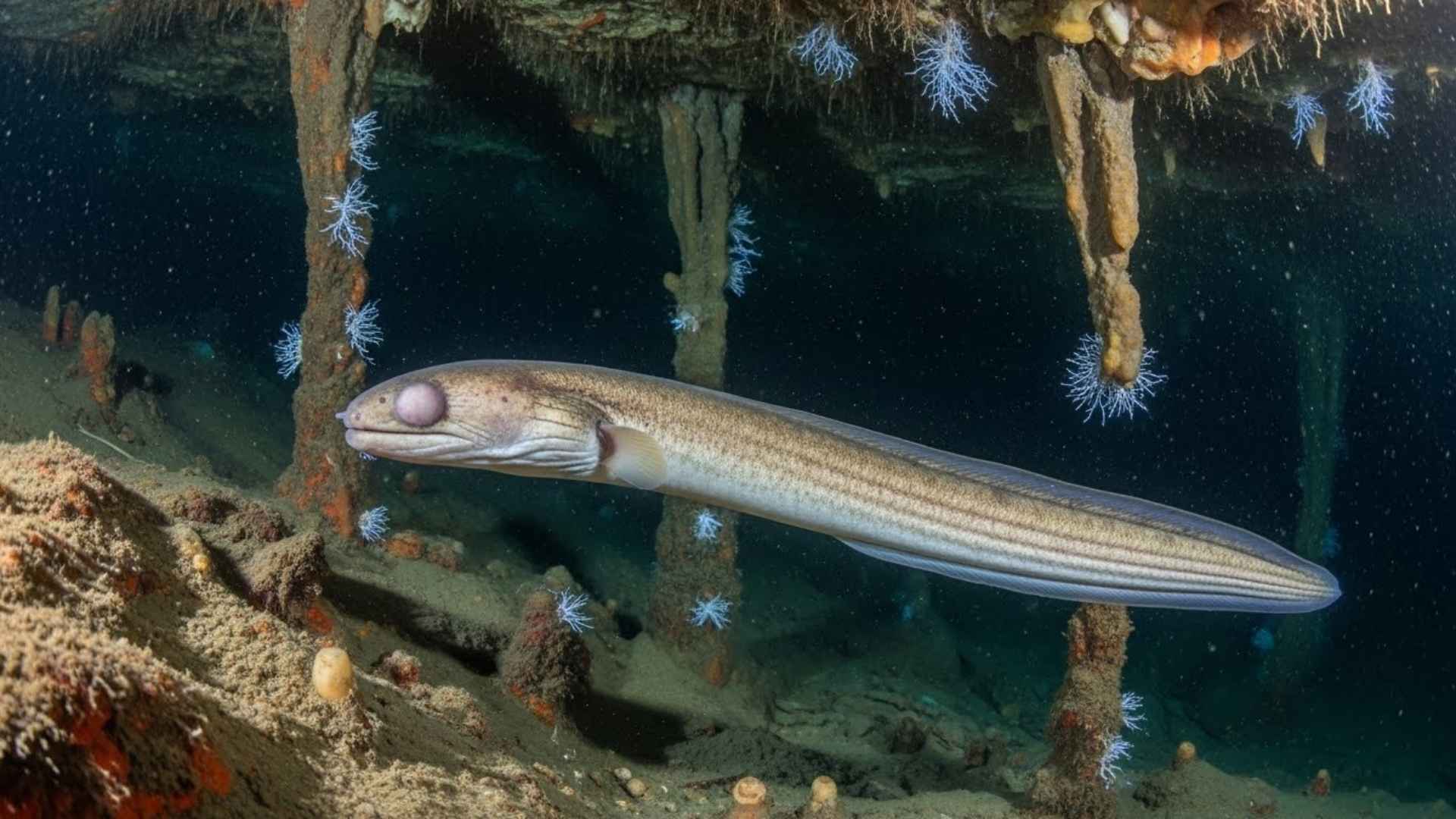
In the perpetual darkness of subterranean caverns and aquifers, there are fish that have no eyes and live in caves. These creatures have not only lost their sight but have also evolved extraordinary adaptations to thrive in places where light never reaches.
This phenomenon is a perfect example of regressive evolution, where a species loses a complex trait over time because it is no longer necessary. For these cave-dwelling fish, maintaining functional eyes and the brain power to process visual information is a waste of energy.
By shedding these “expensive” organs, they can redirect their resources toward traits that actually help them find food and mates in the dark. It challenges our understanding of biology, showing that sometimes, less really is more.
In this blog, we are going to explore seven distinct types of these biological marvels. We will look at how they navigate without eyes, how they survive in food-scarce environments, and the specific genetic factors that led to their blindness.
Fish That Have No Eyes and Live in Caves
1. Blind Cave Fish

The Blind Cave Fish, scientifically known as Astyanax mexicanus, is perhaps the most famous example of a creature adapting to the dark. Also known as the Mexican Tetra, this species is found in northeastern Mexico and parts of Texas, inhabiting the lower Rio Grande, Nueces, and Pecos Rivers.
While a blind fish might seem helpless, the Mexican Blind Cavefish is actually very clever and highly adapted. The eyes and the parts of the brain required to process vision consume a massive amount of energy. In a cave environment where food is often scarce, nature prioritizes conservation.
To compensate for the loss of vision, these fish have evolved traits that enhance their ability to see. They possess a highly developed lateral line system and a heightened sense of smell and touch. They can immediately detect the location of objects or other animals by sensing slight changes in water pressure. This mechanism is vaguely similar to echolocation used by bats.
It allows Astyanax cavefish to navigate the rocky and sandy bottoms of pools without crashing into walls, making them efficient hunters despite total darkness.
The genetic mechanism behind this is fascinating. The National Geographic points out that scientists refer to a process called pleiotropy, in which genes that are usually needed for eye development are reassigned to other functions.
2. Southern Cavefish

The Southern Cavefish is a ghostly inhabitant of subterranean waters throughout the eastern United States. Small, colorless, and blind, these amblyopsid cavefishes are starkly different from the fish we see in lakes and streams.
While some scientists previously argued it was just a random “withering away,” the consensus now, according to experts like evolutionary physiologist Nicolas Rohner, is that eyes are very resource-intensive. If you don’t need them, losing them provides a massive metabolic advantage.
Researchers have used advanced techniques to understand the evolutionary genetics of these fish. By studying the genetic mutations that caused eye degeneration, they developed a “mutational clock.” This allowed them to estimate that the vision-related genes of the oldest species, the Ozark cavefish, began to degrade up to 11 million years ago.
One of the most interesting findings from studying different cavefish populations is that they evolved independently. An analysis of 88 vision-related genes revealed that different lineages had distinct sets of mutations.
This suggests that separate species colonized caves and adapted to those ecosystems independently of each other. It wasn’t a single event; it was multiple populations converging on the same evolutionary solution to the problem of darkness.
This genetic basis for blindness highlights the power of natural selection. Even though the cavefish embryos might start to develop eyes, the process is halted or reversed because the genes are switched off or mutated.
3. Toothless Blindcat

Deep within the water-filled caverns of the Edwards Aquifer in Texas lives the Toothless Blindcat. This species lives at depths of 900 to 2,000 feet, making it one of the deepest-dwelling freshwater fish in the world.
Because it lives in such a dark and isolated habitat, it has developed a notably unique appearance. The absence of light means there is no need for protective pigment, so the fish appears pink or almost translucent, with its blood vessels visible through the skin.
As the name suggests, this catfish lacks teeth. Instead of biting its prey, it relies on suction and highly attuned senses. It has no eyes and relies entirely on smell, touch, and taste to find its food.
Its diet likely consists of invertebrates and fungi scavenged from the aquifer floor. The Toothless Blindcat is a scavenger of the deep, using its sensory barbels (whiskers) to feel around in the pitch-black for anything edible.
Humans rarely see this fish. It typically only appears when it is accidentally pumped to the surface through agricultural or municipal wells. Because they live in such a remote environment, they have likely adapted to live longer and reproduce less often than surface catfish. This slow life cycle makes them very vulnerable. If their population declines, it is tough for them to recover, putting them at high risk.
Sadly, the Toothless Blindcat is facing significant threats. The over-extraction of groundwater from the Edwards Aquifer is shrinking its limited habitat. Conservation of this unique blind fish is difficult because we cannot easily access its home.
4. Cave Angel Fish

The Cave Angel Fish, also known as the waterfall-climbing cave loach (Cryptotora thamicola), is one of the most bizarre creatures on the planet.
Found only in two caves in northern Thailand, this little fish—about 1.2 inches long—lives on underground waterfalls. Unlike other cave-dwelling fish that swim in pools, these fish are often found barely wet, shimmying around in a thin layer of fast-flowing water over the rock.
What makes them truly unique is their total lack of eyes. Unlike Astyanax mexicanus or other cavefish, which often begin developing eyes as embryos before they degenerate, the Cave Angel Fish doesn’t seem to have eyes or even vestiges of them at any point in its life cycle. Eye development appears to be linked to forebrain growth in vertebrates.
The most fantastic attribute of this fish is its method of locomotion. Swimming isn’t practical in a rushing waterfall, so they have developed a special means of “walking” like a salamander.
This structure is significant for understanding vertebrate evolution. It mimics the anatomy that allowed the ancestors of all land animals to crawl out of the water hundreds of millions of years ago.
5. Blind Golden-Line Barbel

The Blind Golden-Line Barbel (Sinocyclocheilus anophthalmus) is a rare species found only in Yiliang County, Yunnan, China. It is a member of the Cyprinidae family, which includes common fish like carps and minnows.
This fish is a classic example of convergent evolution, as per National Geographic, where different species facing the same problem (darkness) evolve similar solutions. Like the Mexican tetra, it evolved from surface-dwelling ancestors and slowly lost its vision as it adapted to cave life.
Physically, this fish is striking. It has a “golden line” running along its body, despite having no eyes to see it. Its brain structure has changed significantly compared to its surface relatives; it possesses smaller optic lobes but larger olfactory systems.
This indicates that as the eye develops less, the sense of smell becomes the primary way to interact with the world. It is a literal rewiring of the brain to suit a new environment.
6. Iraqi Blind Carp

In the subterranean waters near Haditha, Iraq, lives the Iraq Blind Barb, also known as Garra widdowsoni. This fish has adapted to life in perpetual darkness by losing both its eyes and its scales.
Its skin has a pinkish, translucent hue, similar to other cave forms we have discussed. Without the need for camouflage from the sun or predators that hunt by sight, maintaining pigment is just another unnecessary energy cost.
Like other blind cavefish species, the Iraqi Blind Barb compensates for its lack of vision with a highly developed sensory system. It utilizes an enhanced lateral line organ to detect vibrations and changes in water pressure.
This helps it navigate the complex underground channels and find food without ever seeing it. It is a peaceful grazer, likely feeding on the organic film and detritus found in the cave systems.
These animals have spent millennia adapting to a stable, dark environment, only to have that stability threatened by modern water usage. Protecting these fish species requires international awareness and local management of aquifers. Losing them would mean losing a unique branch of the family tree that exists nowhere else on Earth.
7. Blind Swamp Eel

The Blind Swamp Eel (Ophisternon candidum) is the longest cavefish in Australia, growing up to sixteen inches in length.
As its name implies, it is blind, with an eel-like, elongated body. Its non-pigmented skin ranges from white to pink, giving it a ghostly appearance as it moves through the water.
Its preferred habitat is quite specific. It lives in underground waters and caves where salinity levels are very high. These waters are often stratified, meaning a layer of fresh water sits on top of denser salt water.
In terms of diet, Fishbase mentions that the Blind Swamp Eel feeds primarily on crustaceans found in the subterranean substrate, such as Halosbaena tulki. However, they have also been documented eating terrestrial insects that get washed into the cave system. Examination of their stomach contents has revealed everything from isopods to larvae.
Despite being restricted to subterranean waters, they are sometimes observed in shallow water lying on rock surfaces. This behavior is rare but shows that they are active explorers of their environment.
Whether on its own or in pairs, the Blind Swamp Eel is a top predator in its isolated ecosystem. It represents the apex of cavefish biology in Australia, surviving in conditions toxic or inhospitable to most surface fish.
Conclusion
The existence of fish with no eyes that live in caves is a powerful testament to the flexibility of life. Through genetic drift and natural selection, they have shown that functional eyes are not required for success. Instead, they rely on taste buds, pressure sensors, and biological efficiency to survive in food-scarce environments.
However, these unique populations are incredibly fragile. Because they often live in isolated pools or aquifers, they are highly susceptible to pollution and water extraction.
Studying these fish provides scientists with invaluable insights into vertebrate evolution, developmental biology, and the genetic basis of trait loss. They are nature’s experiments, showing us how genes can be turned on and off to suit a specific niche. The most striking experiments are the ones nature has run on its own, deep underground.
As we continue to explore the depths of our planet, we will likely discover even stranger and more wonderful cave animals.
