





While humans rely primarily on sight and sound, aquatic animals have evolved a stunning array of “superpowers” to navigate their world and find their next meal. We’re talking about senses that can detect electricity, feel the tiniest vibrations, and smell a single drop of blood from miles away.
The aquatic environment is a challenging place to hunt. Light fades quickly, water can be murky, and prey can hide in the sand or coral. To survive, predators needed to develop extraordinary methods of perception. These abilities are a testament to the power of evolution, which has created some of nature’s most effective hunters.
In this article, we’re going to dive into the amazing sensory world of fish that can detect prey from a distance. Get ready to have your mind blown by these incredible organisms!
Fish That Can Detect Prey from a Distance
1. Great White Shark
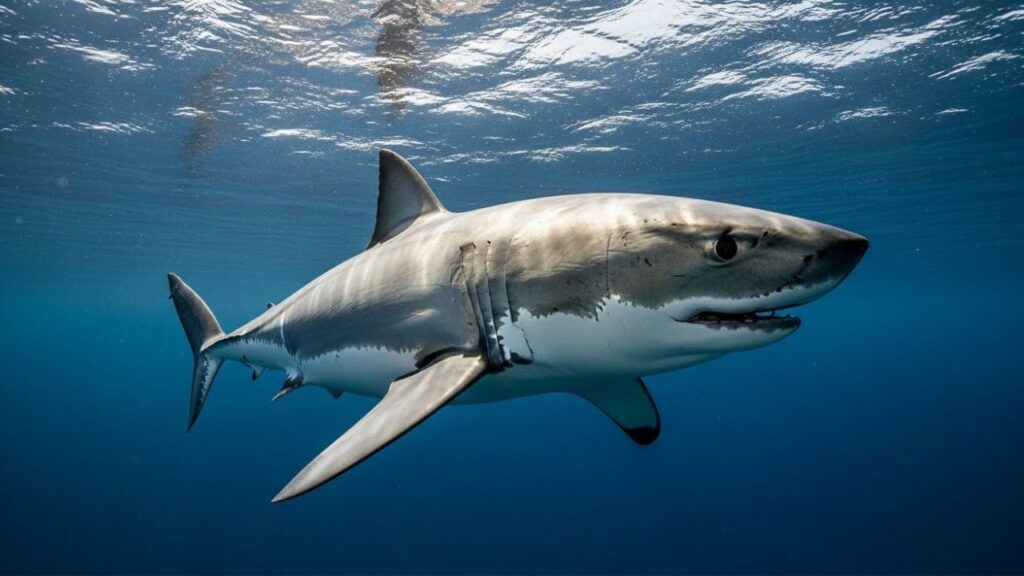
The Great White Shark is a sensory masterpiece, a perfectly tuned hunting machine that can locate prey from incredible distances long before it ever lays eyes on it. It’s a prime example of how multiple advanced senses can work together in perfect harmony.
The Great White’s first clue often comes from its hearing.
Sound travels much farther and faster in water than in air, and sharks have an uncanny ability to pick up on low-frequency sounds. The panicked thrashing of a struggling fish creates vibrations that a Great White can detect from over 800 feet away.
It can detect a small amount of blood or other bodily fluids from miles away, allowing it to follow a scent trail through the ocean with pinpoint accuracy.
But that’s not all.
Running along the shark’s body is a special sensory organ called the mechanosensory lateral line. This structure, a key characteristic of many aquatic organisms, is a series of pores and canals that can feel the tiniest vibrations and pressure changes in the water. This helps the shark sense the movement, size, and direction of nearby objects and fish from up to 100 meters away.
2. Hammerhead Shark

The Hammerhead has taken the shark’s classic sensory toolkit and supercharged it, turning its head into a sophisticated scanning device.
Its greatest trick is its mastery of electroreception. While all sharks have Ampullae of Lorenzini, the Hammerhead’s broad head spreads these sensory organs out over a much larger area. This allows it to scan the seafloor like a metal detector, sweeping its head back and forth.
It can detect the minute electrical pulses from a stingray—its favorite food—entirely buried out of sight in the sand. This incredible ability has been confirmed in many studies and allows it to chase in total darkness effectively.
Of course, the Hammerhead also has the other powerful shark senses. Its lateral line system is highly sensitive, feeling vibrations from moving prey from over 800 feet away. Its hearing is tuned to the low-frequency sounds of struggling organisms, which can alert it to a potential meal from over a kilometer away.
What’s also fascinating is its vision. The wide-set eyes give the Hammerhead a wide field of vision. While it has a blind spot directly in front of its nose, the wider the head, the better its binocular vision becomes, improving its depth perception.
3. Tiger Shark

Often called the “garbage can of the sea” for its non-discriminatory diet, the Tiger Shark is another apex predator with a sensory arsenal that is second to none. This mighty hunter roams tropical and temperate waters, and, like its shark cousins, it relies on a suite of super senses to locate everything from sea turtles and seals to other fish.
The Florida Museum notes that the Tiger Shark’s primary long-range sense is hearing. It can detect low-frequency sound pulses from a distressed animal over a mile away. Its nostrils, or nares, are incredibly powerful, able to detect minuscule traces of amino acids in blood in the water from a quarter-mile or more away.
It will swim in a zigzag pattern, using its two nostrils to determine which direction the scent is most potent, homing in on its target.
As it gets closer, the Tiger Shark engages its lateral line system. This network of receptors along its flanks detects water vibrations, giving it a “feel” for the movements of nearby prey up to 250 meters away.
This is especially useful for hunting at night or in cloudy water where vision is limited. And for the final attack, it uses its Ampullae of Lorenzini to detect the electrical fields of its prey, ensuring it doesn’t miss, even if the target is hidden.
The combination of these four powerful senses makes the Tiger Shark an incredibly versatile and successful predator. It doesn’t need to see its prey to track it. By following a trail of sound, smell, and vibration, it can navigate vast stretches of ocean to find a meal.
4. Electric Eel
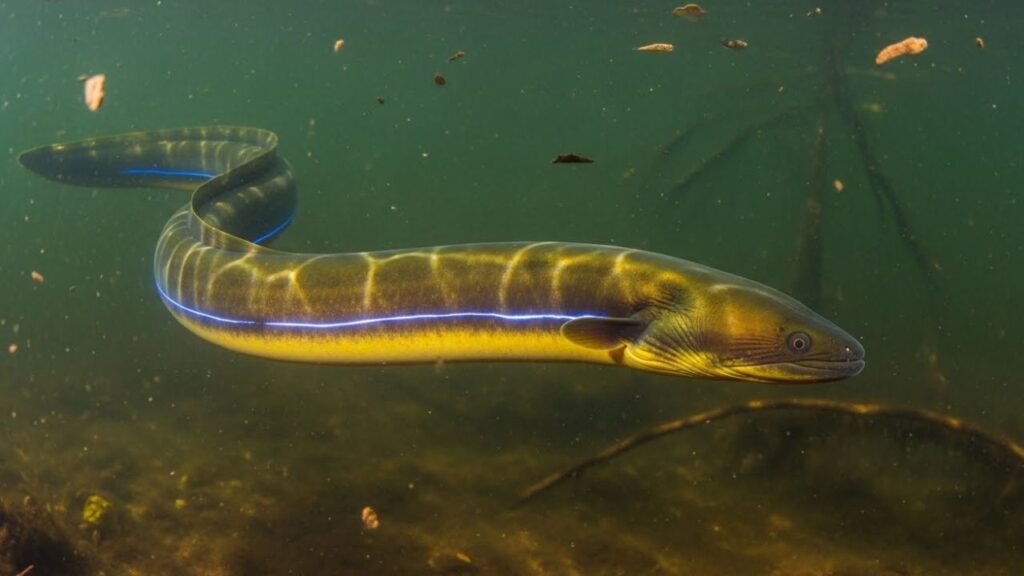
The Electric Eel isn’t a true eel but a type of knifefish, and it has one of the most mind-boggling hunting methods in the entire animal kingdom. Living in the murky, muddy waters of the Amazon, where vision is almost useless, this fish has evolved to control its own electricity, using it as both a weapon and a highly advanced long-distance sensory system.
The eel’s sensory genius starts with low-voltage probing. It has a special organ, the Sachs’ organ, that emits weak electrical pulses (around 10V) into the surrounding water. Its skin is covered in sensitive electroreceptors that detect any distortions in this electric field.
A rock, a log, or a potential prey item will all change the shape of the field in different ways, allowing the eel to “see” its surroundings in 3D electricity, even in complete darkness. It’s like a personal radar system.
But what if the prey is hiding? The eel has a shocking trick. It will unleash a rapid pair of high-voltage pulses, called a “doublet.” This jolt doesn’t aim to stun but to “remote control” the hidden fish. The electricity causes the prey’s muscles to contract involuntarily, making it twitch.
The eel feels this movement immediately and knows exactly where the hidden meal is. It essentially forces its prey to reveal its own position.
5. Swordfish

Let’s rocket from the murky rivers to the deep, dark depths of the open ocean to meet the Swordfish. This powerful, migratory predator is famous for its incredible speed and, of course, its long “sword” or bill.
But one of its most remarkable adaptations is a unique biological heater that gives it super-vision, allowing it to hunt agile prey like squid and fish in the cold, dim light of the deep sea.
The Swordfish’s secret weapon is a specialized organ near its eyes that heats both its eyes and its brain. This organ can warm these critical parts by 10-15°C (18-27°F) above the freezing temperature of the water around it. Why does this matter? For the same reason, a sports car’s engine works better when it’s warm.
According to Britannica, they have a large lens and a reflective layer (the tapetum lucidum, the same thing that makes a cat’s eyes glow) to catch every last photon of light from the depths. This exceptional vision allows them to effectively hunt at depths of over 1,800 feet, where sunlight barely penetrates.
While vision is their primary tool, Swordfish also use a lateral line system to detect vibrations and movement in the water, helping them track a struggling animal even when visual cues are poor. Some research also suggests a well-developed sense of smell allows them locate food from a distance.
6. Barracuda

With its sleek, torpedo-shaped body and a menacing underbite full of sharp teeth, Barracuda is a picture-perfect ambush predator.
Its number one hunting tool is its phenomenal eyesight.
They are primarily visual hunters, and their large eyes are incredibly sharp, able to spot the slightest movement or reflection from far away. They are particularly attuned to silvery, shiny objects, which is why they are known to strike jewelry or other metallic objects by mistake.
In addition to their killer vision, Barracudas rely on their highly developed lateral line. This sensory organ, which runs the length of their silvery body, detects vibrations and pressure changes in the water. This is especially useful for hunting in murky water or during the low-light hours of dawn and dusk.
They are specialists who have perfected a single hunting strategy: ambush. They use their abilities to detect a target, remain ideally still to avoid being seen, and then accelerate to up to 36 mph (58 kph) to capture their meal in a flash.
7. Southern Stingray

This graceful, flat-bodied fish seems to fly through the water, as per Oceana, but it makes its living on the sandy bottom. With its eyes on top of its body and its mouth on the bottom, how does it find the crabs, mollusks, and small fish buried in the sand? The answer lies in a remarkable sensory ability that allows it to “see” hidden prey with electricity.
The Southern Stingray’s primary method of detecting hidden prey is electroreception, using the same organs as sharks: the Ampullae of Lorenzini. The underside of the stingray’s head is peppered with thousands of these tiny, gel-filled pores. As it glides over the seafloor, it constantly scans for the weak bioelectric fields produced by all living organisms.
Even a clam buried deep in the sand gives off a tiny electrical signal when it breathes, and the stingray can detect it.
To test this ability, scientists have conducted experiments in a test tank. In one such experiment, they buried electrodes in the sand that mimicked the electrical field of a small fish.
Analysis of their behaviour shows they can detect these fields from over a foot away, giving them a wide scanning range as they swim. The field of neurobiology has significantly benefited from studying these receptors, and researchers such as Bleckmann H. have done extensive work on the related mechanosensory lateral line.
Conclusion
As we’ve seen in this article, the ocean world is filled with fish that can detect prey from a stretch using senses that seem like science fiction to us.
From the electrical “sight” of a stingray to the heated vision of a Swordfish, these adaptations demonstrate the incredible power of evolution. These fish have developed these abilities to survive and thrive in an environment where our own senses would be almost useless.
The next time you’re at an aquarium or looking out over the ocean, remember that beneath the surface is a complex world of invisible stimuli—vibrations, scents, and electrical fields—that these animals use to navigate, hunt, and survive.
Understanding these exceptional abilities isn’t just fascinating; it’s crucial for conservation. By appreciating the intricate ways these species interact with their environment, we can better understand how to protect them and the delicate ecosystems they call home.
