




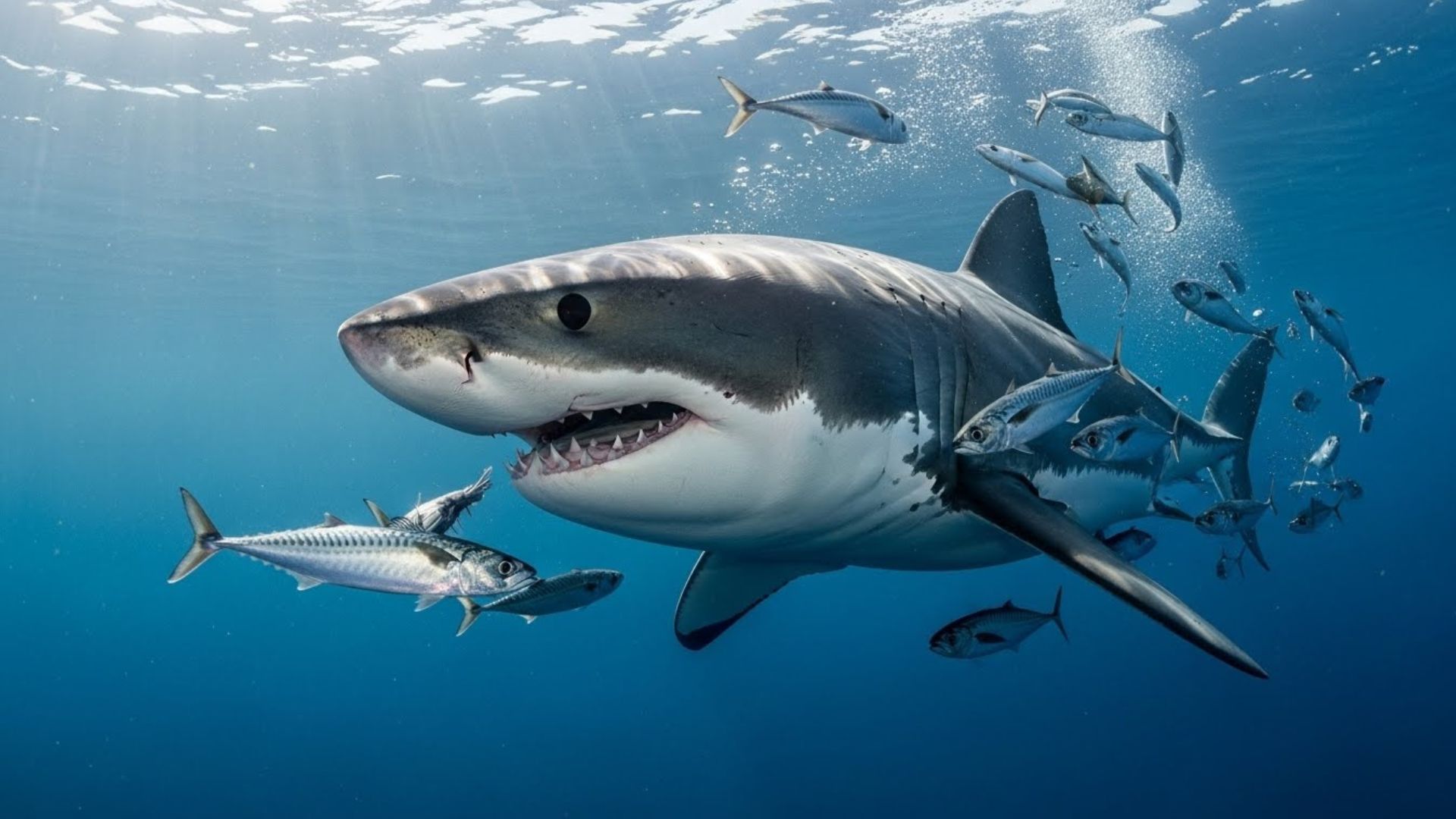
When we look at the water, it usually seems peaceful—just a big, blue blanket wrapping around the earth. But if you peek beneath the surface, the story changes completely. The ocean isn’t just a place for drifting; it is a busy, competitive world where every meal is a puzzle to be solved.
Some freshwater fish have evolved into absolute masters of strategy. They don’t just swim; they plan, they stalk, and they use incredible tricks to survive. We aren’t going to get bogged down in heavy science textbooks today. Instead, we are simply going to appreciate the clever, powerful, and sometimes strange ways these skilled hunters operate.
Be it shallow waters or coasts, these fish species hunt like experts and are apex predators in marine life. We’ll meet seven of the ocean’s most interesting hunters. Let’s wade in and take a look.
Fish That Are Expert Hunters
1. Great White Shark
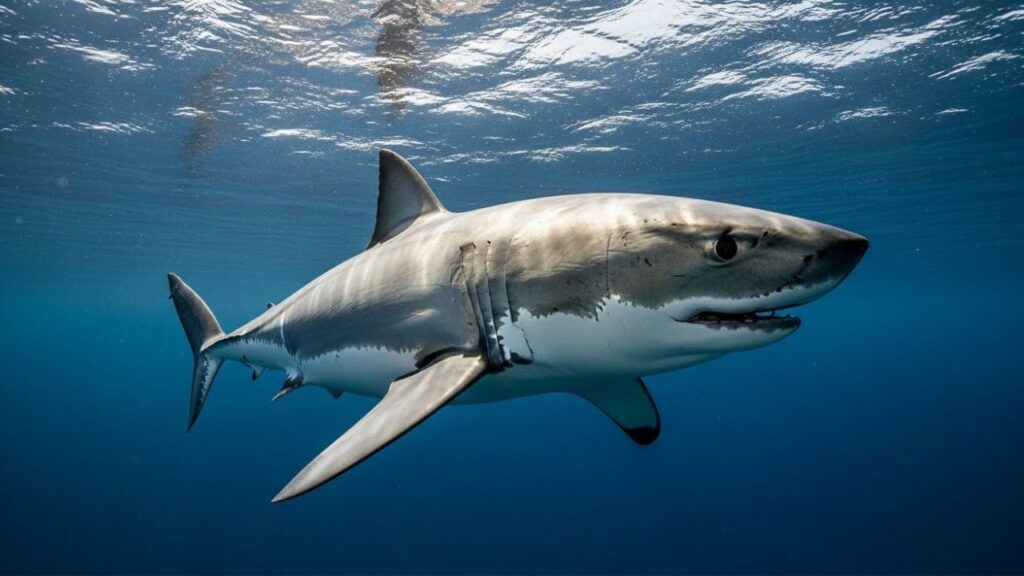
The Great White is built like a heavy, grey torpedo. It has a massive, conical snout and slate-grey skin on top that helps it blend in with the dark ocean floor when viewed from above. Underneath, it is stark white, which hides it against the bright sun when viewed from below. It moves with a slow, confident swagger that tells you it knows exactly where it sits on the food chain.
This shark (not a picky eater) prefers the element of total surprise. It patrols deep below the surface, watching for the silhouette of a seal floating above. When the moment is right, it tilts upward and accelerates with terrifying power, hitting speeds of around 20 to 25 mph.
It often hits the prey with such force that the shark breaches, launching its entire body out of the water. It’s not a long chase; it’s one massive, calculated strike designed to end the contest instantly.
Their sense of smell is almost impossible for humans to understand, honestly. A Great White has a giant olfactory bulb (the part of the brain for smelling) compared to other fish. It can detect a single drop of blood floating in an Olympic-sized swimming pool.
Despite being an apex predator always waiting for its next meal, Sharks must still watch their back from the most prominent member of the dolphin family, the Orca, which is one of the few creatures intelligent enough to hunt them.
2. Barracuda
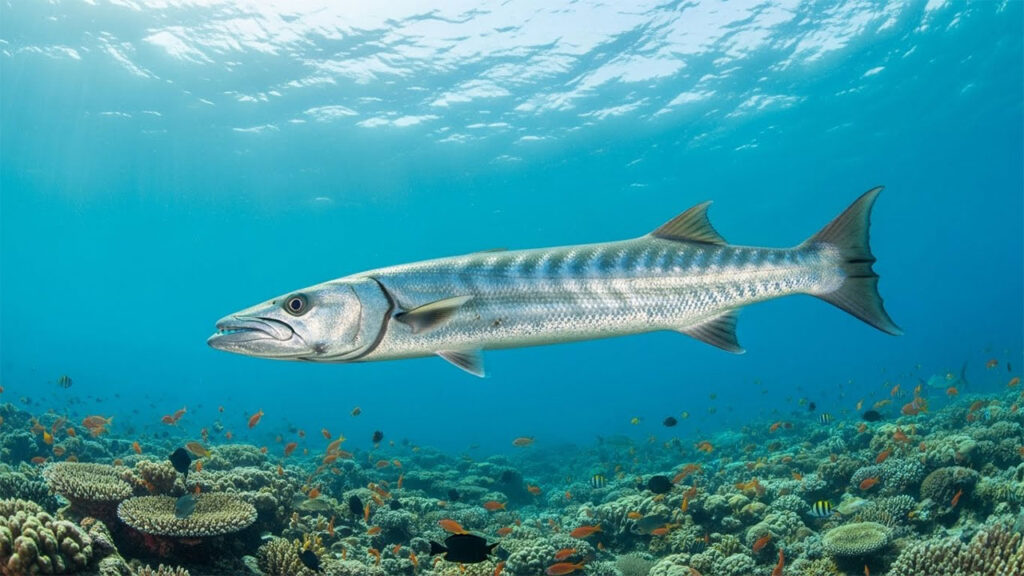
The Barracuda is long and slender, covered in scales that shine like polished chrome. Its most famous feature is its lower jaw, which protrudes farther than the upper one, giving it a permanent, grumpy underbite. This mouth is filled with razor-sharp teeth of different sizes, making it look like a messy drawer of knives.
It is not a marathon runner; it is a sprinter.
It relies on being invisible. It hangs perfectly still in the water column, waiting for a school of fish to drift by. When it spots a target, it explodes forward, reaching speeds of up to 35 mph in a split second. Britannica slices through the water, snaps its jaws shut on the prey, and the hunt is over before the other fish even know what happened.
This marine animal has a serious attraction to anything that sparkles. In the wild, the flash of silver usually means a small fish catching the sunlight, which equals dinner. This is why barracudas sometimes follow divers who are wearing diamond rings, shiny watches, or dangling metal camera clips. They aren’t trying to be mean; they think your jewelry tastes good.
Divers often get nervous when the Barracuda follows them around, its mouth slightly open, looking aggressive. But the truth is, it has to keep its mouth open to breathe correctly. That “mean mug” isn’t personal—it’s just trying to get some oxygen.
3. Giant Trevally
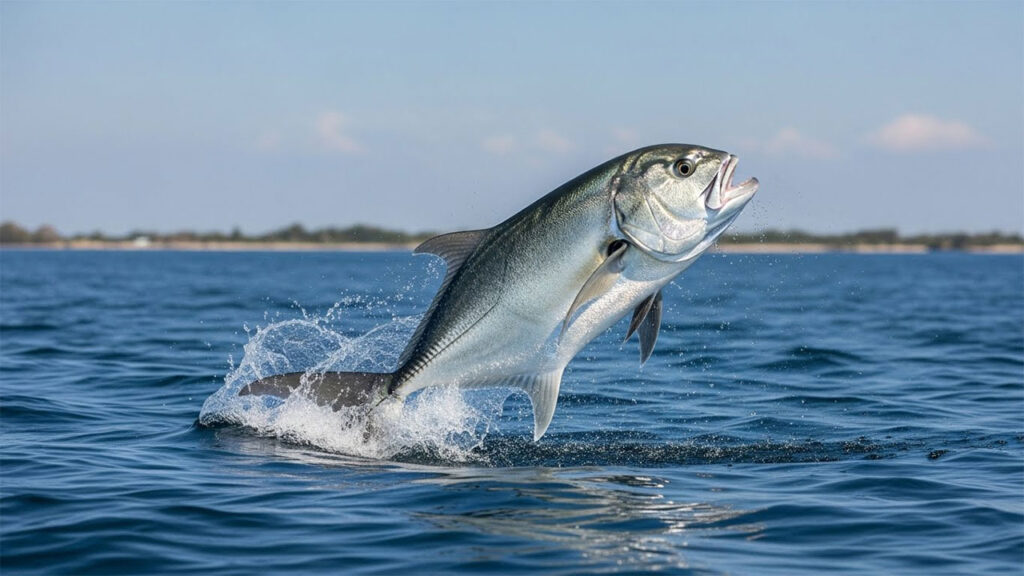
The Giant Trevally, or GT, has a tall, flat body and a steep, sloping forehead that looks like it was carved out of granite. It has a thick, robust tail base and silvery skin that can look dark or bright depending on its mood. It doesn’t hide in the shadows; it patrols the reef with a bold attitude.
Marine Sanctuary states that GTs are famous for using brute force and high energy. They often hunt in packs, terrorizing schools of smaller fish by smashing into them at high speed to create panic. But their most famous trick happens in remote places like the Seychelles. There, they actually calculate the speed and height of birds flying over the water.
It will leap entirely out of the ocean to snatch a bird out of the air. It’s a move that requires perfect timing and a lot of power.
The impact of a Giant Trevally hitting a school of baitfish is so violent that you can actually hear it. If you are underwater, or even standing on a quiet boat, you can listen to a resounding “boom” or a “crack” sound when they strike. It’s like a percussion instrument made of muscle and water.
4. Northern Pike
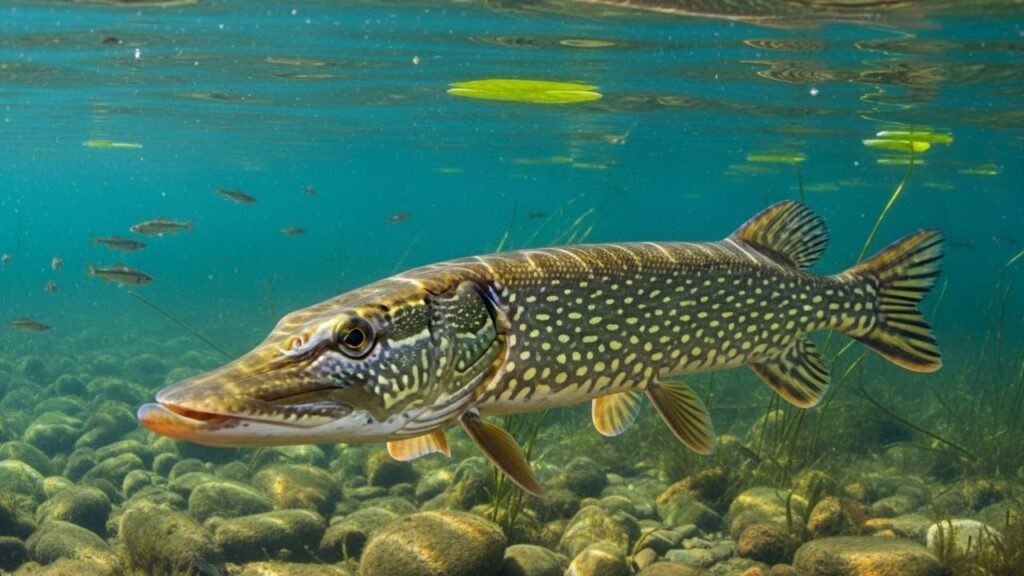
The Northern Pike is the master of camouflage in freshwater lakes. It has a long, tubular body that is olive-green with yellowish-white bean-shaped spots. This pattern makes it look exactly like the weeds and grass where it lives. Its head is flat and shaped like a duck’s bill, filled with rows of backward-facing teeth.
Pike are ambush predators that possess incredible patience. A pike will float near a log or in a weed bed, moving nothing but its pectoral fins, looking like a drifting stick. It waits for a smaller fish to swim within striking distance. Then, it curls its body into an ‘S’ shape and fires like a loaded spring. The acceleration is so fast that the human eye almost misses the moment of impact.
These fish have absolutely zero family loyalty. Pike are known for being cannibals. If food is scarce, or if a smaller pike wanders into the territory of a larger one, the big pike will not hesitate to eat its own brother or sister. In the pike world, if it fits in the mouth, it is food—even if it’s family.
Because they hunt alone and have such sharp teeth, people often call the pike the “Water Wolf.” It’s a fitting name for a solitary hunter that stalks the shallow weeds. The pike doesn’t howl, but it definitely bites.
5. Shortfin Mako Shark
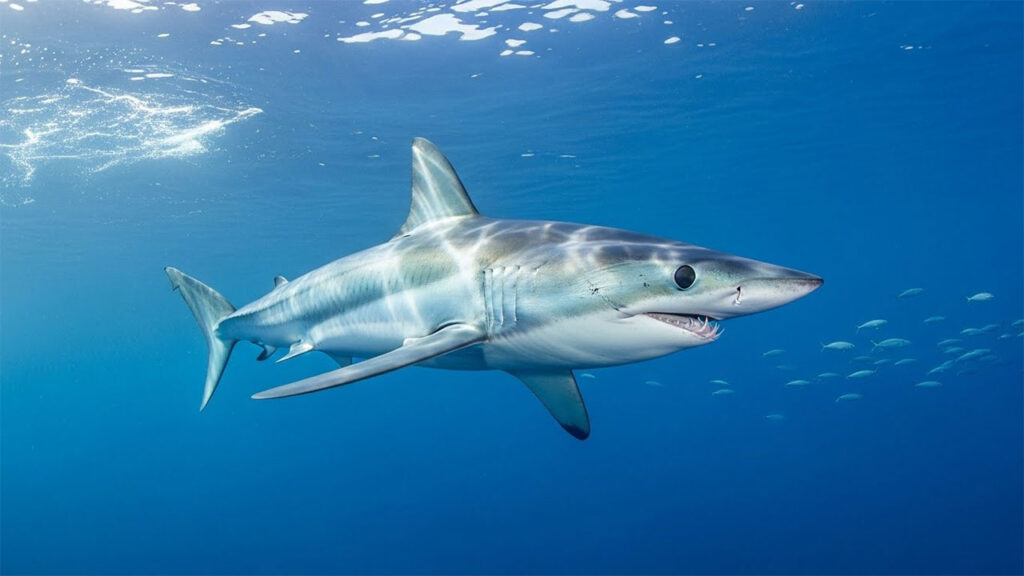
While the Great White is a tank, the Mako is a high-performance sports car. It has a very pointed snout and a slender, streamlined body designed for minimal drag. Its color is stunning—a deep, metallic cobalt blue on top that looks like liquid metal. It has large, black eyes that give it a very focused, intense expression. Everything about this shark screams “speed.”
The Mako is the fastest shark in the ocean, capable of bursts of up to 45 mph. It has to be this fast because its favorite food is tuna, which are also speedy swimmers. A Mako hunt is a high-speed chase across the open ocean. It runs down its prey from behind, often biting the tail first to disable the motor before finishing the meal.
Most fish are cold-blooded, meaning they are the same temperature as the water. The Mako is special; it has a system that recycles body heat, keeping its muscles, eyes, and brain warmer than the surrounding ocean. This “warm blood” makes its muscles work more efficiently and its brain processes information faster, giving it a massive advantage in the cold deep.
If a fisherman accidentally hooks a Mako, they are in for a wild show. This shark is famous for its acrobatics. It will leap twenty feet into the air, doing flips and spins to try and shake the hook. It is the ultimate aerial acrobat of the shark world.
6. Lionfish
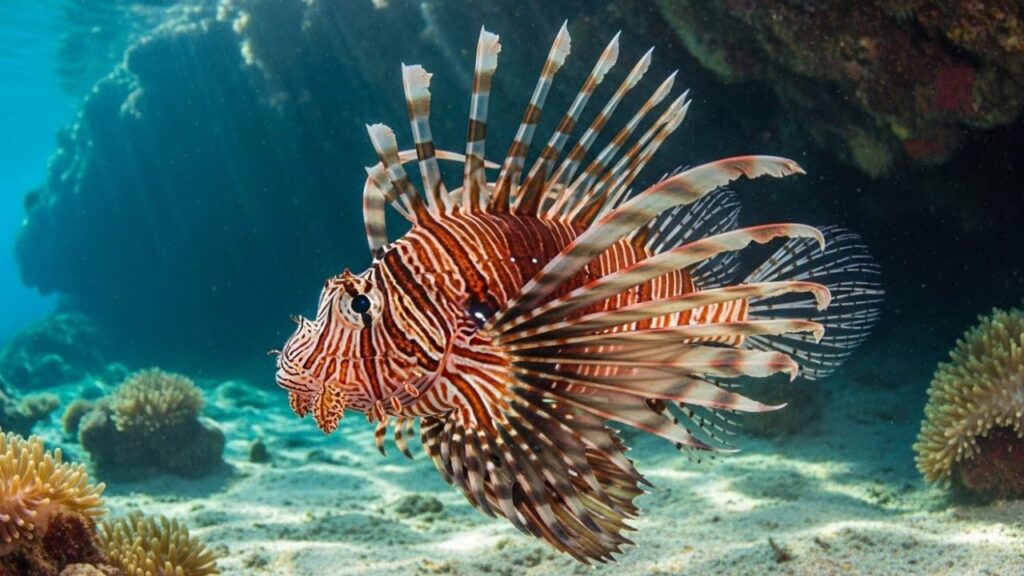
The Lionfish is undeniably beautiful, but it’s a beauty that says, “do not touch.” It has zebra-like stripes of red, white, and brown running vertically down its body. Its pectoral fins are huge and fan-like, resembling the wings of a dragon or a royal cloak. Surrounding its body are long, needle-like spines that drift in the water. It looks less like a fish and more like a floating piece of dangerous art.
It doesn’t need to be fast. It uses its large, fan-like fins to herd small fish into a corner or against a rock, blocking their escape routes. Once the prey is trapped and confused by the predator’s strange shape, the Lionfish strikes. It opens its mouth and creates a suction vacuum that pulls the water—and the fish—straight in. It happens in the blink of an eye.
Because they are a highly aggressive invasive species in the Atlantic, conservationists encourage divers to hunt them to help restore balance to the reef.
Those beautiful spines are actually hypodermic needles loaded with venom. If a predator tries to bite it or a human accidentally steps on it, the spines deliver a nasty sting. Divers report excruciating pain, often described as a burning sensation that travels up the entire arm or leg and lasts for hours.
7. Moray Eel
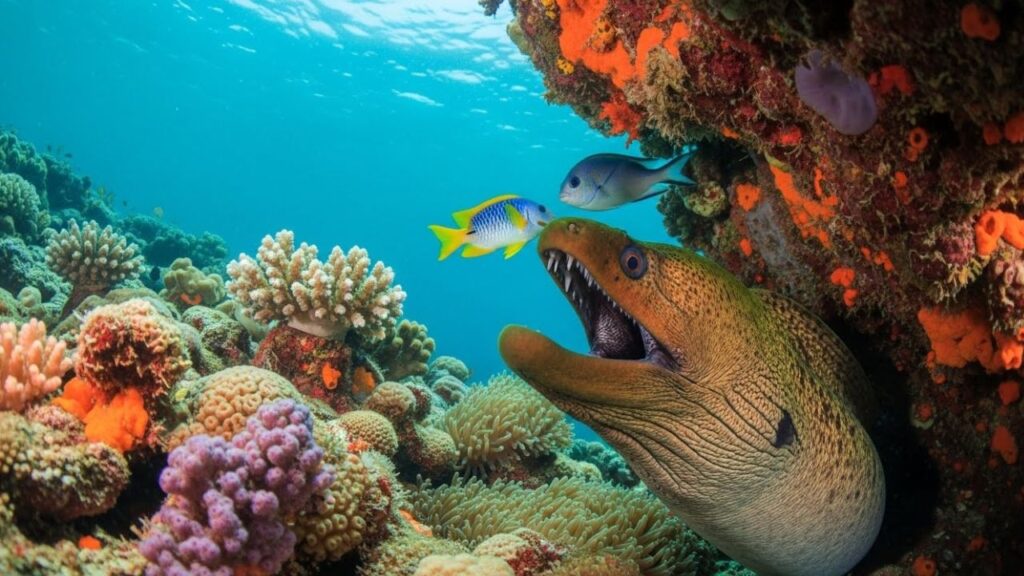
The Moray Eel looks like a sea serpent from an old map. Oceana mentions that it has a long, muscular body that lacks scales, covered instead in thick, slippery skin that is often green or spotted to blend in with the reef. It spends most of its time hidden in holes, with just its head poking out.
Its mouth constantly opens and closes, revealing sharp, curved teeth. This makes it look like it’s gasping or threatening you, but it’s actually just pumping water over its gills.
It is a master of tight spaces. It hunts by smell, sliding through cracks and crevices in the coral to find sleeping fish or octopus. Once it bites, it uses a terrifying hidden weapon. Inside its throat, it has a second set of jaws called pharyngeal jaws. These inner jaws shoot forward into the mouth, grab the prey, and pull it down into the stomach.
Despite their antisocial reputation, they sometimes team up with Groupers (a large type of bass). The Grouper will shake its head near a hole to signal the eel. It goes into the tight rocks to flush out the fish, and the Grouper waits outside to catch it.
Divers are taught never to hand-feed a Moray Eel. Their eyesight is poor, and they can’t easily tell the difference between a hot dog and a human finger. Plus, their teeth are covered in bacteria, so a bite is not only painful but also prone to infection.
Conclusion
So there you have it—seven fish and seven totally different ways to survive in the big blue. Some rely on pure speed, others on invisibility, and some on teamwork or hidden weapons. It just goes to show that the ocean is full of intelligent life, constantly adapting to survive.
Next time you find yourself watching a documentary or staring at the sea, remember these hunters. They are the reason the underwater world is so dynamic. Respect their space, protect their habitat, and stay curious—there is always something new to learn beneath the waves.
