




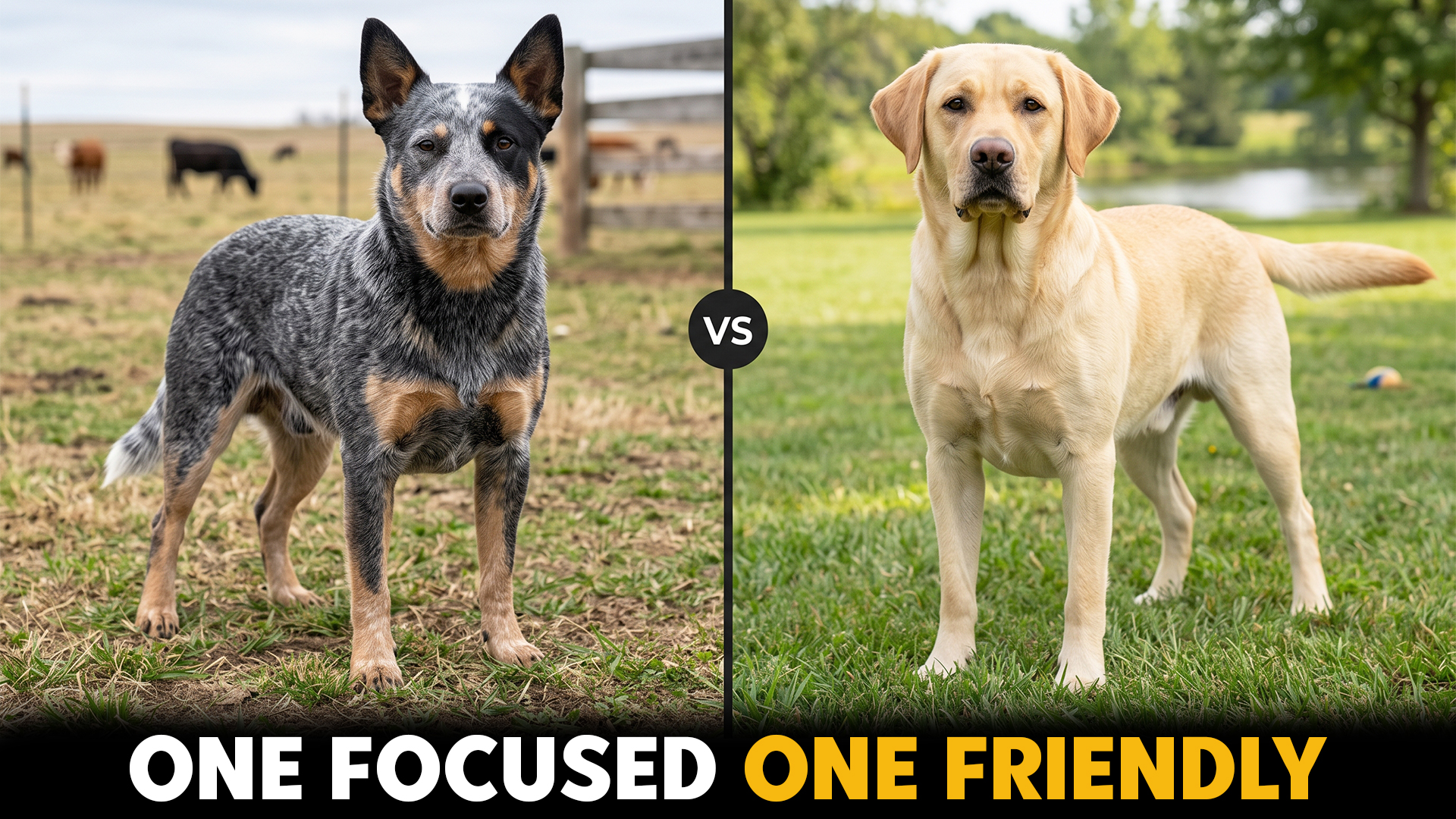
One dog was built to outthink a stampede. The other was built to outswim a duck hunt. Put them side by side, and the differences start before you even open the gate.
Choosing between an Australian Cattle Dog and a Labrador Retriever is really choosing between two philosophies of dog ownership. One rewards owners who want a working partner glued to their every move. The other rewards owners who just want a happy, four-legged shadow around the house.
People searching for either breed usually land here for the same reason: both dogs are brilliant, both are endlessly loyal, and both get recommended constantly, yet they could not feel more different day to day.
This guide breaks that difference down category by category, from build and energy to training style and household fit, with real numbers instead of guesswork.
By the end, you will know exactly which paw print belongs on your doorstep.
Australian Cattle Dog vs Labrador Retriever Dog
Australian Cattle Dogs and Labrador Retrievers are both smart, active breeds, but they differ in temperament, energy, and everyday care. This side-by-side comparison highlights their key traits to help you see which breed may fit your lifestyle better.
Origins & Purpose
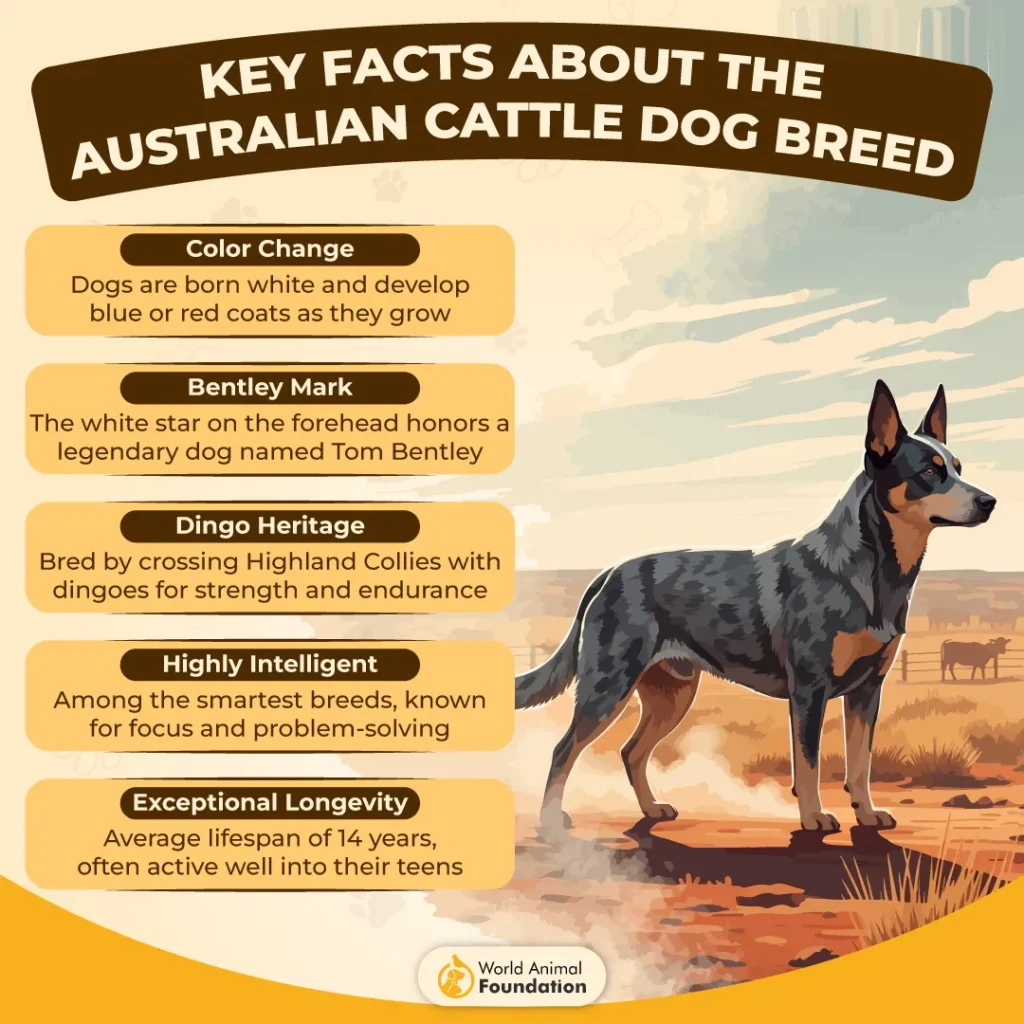
1980 marks the year the American Kennel Club finally welcomed the Australian Cattle Dog into its ranks, generations after Australian settlers first needed the breed on the job. According to the AKC, the dog descends from the Dingo, and that heritage shows in every sharp glance it gives a stranger. Most people simply call it a Blue Heeler, a nod to the work it was bred for.
Herding wild cattle across rugged Outback terrain meant one error cost real money, so breeders selected for independent thinking over blind obedience. The result is a dog clever enough to routinely outsmart its own owners. Function shaped nearly every inch of this breed.
1917 is when the Lab’s own Kennel Club story begins, though its roots trace back further. VCA traces the breed to the Lesser Newfoundland, a sturdy water dog that hauled fishing nets off the Canadian coast before sailors carried it to England in the early 1800s.
English sportsmen refined the dog into a dedicated retriever, and it has held the title of America’s most popular breed since 1991, a streak the Heeler has never touched. The Heeler was engineered to herd; the Lab, to retrieve and please people.
That founding job still explains the behavior you see in the yard today.
Size & Physical Build
A full-grown Labrador can outweigh an Australian Cattle Dog by 30 pounds and still be considered lean. These are genuinely different builds, not just different numbers on a scale.
Cattle Dogs stand 17 to 20 inches at the shoulder and settle between 35 and 50 pounds, a compact and muscular frame low enough to duck under a kicking hoof. That low center of gravity is a working tool, not an accident.
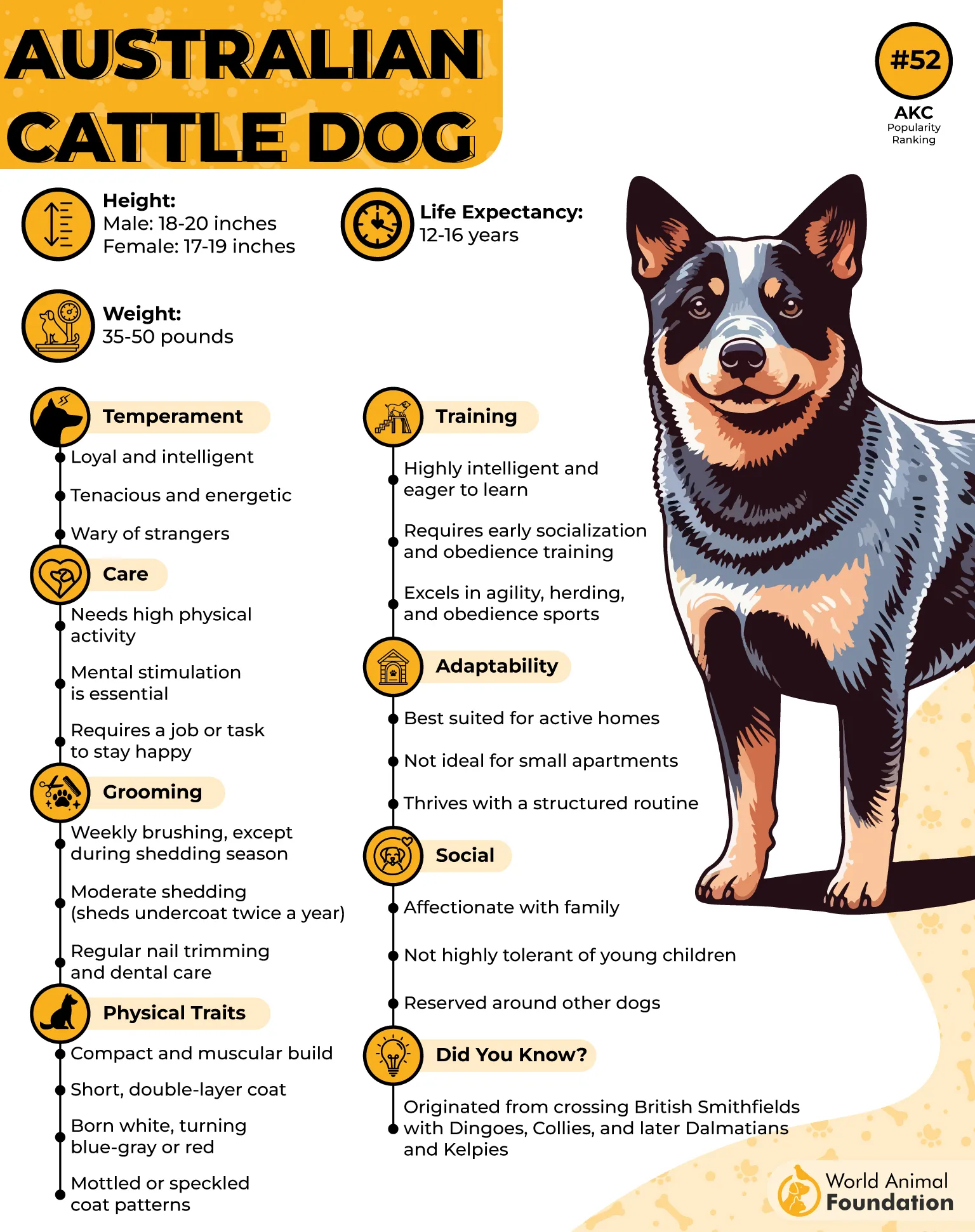
Labradors stand taller at 22 to 25 inches and carry 55 to 80 pounds on a broader, barrel-built chest. The otter-like tail and webbed paws point straight back to a life spent retrieving from cold water, not working dusty paddocks.
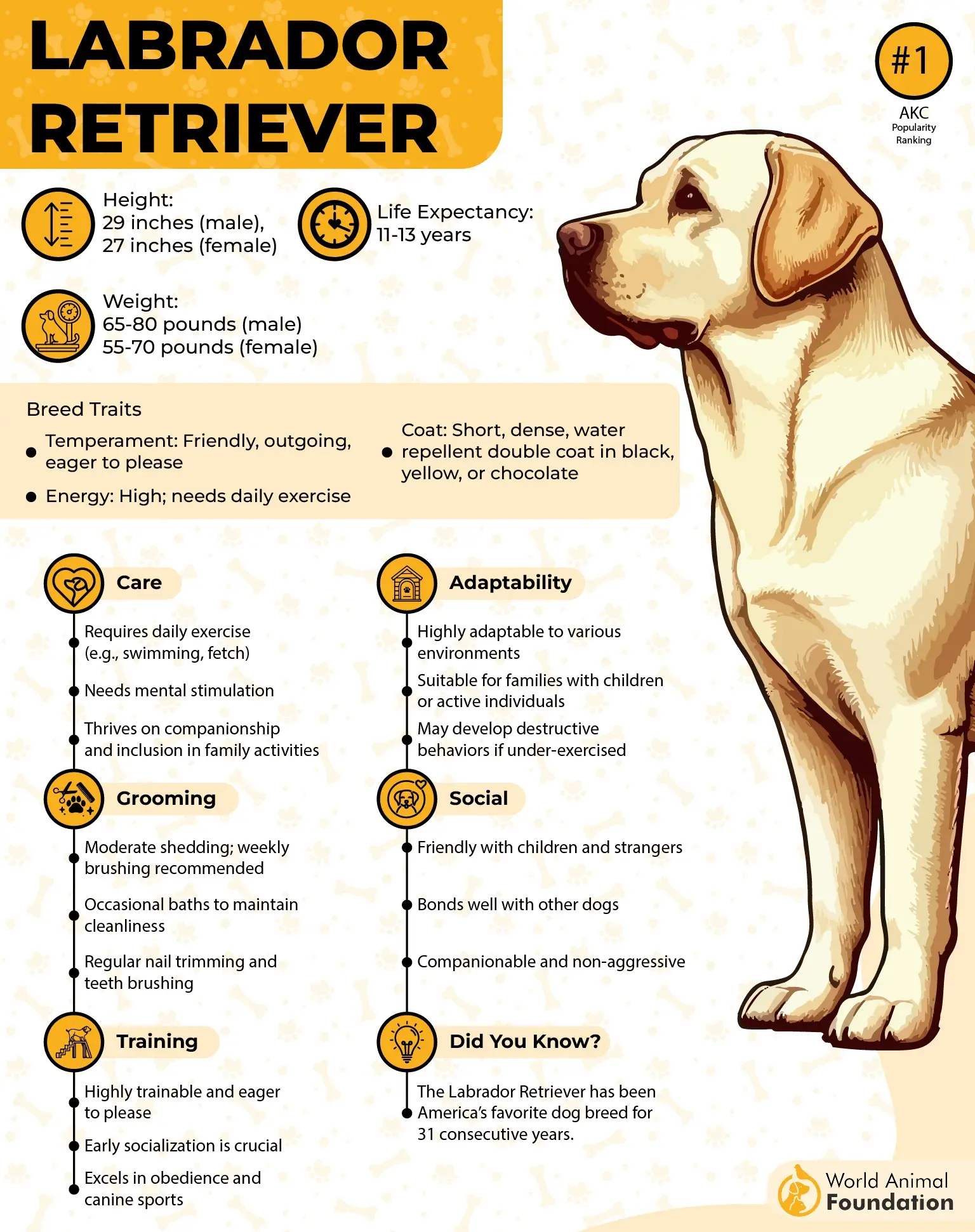
Color tells its own story too. The Cattle Dog comes only in blue or red speckle, while the Lab arrives in black, yellow, or chocolate, with black remaining the breed’s classic, most photographed shade.
Pick the Heeler for compact power, or the Lab for sheer, sporting scale.
Temperament & Personality
Would you rather come home to a dog that is quietly evaluating your guest, or one that is already fetching them a toy? That single question tells you most of what you need to know about these two breeds’ personalities.
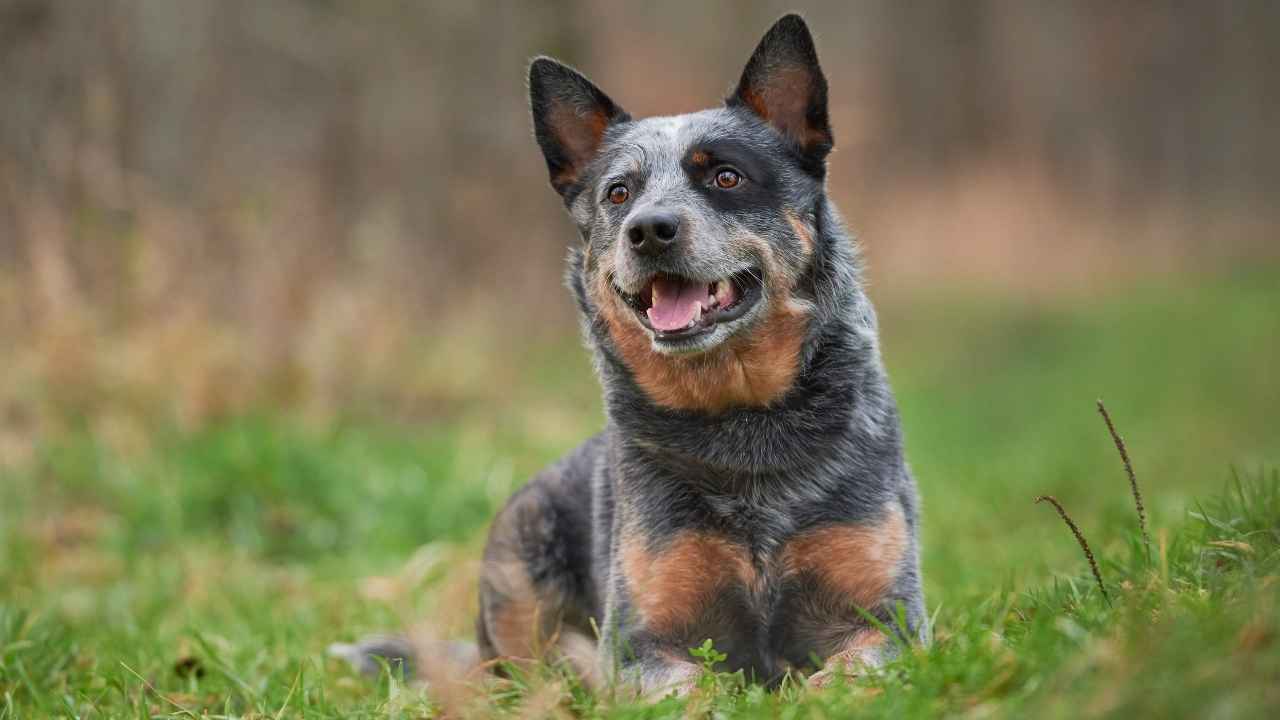
The Cattle Dog is naturally suspicious of strangers and fiercely loyal to its own family, a trait bred in for a reason. That watchfulness often starts back in the litter itself, long before a puppy ever meets a stranger, which is why early socialization matters so much for this breed.
The Labrador takes the opposite approach to life. It greets strangers like old friends, gets along easily with other dogs and pets, and carries what breeders describe as a genuinely good-natured, unbothered attitude through most situations.
Owners of working line Heelers often mention a herding instinct that surfaces around children, a gentle nip meant to move the flock, which is really just the kids. Labrador owners rarely report anything close to that behavior.
One dog watches the door. The other one answers it.
Exercise & Energy Levels
40 minutes a day is the baseline Labrador exercise requirement according to Hill’s Pet, and most Lab owners will tell you that number is a gentle suggestion at best.
Labs carry a sporting dog’s stamina and love swimming, fetching, and long walks in roughly equal measure. Skip the activity and that same dog redirects all that energy into chewed furniture.
The Australian Cattle Dog plays in an entirely different league. PDSA puts the minimum at over 2 hours of exercise daily, and anything less tends to show up as digging, barking, or a dog that reorganizes the garden without permission.
Labrador Retriever: At least 40 minutes of walking, swimming, or fetch, built around a food-motivated, eager attitude.
Australian Cattle Dog: Over 2 hours of vigorous activity plus a job to do, or the energy finds its own outlet.
Match the energy wrong in either direction, and you get a bored dog. Match it right, and you get a genuinely happy one.
Training & Intelligence
Both of these breeds are smart. How that intelligence shows up at training time is where they split completely.
The Cattle Dog thinks for itself first and asks permission second, a habit inherited directly from its herding work. One dog of this breed, known as Skidboot, became famous enough to be called the smartest dog in the world after learning tricks far beyond basic obedience.
Labradors flip that script entirely. Bred to retrieve exactly what a hunter pointed at, the breed is wired to look to people for direction, which makes it one of the most consistently trainable breeds around.

Consistency and positive, reward-based methods work for both dogs, though a Cattle Dog needs a firmer, more confident handler to avoid a battle of wills. A Lab mostly just needs a reason to believe a treat is coming.
Independent thinker meets eager student, and somehow both graduate at the top of obedience class.
Coat Maintenance
Ever wonder why a short-haired dog can still leave fur on every black sweater you own? Meet the double coat, the quiet culprit behind most dog-related laundry complaints.
Both the Cattle Dog and the Labrador carry a dense, weatherproof double coat that blows out twice a year, once in spring and once in fall, dropping a noticeably heavier volume of loose hair than their everyday shedding.
Day-to-day upkeep differs only slightly between the two breeds.
Australian Cattle Dog: A once weekly brushing session clears out loose hair, and shedding stays minimal between the twice-yearly blowouts.
Labrador Retriever: Also needs weekly brushing, stepping up to near-daily sessions once shedding season hits, since the coat sheds at an average to above-average rate.
Bathing stays infrequent for both breeds since natural oils repel dirt and water, so frequent washing actually strips that protection rather than improving it.
Health & Lifespan
29 years and 5 months is the official Guinness World Record for the oldest dog that ever lived, and the title holder, named Bluey, was an Australian Cattle Dog. Most of the breed will not come close, but it hints at serious genetic toughness.
A typical, healthy Cattle Dog lives 12 to 16 years, per Britannica. The breed can face a short list of inherited concerns, mainly progressive retinal atrophy, inherited deafness, and occasional hip dysplasia.
Labradors run a shorter average course at 10 to 12 years. WebMD flags exercise-induced collapse as a breed-specific risk, where warm weather activity can trigger weakness and collapse within 5 to 20 minutes.
Australian Cattle Dog: Progressive retinal atrophy, inherited deafness, and occasional hip dysplasia.
Labrador Retriever: Hip and elbow dysplasia, a tendency toward obesity, and exercise-induced collapse in warmer conditions.
Neither breed is fragile, but both reward owners who keep a close eye on weight and joints.
Australian Cattle Dog vs. Labrador Retriever: Suitability as Family Pets vs. Guard Dogs
Neither of these breeds reads as a classic guard dog on paper, yet one of them will absolutely challenge that idea in practice.
The Cattle Dog takes its watchdog role seriously without any training at all. Natural wariness of strangers, a purposeful bark, and fierce loyalty to its own people add up to a dog that genuinely deters trouble, even though it was never bred specifically for protection work.
The Labrador was built for the opposite job entirely. Friendly toward literally everyone who walks through the door, the breed makes a wonderful family companion but a famously unconvincing guard, happier helping a stranger find the treat jar than chasing them off.
Families with lots of young kids and a steady stream of visitors tend to lean Lab. Owners wanting a watchful presence around the property, with a dog that still curls up with the family at night, tend to lean Cattle Dog.
Either way, you are getting a loyal companion. You are just choosing how loudly it announces visitors.
Conclusion
The Australian Cattle Dog and the Labrador Retriever both come from working stock, yet they ended up as near opposites. The Heeler brings 2-plus hours of daily drive, sharp instincts, and a watchful edge, built for owners who want a partner, not a houseplant. The Lab brings 40-plus minutes of easygoing energy, instant friendliness, and a tail that rarely stops.
Neither breed is the wrong choice, only the wrong fit for the wrong home. Pick the Heeler for guard instinct and nonstop activity, or pick the Lab for warmth and lots of family fun. Either way, you are bringing home a loyal companion for 10 to 16 good years.
