




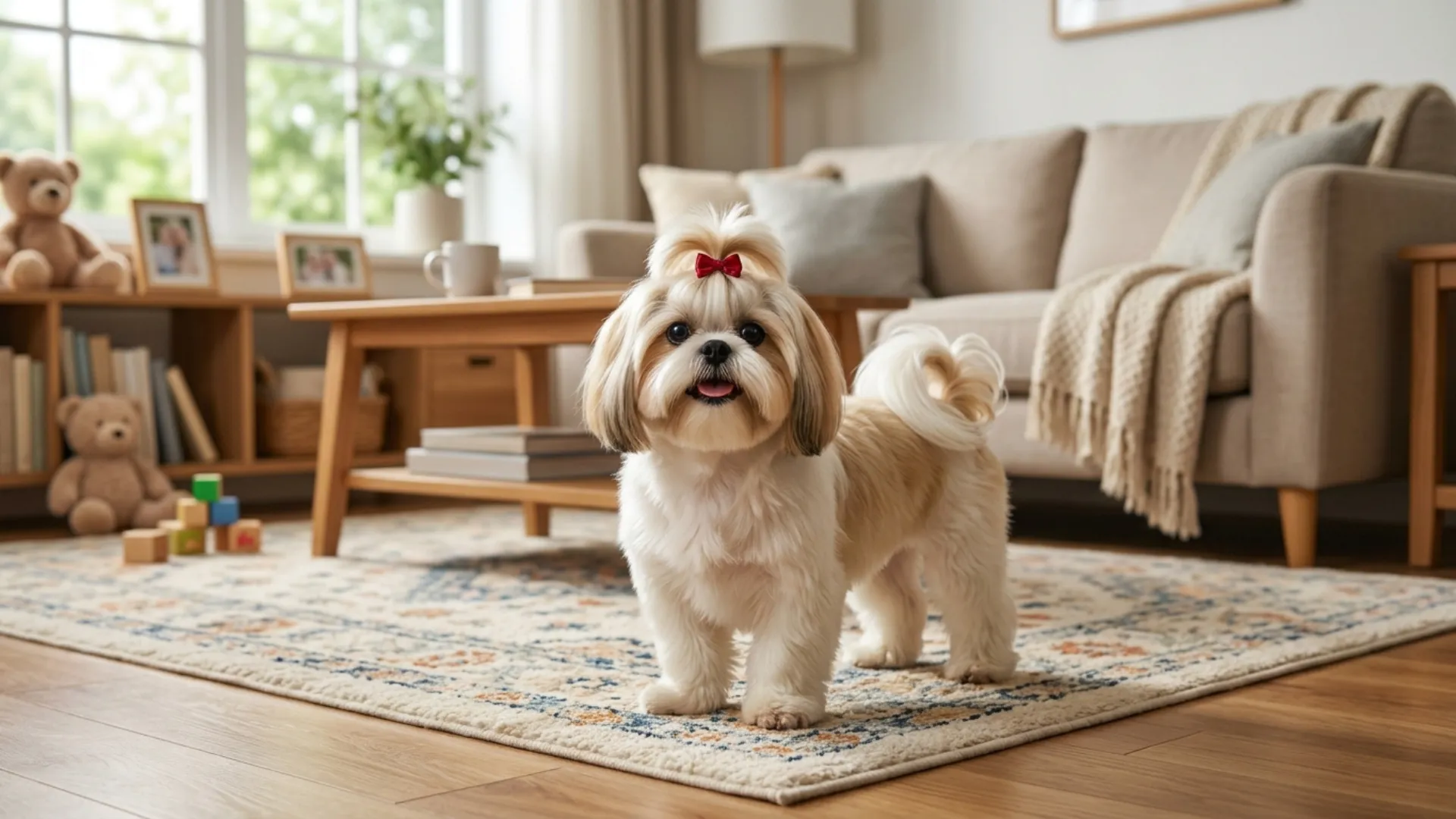
You want a dog. In fact, your kids have been begging for a puppy since last Christmas. But the thought of finding stray fur in your morning coffee, all over your couch, and somehow even inside your fridge? Hard pass.
Fortunately, low-shedding dog breeds are a total game-changer. They are the perfect solution for families who are tired of constant cleanup or managing irritating pet allergies. Choosing a low-dander breed saves you hours of vacuuming time and keeps environmental allergens at bay, allowing you to enjoy pet ownership without the non-stop mess.
According to recent data from the American Pet Products Association, nearly 95 million U.S. households own a pet, and dogs lead the pack every single year. But if you value a tidy home, the real trick is finding a pup that is warm, kid-friendly, and kind to your vacuum cleaner.
If you are ready to find the perfect match for your clean household, here are seven wonderful, low-shedding dog breeds your family will fall completely head-over-paws for.
Wonderful Low-Shedding Dog Breeds for Families
1. Bichon Frise
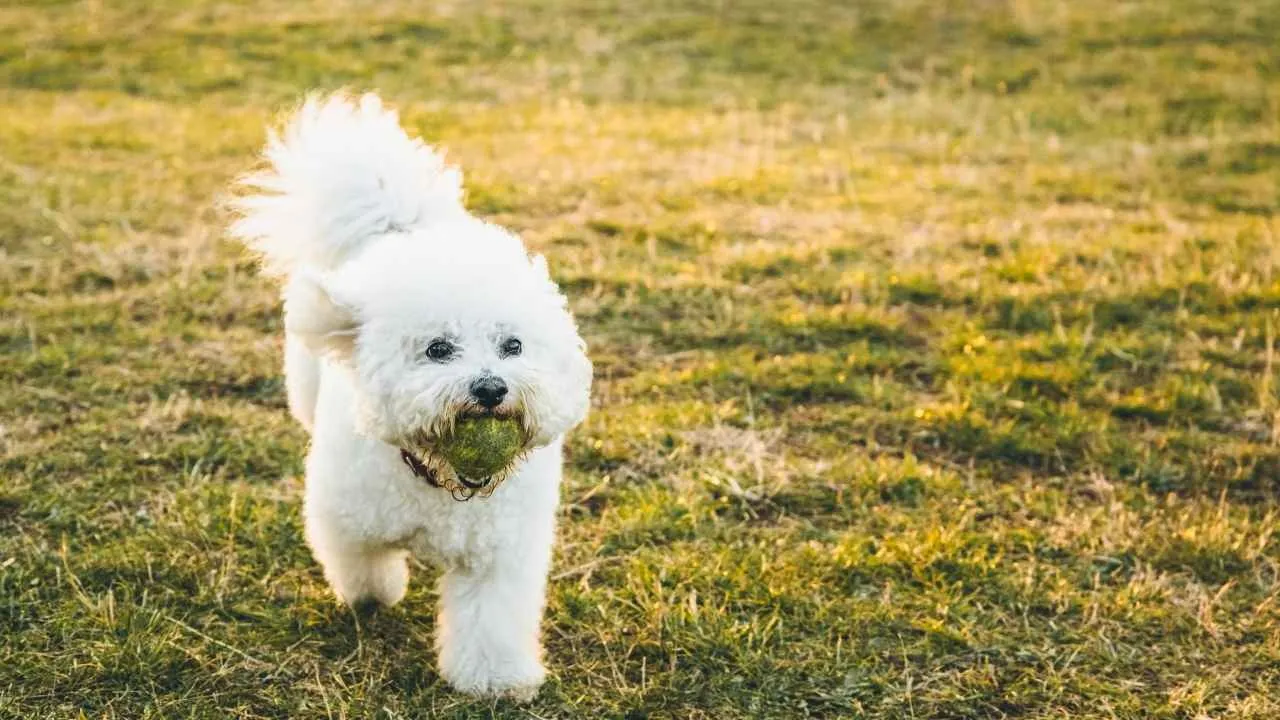
Originally bred in the Mediterranean centuries ago, this breed was eventually brought to Europe by sailors in the 14th century. Today, this excellent therapy dog has even been depicted in the royal historical paintings of Spain and France. Once a treasured royal lapdog, the Bichon Frise unfortunately had to adapt to life on the streets for survival after the French Revolution, according to Purina UK.
Their iconic, plush, velvety coat consists of a dense, curly outer coat and a soft undercoat. Puppies are usually born pure white and slowly start developing subtle shades of apricot, cream, and buff within their first year.
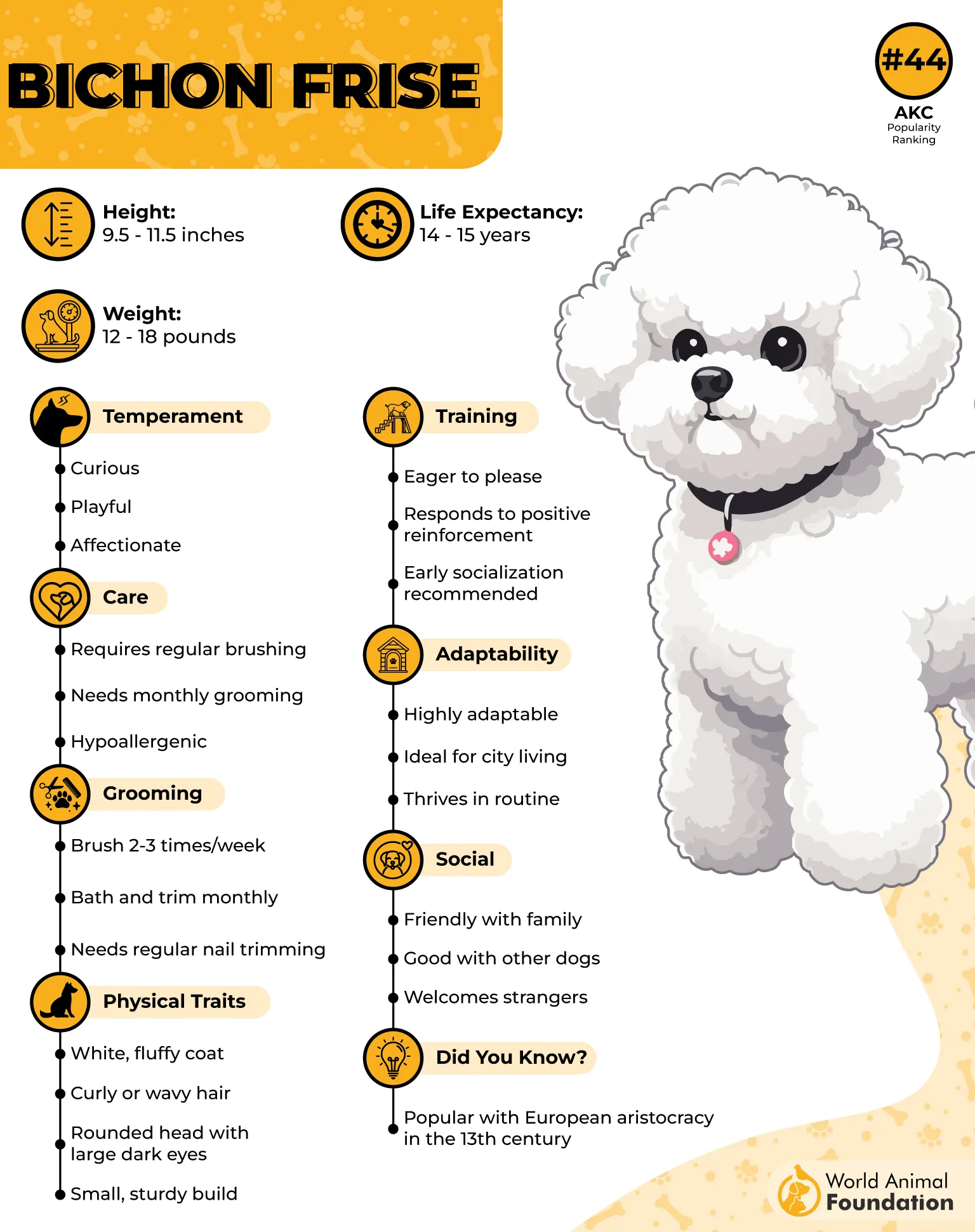
While their hair continuously grows, it sheds minimally, making them a fantastic hypoallergenic dog breed. Any loose hair naturally traps within the curly outer coat rather than falling onto your furniture.
Regular grooming requirements include daily brushing using a slicker brush and a metal comb, paired with a detangling spray to prevent hair breakage and painful matting. You should never let this breed air dry; instead, always use a pet blow-dryer while gently brushing through the coat. Finally, a routine monthly bath is recommended to keep their white fur looking pristine.
2. Miniature Poodle
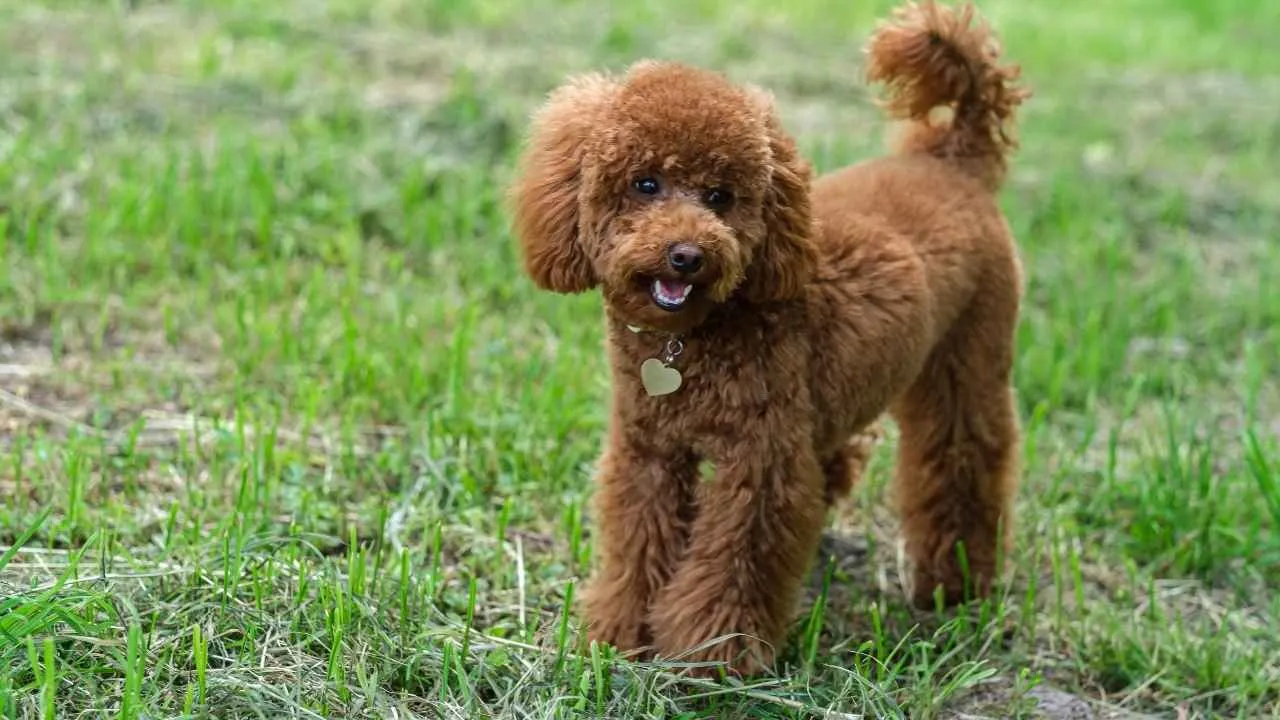
The Poodle is widely recognized as one of the smartest dog breeds in the world. Originally developed in Germany as a rugged water retriever, the Poodle comes in three distinct size varieties: Standard, Miniature, and Toy.
Its name is actually derived from the German word Pudelin, which translates to “to splash.” Beyond their intelligence, this breed boasts a lifespan of 10 to 18 years, making them one of the longest-living dog breeds.
Their uniquely dense, wiry coat completely lacks an undercoat. While adult Poodles sport tight, springy curls, puppies possess a much softer, wavy “cloud coat.” This wavy texture naturally transitions into a proper curly adult coat between 9 and 18 months of age.
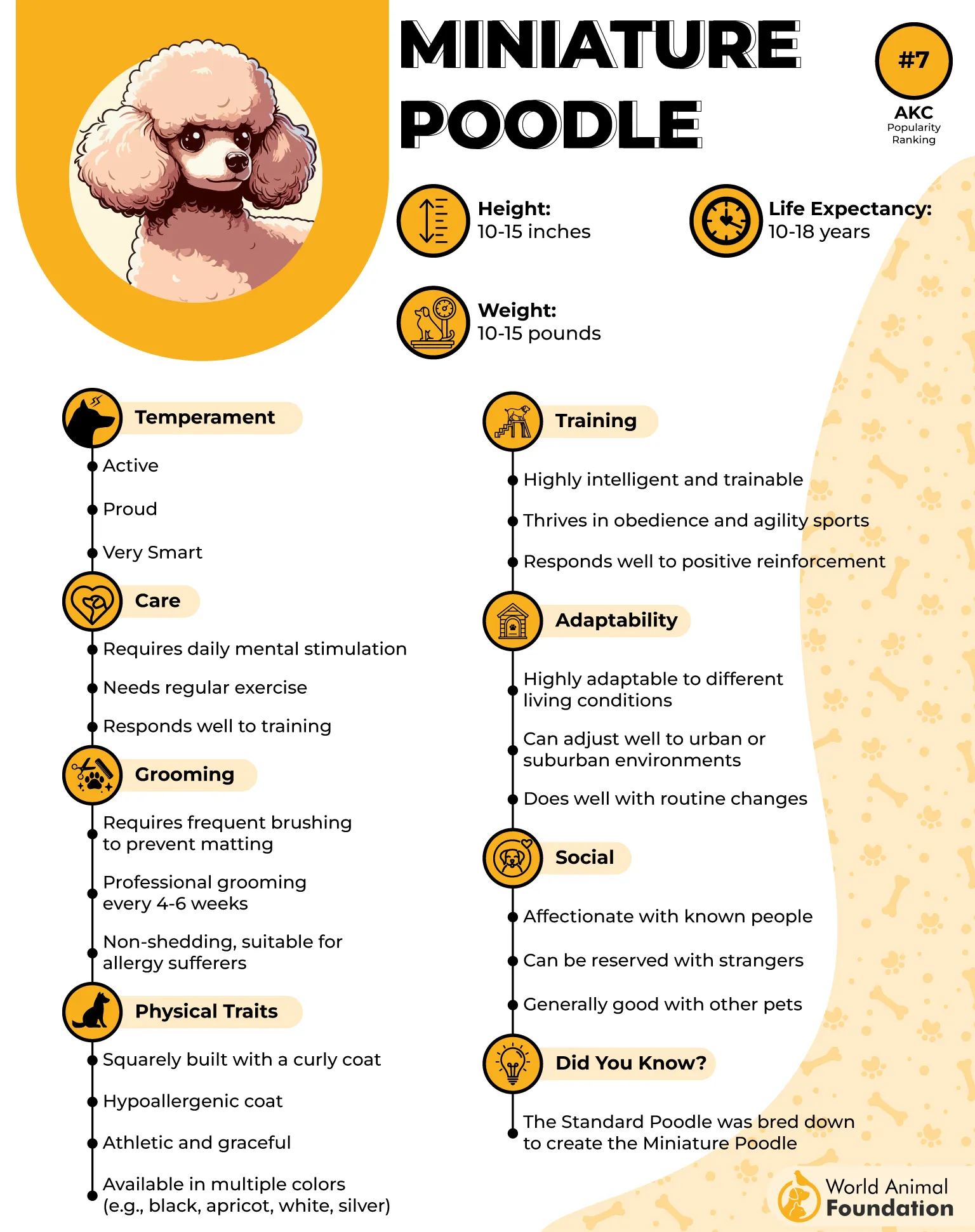
The breed’s versatile coat comes in a wide array of solid colors, including black, white, silver, grey, cream, apricot, red, silver-beige, and brown, as well as striking multi-color patterns like phantom, parti, and brindle.
Because Poodles have single-layered hair instead of traditional fur, their coat grows continuously and sheds minimally. To keep this companion dog looking its best, they require regular (ideally daily) brushing and professional grooming every 4 to 6 weeks.

For the best results, owners should use a slicker brush followed by a metal greyhound comb, adopting the “line brushing” technique to get down to the skin and prevent painful matting.
3. Shih Tzu
This affectionate breed was originally developed in Tibet by crossing the Lhasa Apso and the Pekingese. The goal was to create a small companion with an alert nature that resembled a miniature lion, an animal that holds a sacred place throughout Chinese culture. True to this history, the breed features thick hair around the neck that creates a striking, mane-like appearance, as noted by PetMD.
Their dense double coat consists of a long, silky outer coat and a soft, insulating undercoat. Puppies are born with a short, single-layered coat, with the transition to their adult fur beginning around one year of age.
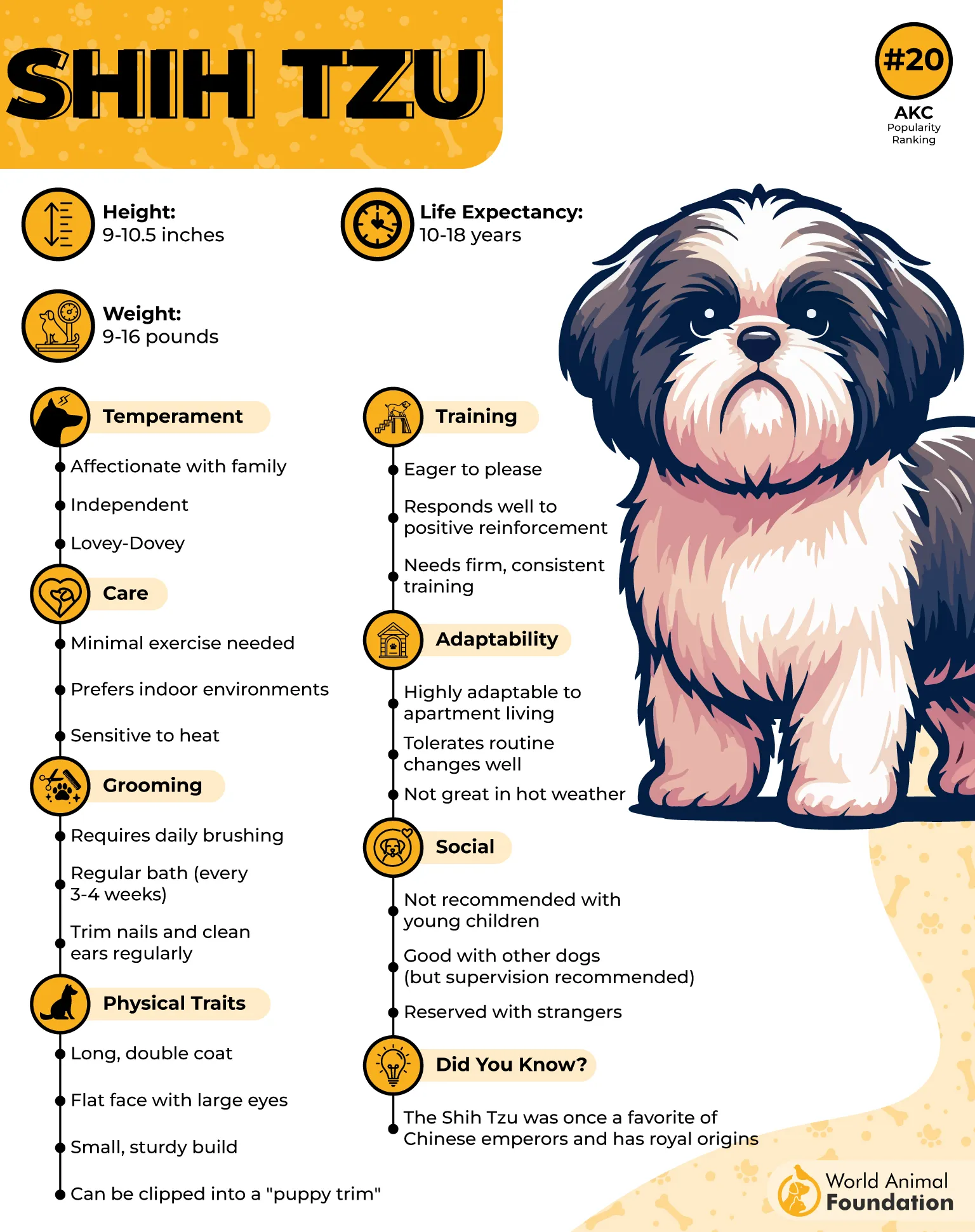
The breed boasts 14 standard colors, including silver, red, black, gold, and various multi-color combinations. For easy maintenance, many owners opt for a short, even haircut; however, if the coat is kept long, the head hair is typically tied into a topknot to prevent eye irritation.
Though this breed is considered hypoallergenic, their low-shedding hair requires consistent grooming. You should brush them daily using a pin brush or a slicker brush, followed by a metal greyhound comb to ensure the coat is entirely free of mats and tangles.
When grooming, pay special attention to high-friction zones, such as the armpits, behind the ears, under the chin, inner thighs, and around the belly, where knots are most likely to form.
4. Havanese
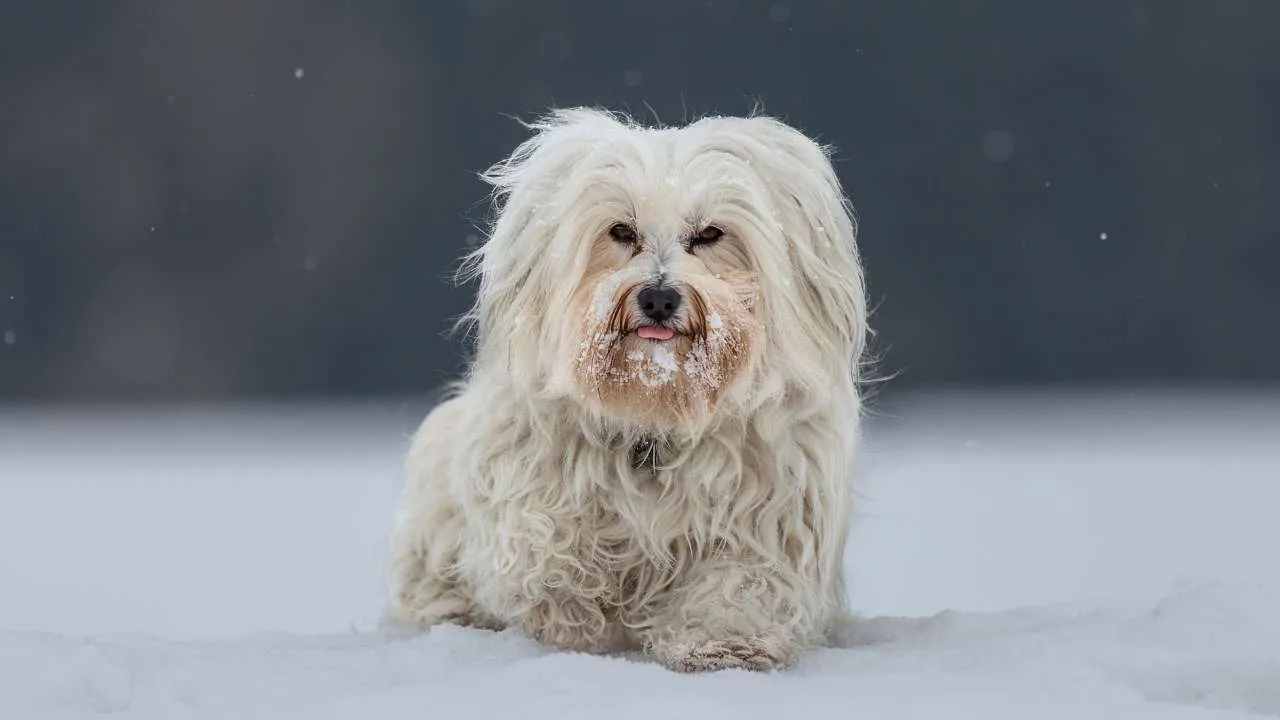
The national dog of Cuba, the Havanese is a charming bichon-type dog that was originally developed by crossing the now-extinct Blanquito de la Habana with the Poodle. Once widely known as the “Havanese Silk Dog,” its famously friendly disposition makes it an excellent worker in agility performance, assistance, therapy, and signaling roles.
It features a remarkably silky double coat and is widely considered a low-shedding dog breed. Unlike many double-coated breeds, both the undercoat and outer coat are incredibly soft. This coat’s texture can vary widely, ranging from bone-straight or gentle waves to tight, curly ringlets.
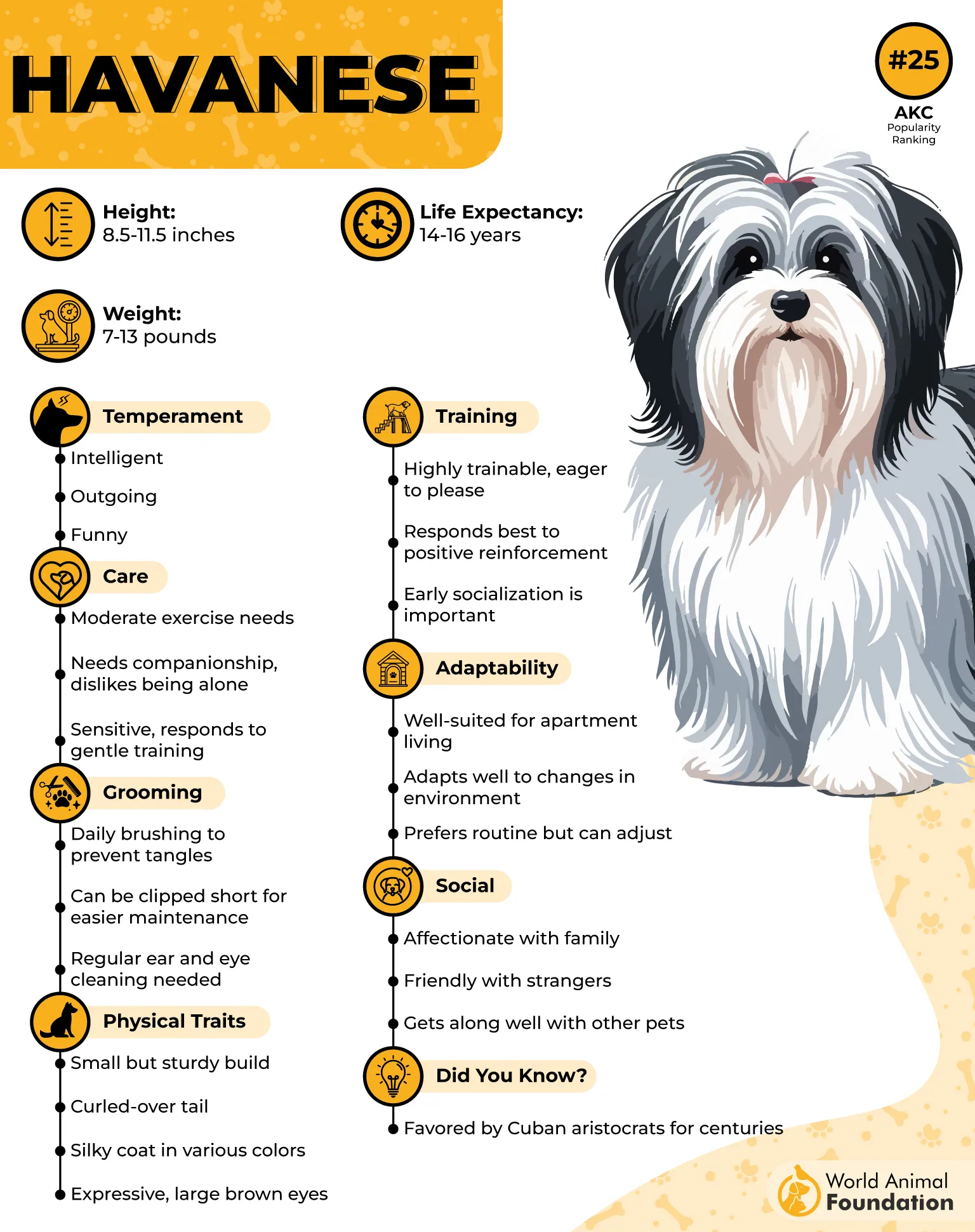
Fascinatingly, their coat acts as a natural thermoregulator by trapping air between the layers, providing a cooling effect in the summer heat and insulation during cold winters.
The initial puppy coat is soft and plush, and it naturally sheds out during the first year to make room for the adult double coat. The fur is highly prone to matting during this transitional phase, making daily brushing absolutely essential. It ultimately takes about 3 to 4 years for the dog to fully acquire its adult coat, which can eventually reach an impressive length of 6 to 10 inches.
5. Yorkshire Terrier
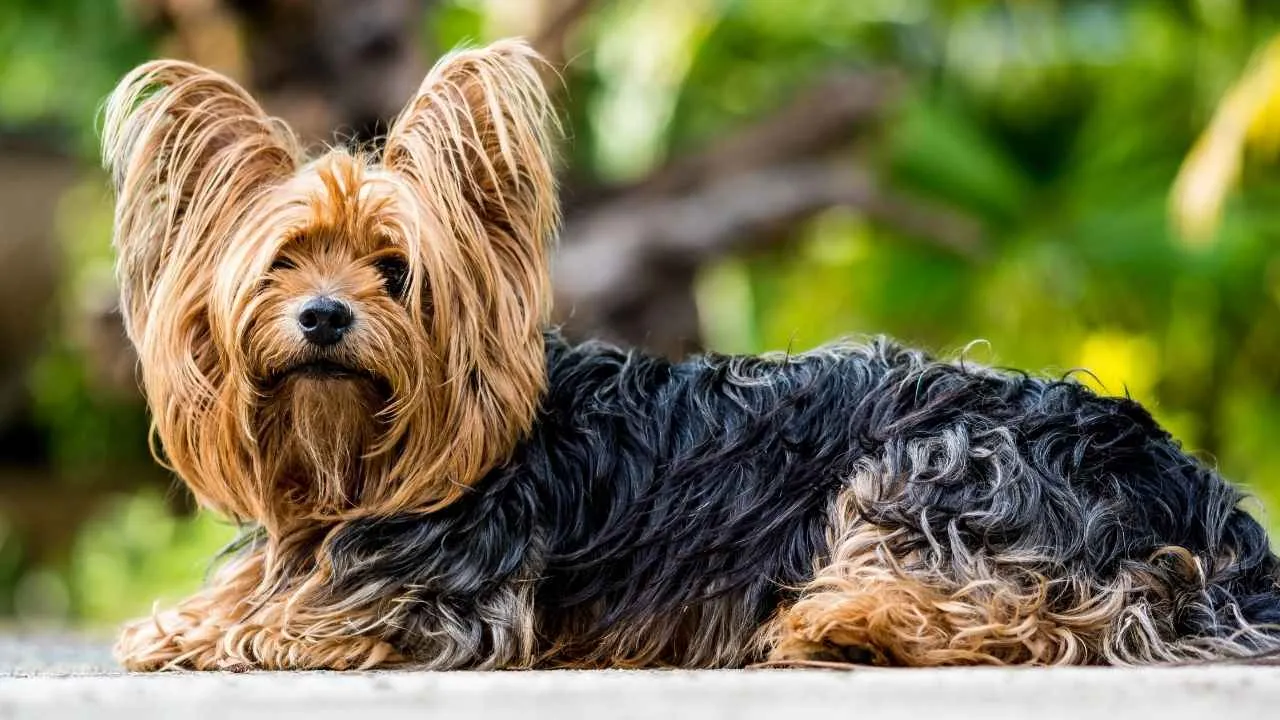
Scottish weavers migrated to Yorkshire during the Industrial Revolution in the 1850s, bringing their local small terriers with them. They crossbred these dogs with local English terrier breeds, eventually developing the small but mighty Yorkshire Terrier. The breed’s primary job was to hunt down rodents and rats in cotton mills by burrowing into tight spaces.
The Yorkie boasts a glossy, silky coat that sheds minimally, making it an ideal choice for allergy sufferers. True to breed standards, the coat has absolutely zero woolly or wavy texture. While puppies are born almost entirely black and tan, they gradually transition into their adult coat colors, a stunning combination of deep steely blue and rich golden tan.
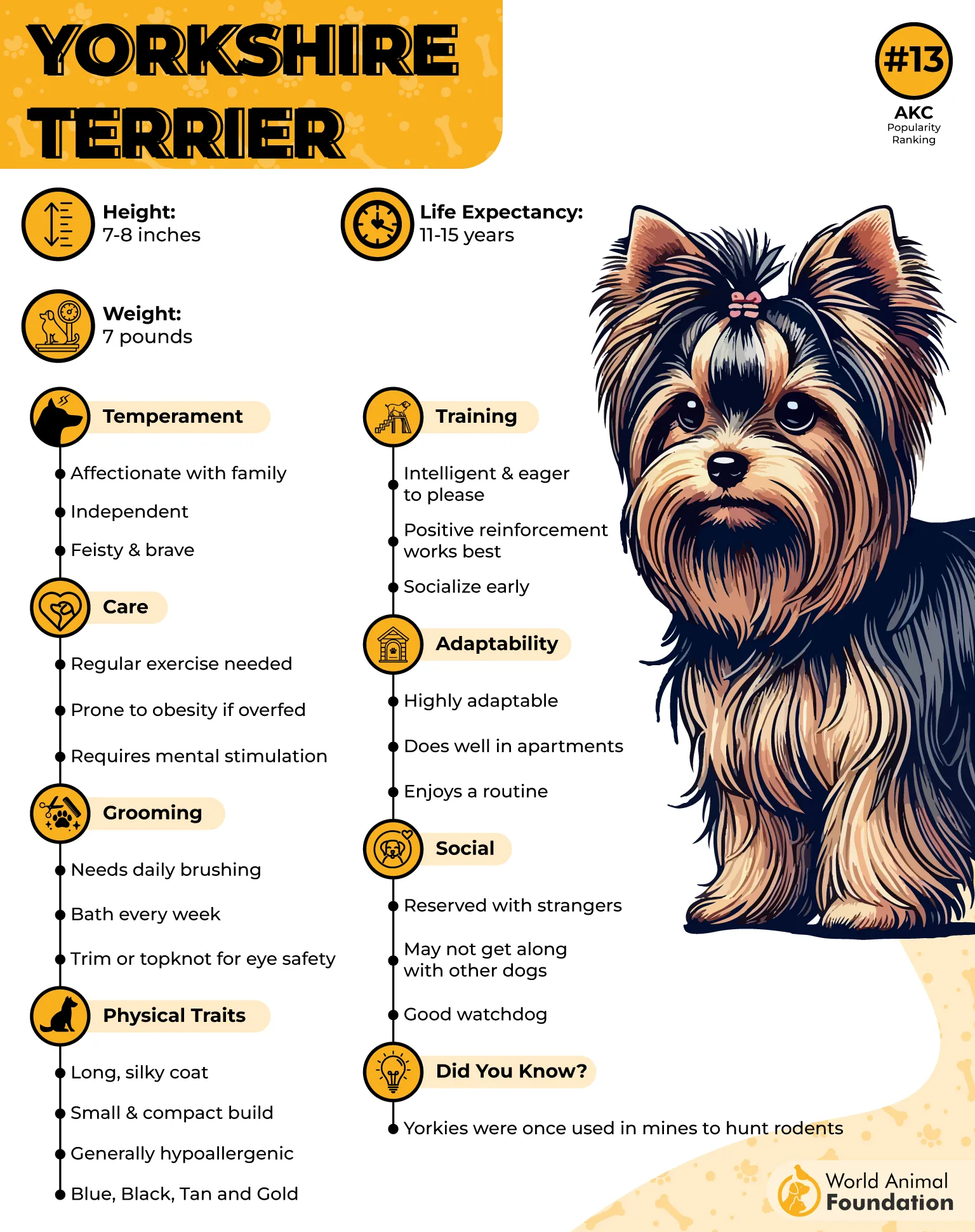
Though this hypoallergenic breed is low-shedding, it does require regular grooming to maintain its hair-like coat. You should brush them daily using a pin brush and a metal greyhound comb, paired with a light conditioning spray to gently unlock tangles.
Give your Yorkie a bath every 2 to 3 weeks to prevent dog odor and keep skin pores clear. Finally, remember to carefully remove any excess hair growing inside the ear canal and wipe down the outer ear flaps with a pet-safe wipe.
6. Maltese
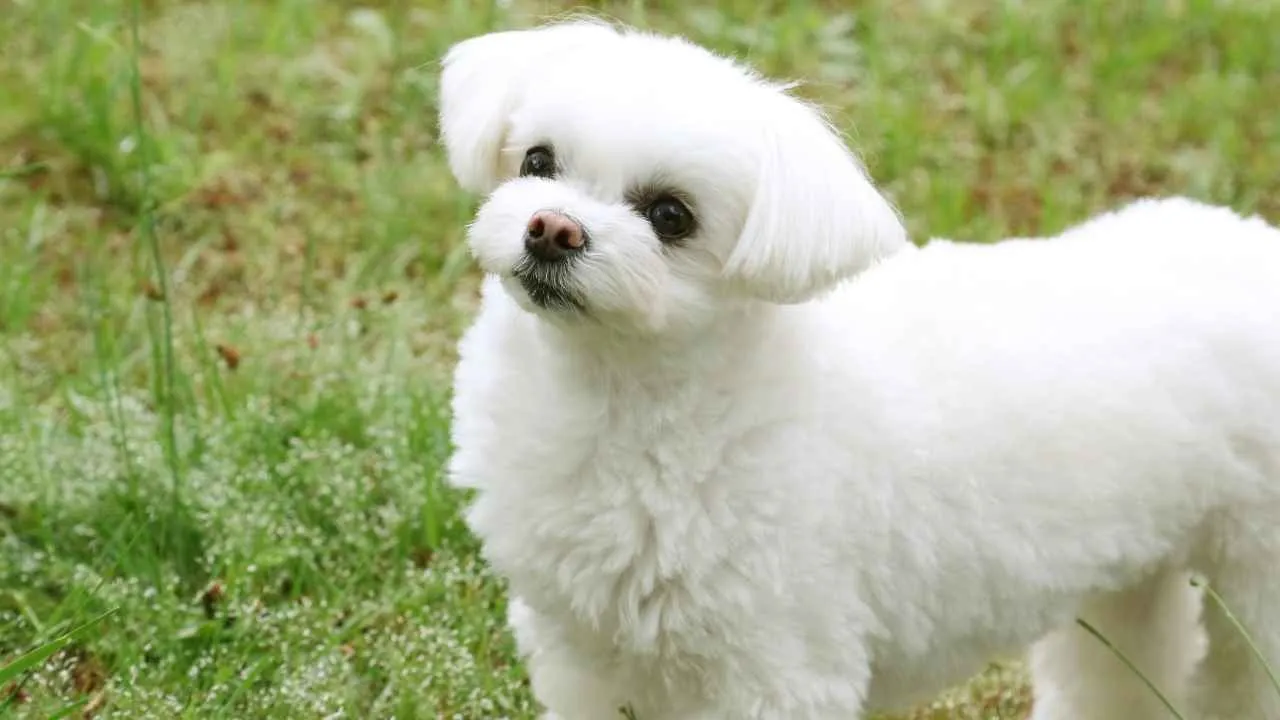
The Maltese was originally introduced to Malta by the Phoenicians long before the Greeks invaded the region. It was frequently depicted in ancient art and was even described as a “perfectly proportioned” breed by Aristotle himself. Later, it became the ultimate fashion statement, often referred to as the “Roman Ladies’ Dog,” according to the American Kennel Club.
The breed boasts a pristine white, single-layered coat that can sometimes feature a subtle touch of lemon or tan shading on the ears. While beautiful, this intelligent dog is highly prone to tear staining and food stains around the muzzle, requiring consistent daily cleaning.
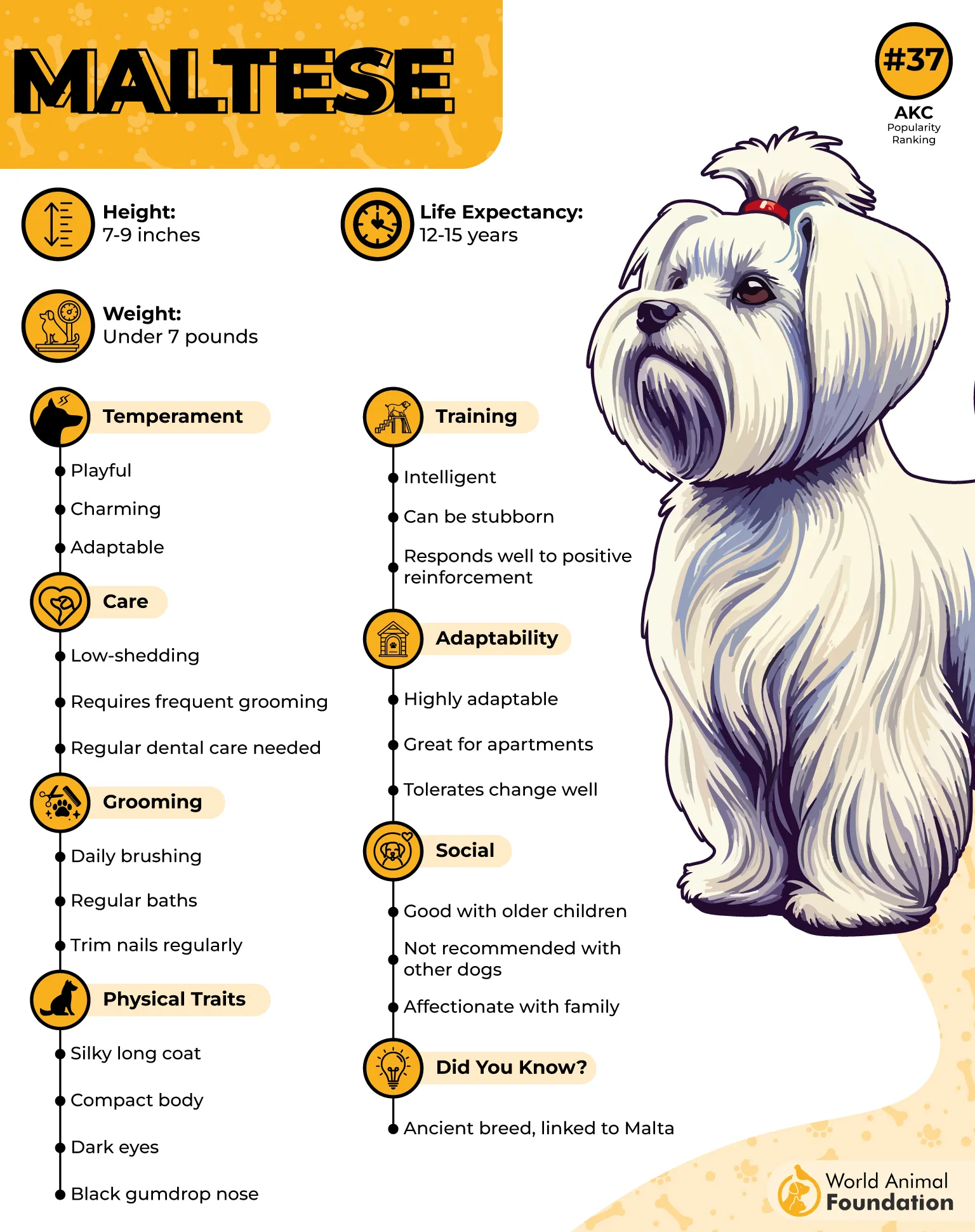
Popular styling options for their hair include the puppy cut (where the entire coat is trimmed to a short, even length), the show dog cut (where the coat is parted down the middle and allowed to grow to the floor), and the teddy bear cut (which keeps the fur a bit longer and fluffier to mimic a stuffed animal).
This small dog has moderate exercise requirements, needing about 30 to 60 minutes of activity daily. This is easily achieved through two gentle walks a day paired with interactive indoor play sessions for physical and mental stimulation.
Because the breed is anatomically prone to a collapsing trachea, you should always attach the leash to a supportive dog harness rather than a standard collar to prevent dangerous throat strain.
7. Boston Terrier
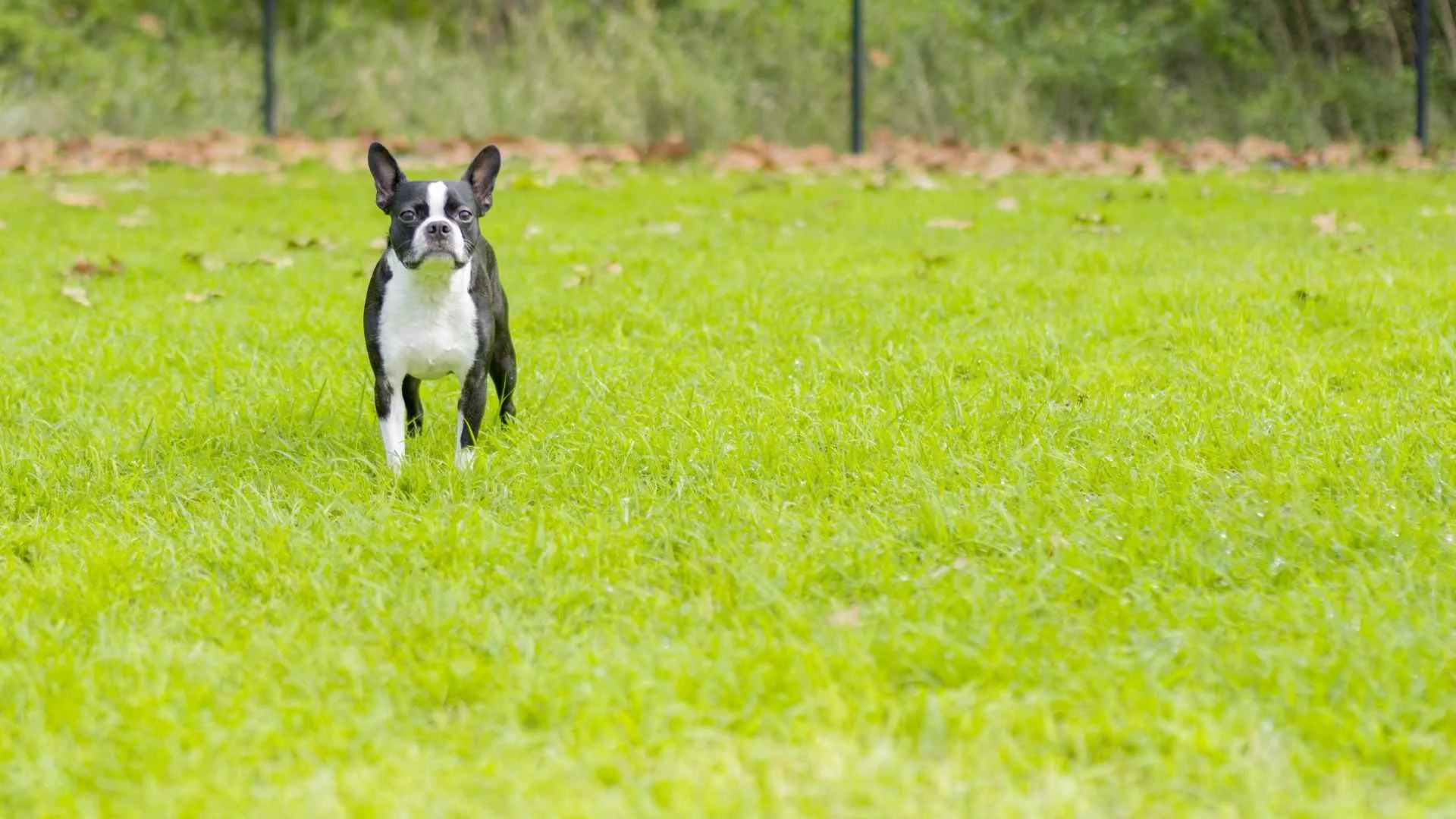
Widely known as the “American Gentleman,” the Boston Terrier was developed in the United States. Its erect ears, short tail, and compact size make it an ideal choice for apartment living and a great match for people prone to pet allergies. While they possess a friendly, affectionate personality and are eager to please their family members, they can sometimes be a bit aloof toward strangers.
The breed features a short, sleek, single-layered coat that creates a dapper “tuxedo” appearance, thanks to distinct white markings on the chest, around the muzzle, and between the eyes. The standard accepted coat colors are brindle, black, or seal.
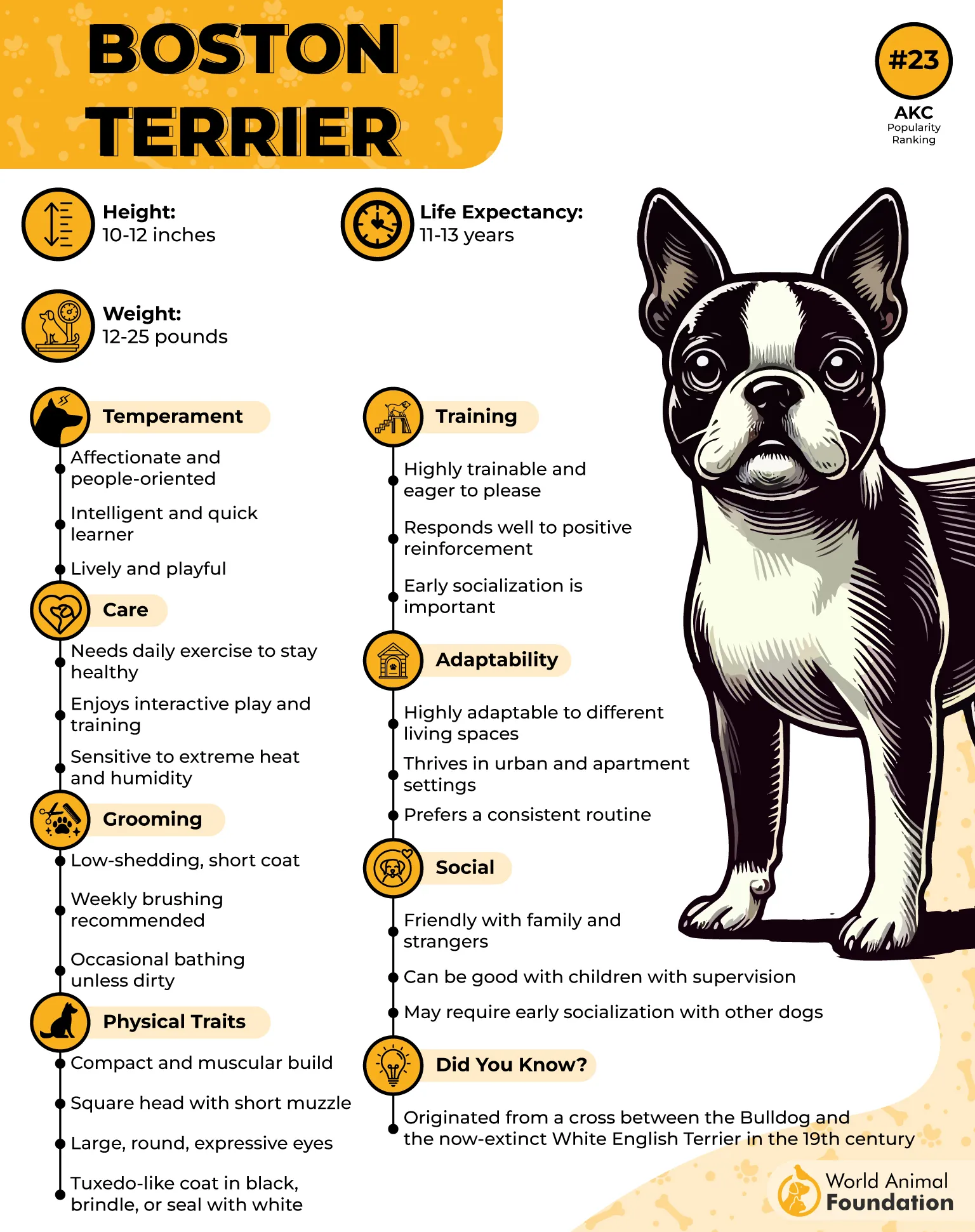
Interestingly, Bostons exhibit a somewhat cat-like nature when it comes to hygiene; they carry minimal dog odor and will frequently lick their own coats to remove dirt and debris.
Because they produce very little dander, their grooming needs are remarkably low. A weekly brushing using a rubber curry comb or a hound glove is all it takes to remove loose hair and evenly distribute the skin’s natural oils.
Occasional baths every 4 to 6 weeks using a mild, pH-balanced dog shampoo are more than enough. Just be sure to always dry the coat thoroughly after a bath, paying special attention to their facial skin folds—to prevent moisture from trapping and causing infections.
Conclusion
Choosing a family dog is one of the most joyful, heartfelt decisions you will ever make. And choosing a low-shedding breed? That is just smart planning layered on top of the joy. The Bichon’s bottomless cheer. The Yorkie’s fierce devotion. The Boston Terrier’s tuxedo swagger. The Havanese’s Cuban warmth. Each one is a character, a companion, and a small furry reason to come home.
Take your time. Visit a reputable breeder or check a local rescue. Ask every question you have. And when the dog looks up at you for the first time with those eyes, you will know. Your home just got warmer. So, do deep research before adopting a dog. This will make your home a heaven!
