





Every year, millions of birds take off on journeys so long and precise that they seem almost unbelievable. They travel across deserts, forests, and even entire oceans—often at night, often alone—and somehow still know exactly where they’re going. No maps. No GPS. Just instinct and nature’s hidden signals. So how do they do it?
One of the most fascinating answers is that birds can actually sense the Earth’s magnetic field. Scientists have discovered that birds use this invisible force like a natural compass, helping them tell direction and stay on course during migration.
Here’s a mind-blowing fact: Birds don’t read the magnetic field the way a compass needle does—instead, they “see” it. Special light-sensitive molecules in their eyes react to Earth’s magnetism, creating visual patterns that guide their flight.
But that’s not all. Birds don’t rely on just one trick. They combine magnetic cues with the position of the sun, stars, and even subtle changes in light at dusk to fine-tune their direction.
Young birds are born with a basic sense of where to go, while adults can correct their route if they’re pushed off course—showing that navigation is part instinct, part learning.
This remarkable built-in system turns the entire planet into a guidebook, making bird migration one of the greatest navigation stories in the natural world.
Key Takeaway
See how birds like the European Robin and Pigeon use Earth’s magnetic field to find their way, like nature’s GPS.
Meet incredible travelers like the Arctic Tern and Bobolink with jaw-dropping migration journeys.
Discover how birds mix magnetic signals with vision to navigate across vast oceans and forests.
Explore the magnetic skills of familiar birds like the Blackcap and White-crowned Sparrow.
Birds That Can Navigate Using the Earth’s Magnetic Field
1. European Robin

The European robin is a small, familiar songbird known for its bright orange face and breast. It is one of the most loved birds in Europe, especially in the UK and Ireland, where it often visits gardens and parks.
Across other parts of Europe, it prefers dense undergrowth in forests, heathland, and shaded woodlands. Many robins stay in the same area all year, but those from northern regions travel west during winter, making seasonal movements an important part of their life.
What makes this bird truly remarkable is its magnetic sensitivity. European robins can sense magnetic signals through special molecules in their eyes. These molecules react to Earth’s magnetism and create patterns of light, shade, or color that blend into the bird’s normal vision.
In simple terms, the robin can see the magnetic field. Scientists from Germany and New Zealand have shown that robins use part of their visual brain center for this magnetic compass, proving that navigation and vision are closely linked.
Why the European Robin stands out
Uses Earth’s magnetic field like a compass during migration
Relies on vision to detect magnetic patterns
Uses a specific visual brain region for orientation
Common in gardens, forests, and woodland edges
Symbolic bird on European Christmas cards
2. Pigeon

Pigeons have impressed humans for centuries with their powerful homing ability. From the time of the ancient Romans to the Allied forces in World War II, people relied on pigeons to carry important messages over long distances.
These birds could always find their way back home, even from unfamiliar places. This rare skill made them trusted messengers long before modern technology existed.
Scientists believe pigeons, along with many migratory birds, detect magnetic fields to stay on course. Research suggests that pigeons may sense this magnetic information using tiny magnetic particles located in their beaks.
These particles help them detect the planet’s magnetic signals, allowing them to orient themselves and choose the right direction. While researchers are still uncovering how the brain processes this information, new studies continue to reveal how advanced this natural navigation system truly is.
Why pigeons are remarkable navigators
Use Earth’s magnetic field to guide long-distance travel
Likely sense magnetism through particles in their beaks
Historically used by humans to deliver messages
Strong wings support long, sustained flights
Appear in many forms, from wild pigeons to domestic doves
3. Arctic Tern
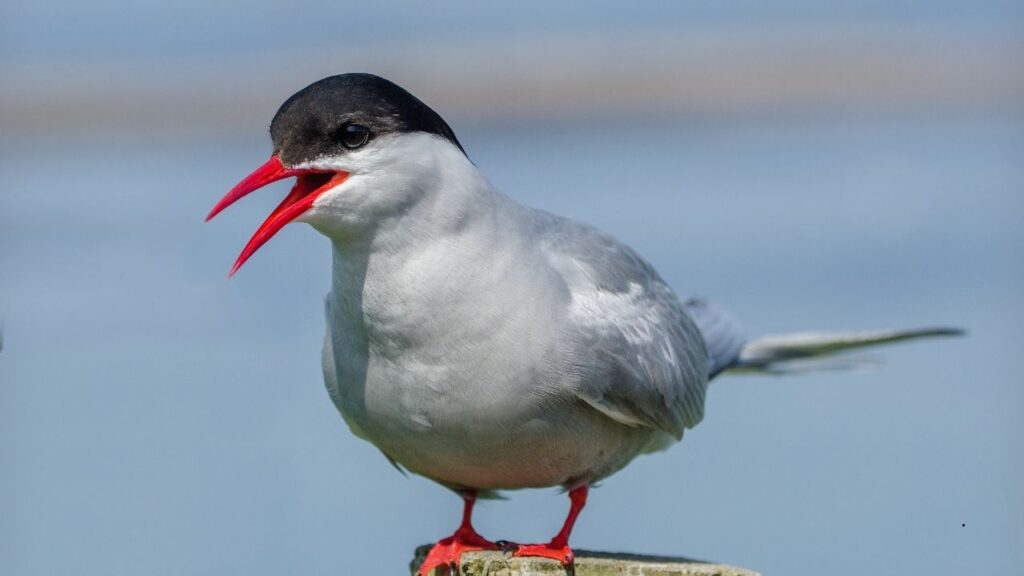
With long tail streamers, a sleek body, a black cap, and a white forehead, this elegant seabird is often called the “sea swallow,” according to All About Birds.
During the breeding season, it also shows a red bill and short red legs. The Arctic tern is a true long-distance migrant, traveling all the way from Arctic breeding grounds to Antarctic wintering areas.
It is a small, slender gray-and-white bird with angular wings and a graceful flight, often seen resting on ice or flying effortlessly over open oceans.
The Arctic tern is famous for holding the record for the longest migration of any animal on Earth. Each year, it journeys from the Arctic Circle to the Antarctic Circle, covering around 25,000 miles.
One tracked individual flew nearly 60,000 miles in a single year by taking winding routes across oceans and continents instead of a straight path. These epic journeys take the bird to every ocean and near every continent, making accurate navigation essential.
Why the Arctic Tern stands out
Migrates between the Arctic and Antarctic every year
Uses Earth’s magnetic field to stay on course over open seas
Forages in groups and nests on the ground in colonies
Has an extremely large global range across multiple continents
Classified as Least Concern despite a slowly declining population
4. Garden Warbler

The Garden Warbler is a plain-looking songbird that visits the UK in summer. It is shy and secretive, and more often heard than seen. This warbler lives in woodland, dense scrub, and bushy undergrowth, usually staying hidden among trees.
Despite its name, it is rarely found in gardens unless they are mature and close to woodland. Its soft brown coloring, beige underparts, dark bill, and small black eye help it blend easily into its surroundings.
Although visually modest, the Garden Warbler is well known for its rich and flowing song. Males sing long, continuous, and varied phrases that can last several minutes.
The song is often compared to that of the Blackcap, but sounds smoother and more relaxed. The bird prefers wooded countryside and woodland edges and can be found across a wide range of elevations, from lowlands up to the treeline in some regions.
Why the Garden Warbler is a skilled navigator
Migrates south of the Sahara during winter
Uses Earth’s magnetic field to guide long-distance travel
Feeds mainly on insects during the breeding season
Eats berries in autumn to build fat for migration
Has a very large range and is listed as Least Concern
5. Bobolink

The Bobolink is a migratory grassland songbird that breeds in open meadows and hayfields. In places like Massachusetts, females weave nests from dead grasses in early May. During the breeding season, males are impossible to miss.
They perch on grass stems or fly low over fields while singing. Their bold black-and-white plumage, often described as a tuxedo worn backward, makes them one of the most striking songbirds in North America.
As summer ends, Bobolinks change dramatically. Males molt into a buff and brown appearance that looks much like the female. This plumage once led to the nickname “ricebird” in the southern regions, where large flocks fed in ricefields.
Bobolinks are famous for their bubbling, musical song, often delivered during stiff-winged, helicopter-like display flights. This lively behavior even inspired the famous poem “Robert of Lincoln.”
Why the Bobolink is a remarkable navigator
Travels south of the equator each autumn
Completes a round-trip migration of about 20,000 kilometers
Uses natural cues, including Earth’s magnetic field, to stay on course
Makes extended stopovers before reaching South America
Faces global declines due to habitat loss and early mowing
6. Blackcap

The Blackcap is a familiar and steadily increasing warbler in the UK and Ireland. Since the late 1970s, its breeding numbers have grown, and its range has expanded, reaching northern Scotland and many islands.
This bird is now found in most woodland, park, and garden areas, except the highest mountain peaks and the most remote islands.
RSPB mentions that male Blackcaps are easy to spot by their distinctive black caps, while females wear a warm chestnut-brown cap. Their overall coloring is a soft grey-brown, helping them blend into scrubby woodland and leafy environments.
These stocky warblers arrive in the UK from early April to breed, with males usually coming first, followed by females a week or two later.
Why the Blackcap is an expert navigator
Uses Earth’s magnetic field to guide seasonal migration
Expands breeding range due to adaptability and navigation skills
Prefers scrubby woodland habitats for nesting
Males and females can be distinguished by cap color
Common in parks, gardens, and woodlands
7. White-Crowned Sparrow

The White-crowned Sparrow is a striking bird known for its bold black-and-white striped crown and clear gray breast. It breeds across much of Canada and the northwestern United States and spends winters farther south in the United States and Mexico.
This sparrow is common in brushy fields, gardens, and overgrown areas where it forages in flocks, especially during winter. Its sharp, sweet whistle and varied song make it easy to recognize.
This species has a very large range and a stable population, so it is not considered vulnerable. In the western parts of its range, the White-crowned Sparrow can be seen year-round along the coast, while in the east it is usually a migrant or winter visitor.
Scientists have studied its local song variations or “dialects,” which differ depending on the region. These unique songs add to the charm of this already fascinating bird.
Why the White-crowned Sparrow is a skilled navigator
Migrates thousands of miles between breeding and wintering grounds
Uses Earth’s magnetic field to guide its journeys
Shows regional dialects in song, indicating complex communication
Often seen in flocks during the winter months
Classified as Least Concern with a stable population
Conclusion
In conclusion, growing experimental evidence shows that the magnetic sense in migrating birds is closely linked to birds’ eyes, especially birds’ retinas, where blue light activates a magnetic sensor through the radical pair mechanism.
This possible mechanism helps explain why birds are oriented in the same direction during migratory restlessness, while disruptions from magnetic coils or electrical equipment cause birds to be oriented toward random directions.
The birds’ ability to detect signals a million times weaker than a stronger magnetic field previously thought necessary highlights how extremely sensitive this system is for direction-finding across the Earth’s surface.
Further evidence suggests this magnetically sensitive system works alongside a sun compass, an internal clock, visual cues, and other cues shaped by environmental stimuli to process directional information.
Together, this evidence reshapes what was previously thought about navigation, showing that birds oriented using magnetic sense and other cues in ways far more precise than previously thought possible.
