




Bird communication is far more complex than it appears at first glance. What many people dismiss as simple chirping is actually a well-organized system of sounds used to share information, express intent, and respond to the environment.
Researchers have discovered that birds can combine different calls to create new meanings, a skill known as compositional syntax—an ability once thought to exist only in humans. This authentic scientific finding has transformed how we view avian intelligence.
These calls are carefully structured using changes in pitch, rhythm, and order, allowing birds to deliver specific messages that others instantly understand. Some sounds warn of danger, others help maintain social bonds, and many coordinate movement or location.
What makes bird communication truly fascinating is how naturally it blends into everyday life, often happening unnoticed around us. Birds listen, react, and respond with precision, proving their calls are not random but purposeful.
By exploring how birds communicate through complex calls, we begin to uncover a hidden language that reveals intelligence, cooperation, and connection in the natural world.
Key Takeaways
Meet the African Grey and Common Raven—birds that talk with surprising intelligence.
Hear how Superb Lyrebirds and Starlings mimic sounds like nature’s greatest impressionists.
Discover why Chickadees and Mockingbirds use calls to connect and protect their world.
Unlock the secret language of birds and what it reveals about their cleverness.
Birds That Can Communicate Through Complex Calls
1. African Grey Parrot
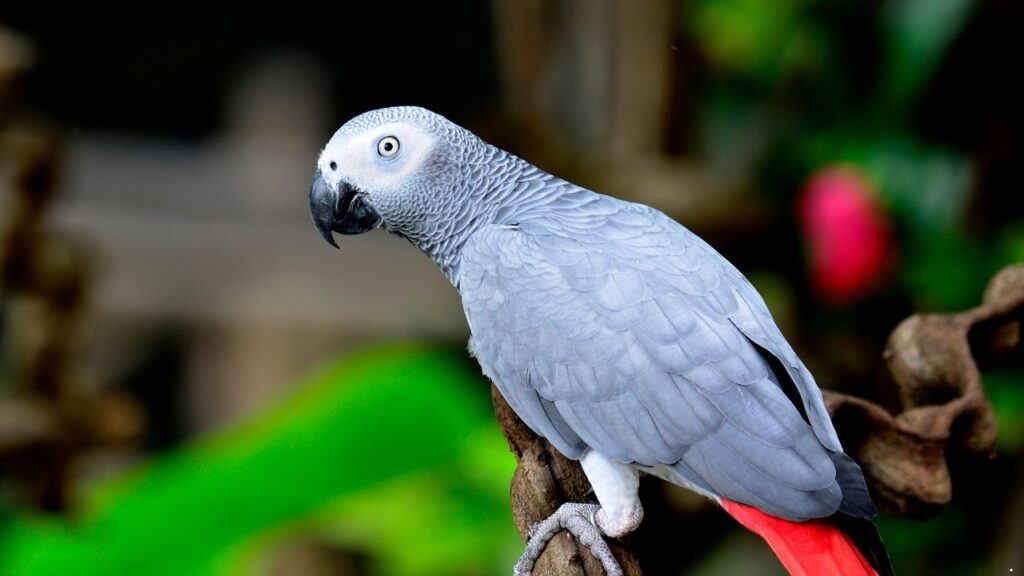
The African grey parrot is one of the most remarkable birds when it comes to communicating through complex calls.
Often called the Einsteins of the bird world, these parrots are famous for their exceptional intelligence, emotional depth, and long history as companion birds since biblical times.
They are not just beautiful or entertaining. They are highly intelligent birds that continue to fascinate researchers and bird enthusiasts alike, yet they remain widely misunderstood.
Subspecies and Key Differences
Congo African grey (Psittacus erithacus erithacus): Slightly larger, with bright red tail feathers and a grey beak.
Timneh African grey (Psittacus erithacus timneh): Darker overall coloring, maroon tail feathers, and a bone-colored upper mandible with a dark edge, while the lower mandible is grey.
The Timneh often appears darker along the back, though this is not always the case.
African grey parrots rank number one among intelligent talking birds. SeaWorld says that they can learn up to 1,000 words and are believed to have intelligence similar to a 2–to 3-year-old toddler.
They do more than mimic sounds. Many use words in context and seem closely attuned to human emotions. Their intelligence makes them engaging companions, but it can also cause trouble. They can be moody, destructive, and capable of delivering very painful bites.
2. Common Raven
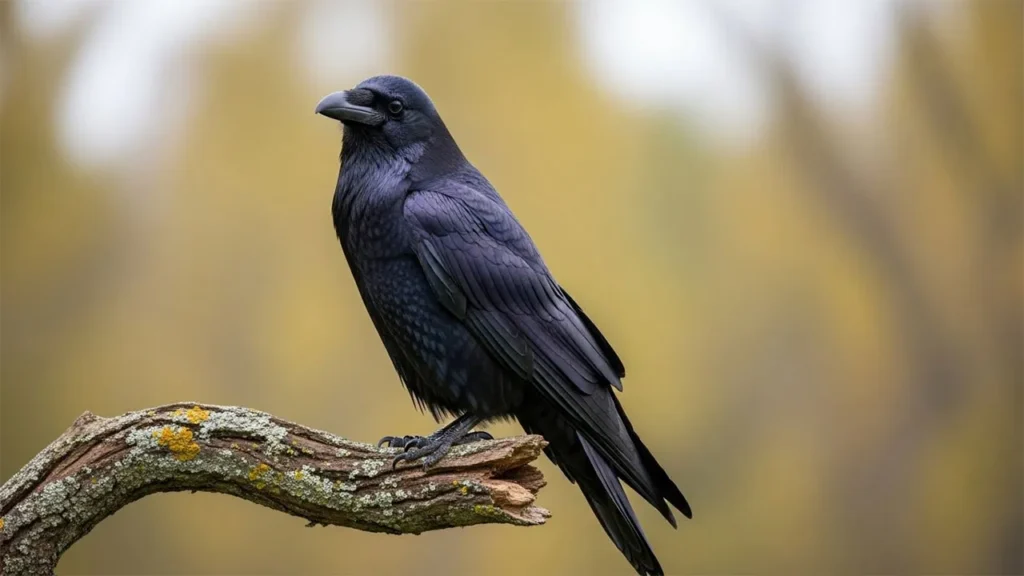
The Common Raven is one of the most intelligent birds on the planet and a powerful example of complex communication through calls. Known for its deep, echoing croak, this bird fills forests, mountains, deserts, tundra, and coastal areas across the Northern Hemisphere with sound.
Ravens have lived alongside humans for centuries, following wagons, hunting parties, sleds, and settlements in search of food. Their ability to thrive both in remote wilderness and busy human spaces shows just how adaptable and clever they are.
Key Traits and Behavior
Among the smartest of all birds, known for solving complex problems
Uses a wide range of vocal sounds to communicate
Extremely resourceful, feeding on roadkill, garbage, small animals, and stolen eggs
Soars smoothly in flight with long, slender wings and a wedge-shaped tail
Often confused with crows, but larger, with a shaggy throat and stronger presence
Ravens are members of the crow family and are the largest within it. They are solid black, with thick necks, strong feet, and long bills. Most are year-round residents, though young and non-breeding birds may wander short distances.
Once in decline, their population has rebounded, and they are now common in many habitats, from mountain peaks to city rooftops.
3. Superb Lyrebird

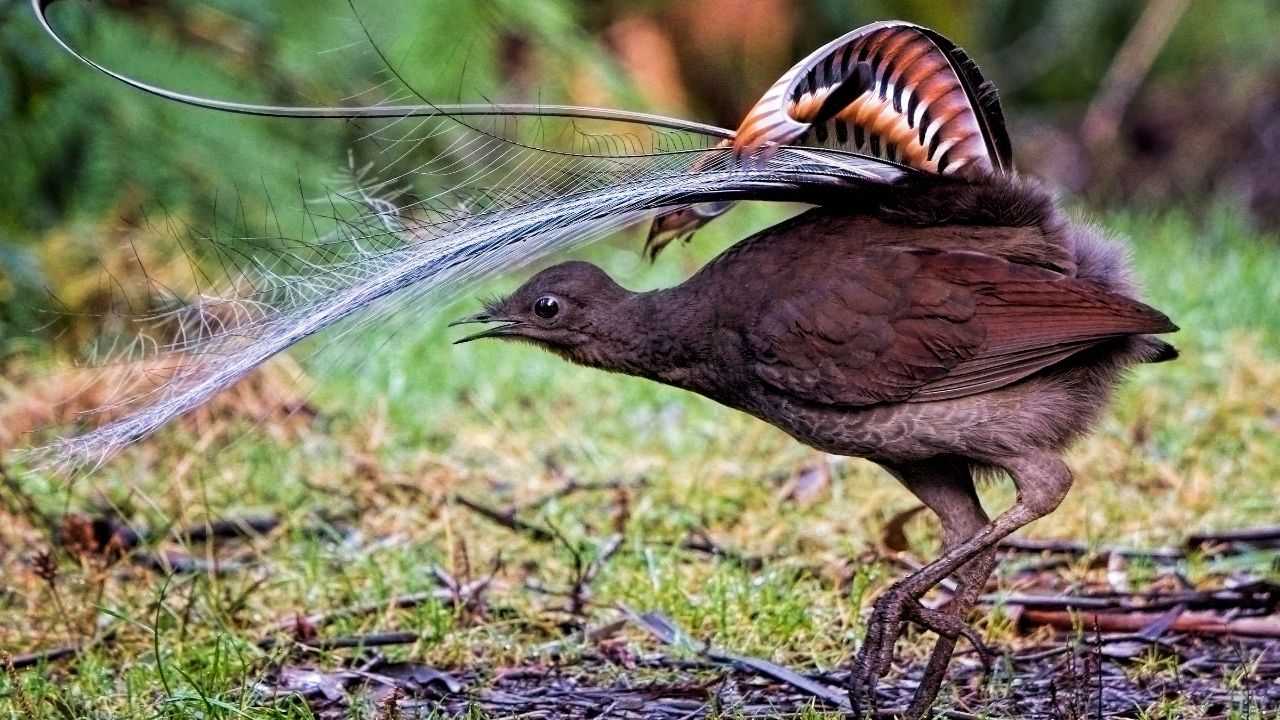
The Superb Lyrebird is one of the most impressive birds known for communicating through complex calls. Native to eastern Australia, this ground-dwelling bird lives in moist forests, rainforests, and wet woodlands across New South Wales and Victoria.
It forages in leaf litter during the day and roosts in trees at night. Lyrebirds are mostly sedentary and usually remain within a home range of about 10 km. Their powerful song and unmatched mimicry make them a must-see for bird watchers.
Appearance and Tail Display
Large ground-dwelling bird with strong legs and a long tail
Gray-brown body with reddish outer wings
Six pairs are thin and whitish, while one pair forms the curved “arms” of the lyre
Main lyre feathers show bold barring; others are plain and wispy
Females and juveniles lack the long tail feathers
What truly sets the Superb Lyrebird apart is its extraordinary vocal performance. Males clear a patch of forest floor and fan their tail plumes over their heads before beginning a carefully timed song-and-dance display. They combine their own powerful calls with rapid-fire imitations of other species.
This complex performance takes years to perfect, and only the most skilled males are chosen as mates. Despite a slow population decline, the species has a very large range and is classified as Least Concern.
4. American Crow
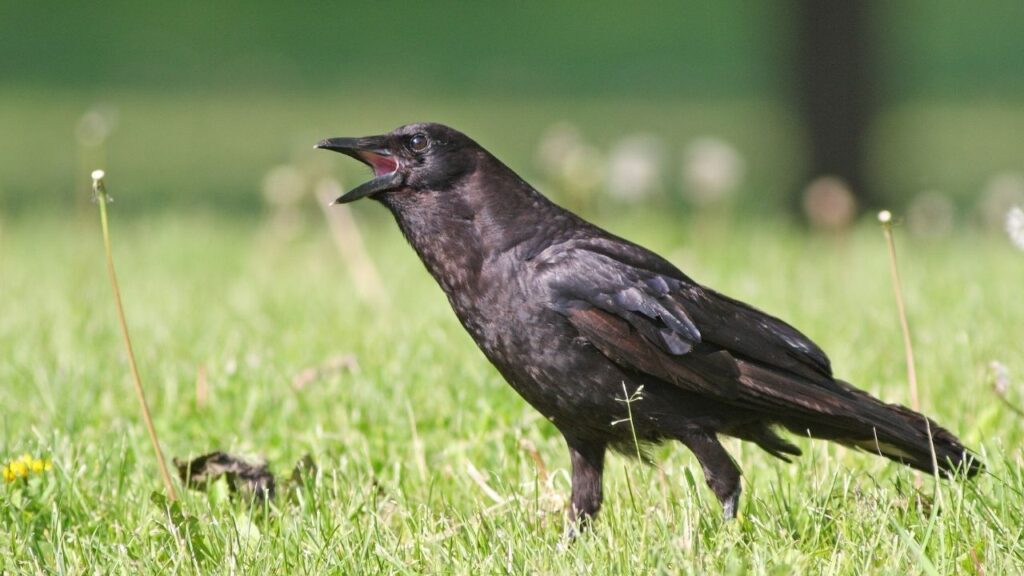
The American Crow is one of the most recognizable birds in North America and a strong example of communication through complex calls. It is an intelligent, social, and highly vocal bird known for its hoarse, familiar caw.
Found across most of the lower 48 states, this species thrives in open woods, fields, beaches, farmlands, town centers, suburban yards, and city parks. Its success in adapting to human environments highlights both its intelligence and flexible behavior.
Key Features and Behavior
Entirely black with a long, heavy, straight bill
Plumage may show a purplish sheen in bright sunlight
Rounded, fan-shaped tail in flight
Patient, steady flapping flight with few glides
Often seen traveling and feeding in large groups
American Crows usually feed on the ground and eat almost anything, as mentioned by the Cornell Lab. Their diet includes earthworms, insects, small animals, seeds, fruit, garbage, carrion, and chicks taken from nests.
They are especially social outside the nesting season and may gather in communal winter roosts with thousands, or even tens of thousands, of birds. Though often confused with ravens, crows are smaller, travel in larger groups, and have a rounded tail rather than a wedge shape.
Clever, curious, and adaptable, the American Crow remains one of the most widespread and vocal birds, using its varied calls to communicate across complex social groups.
5. Northern Mockingbird
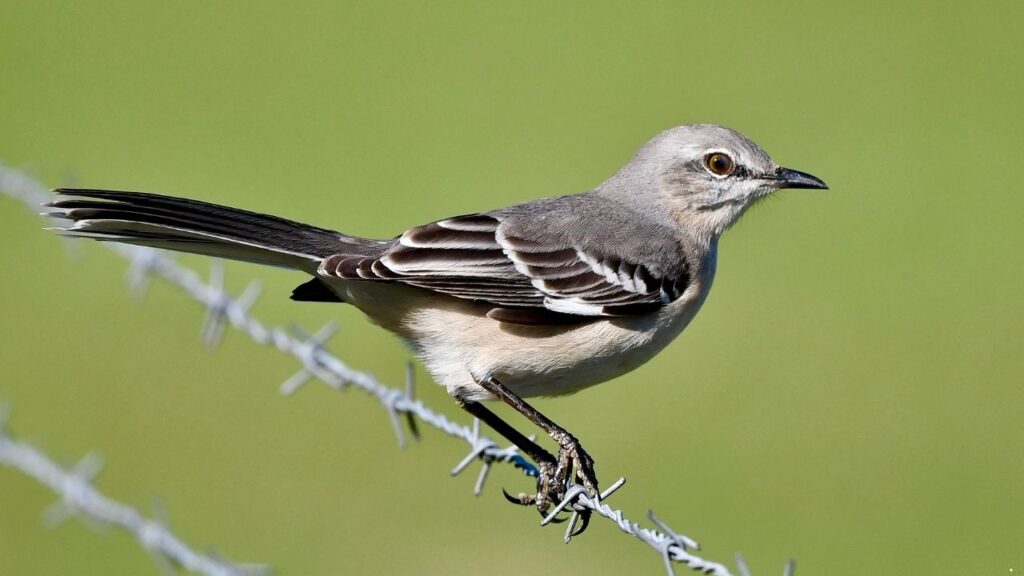
The Northern Mockingbird is one of the most skilled vocal performers among birds that communicate through complex calls. Famous for its loud and creative songs, this bird can sound like 10 to 15 different birds in one long performance.
Its song is made of repeated phrases, usually sung three to five times before changing. During nesting season, it sings all day and often all night.
Common in towns, cities, and neighborhoods, the Northern Mockingbird is especially well known across southern areas and remains a familiar presence year-round in places like Massachusetts.
Appearance and Behavior
Slender gray bird with gray-brown upperparts and pale underparts
Long tail with white outer feathers, most visible in flight
Two white wing bars and bright white wing patches
Long, thin black bill that curves slightly downward
Often seen on wires, fences, lawns, and open spaces
Northern Mockingbirds are bold, active, and highly territorial. They search for insects on open lawns and often pause to flash their white wing patches while moving. During courtship and defense, they spread their wings and tail to show these markings clearly.
Both sexes aggressively defend nesting and feeding areas and may attack cats or even humans that come too close. In winter, they become quieter, shelter in thick vegetation, and feed mainly on berries and soft fruits.
6. Black-Capped Chickadee
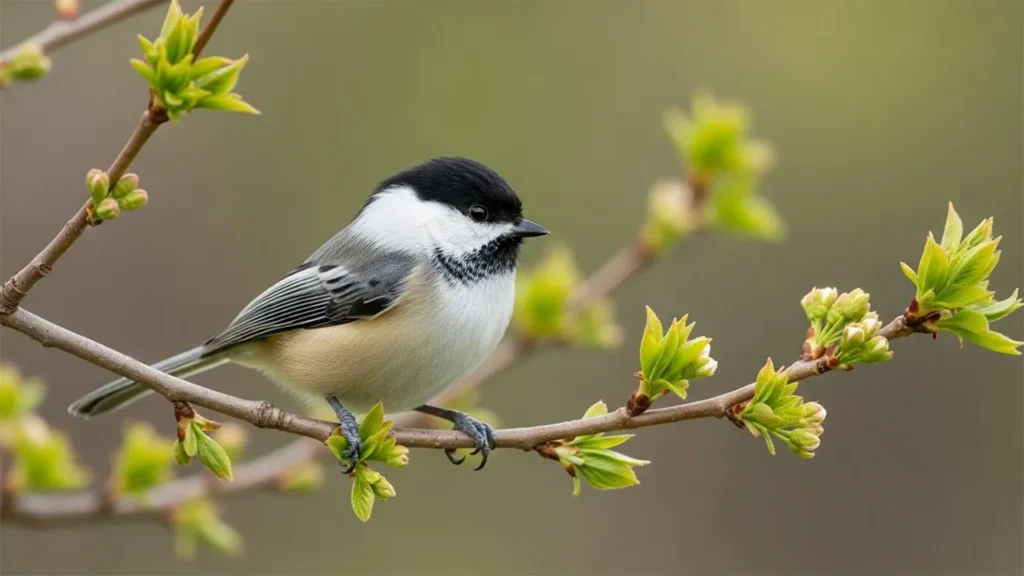
The Black-capped Chickadee is a small bird with a big voice and a strong example of communication through complex calls. According to the National Zoo, its famous “chick-a-dee-dee-dee” sound is an alarm call that is easy to recognize, but not always easy to identify by species.
In some regions, especially where ranges overlap, Black-capped and Carolina chickadees can hybridize or even learn each other’s vocal patterns. This makes their calls even more interesting for birders who rely on sound to tell birds apart.
Appearance and Everyday Behavior
Black cap and bib with bright white cheeks
Gray back, wings, and tail
Whitish underside with soft buffy sides
Curious, active, and quick to approach people
One of the first birds to visit feeders
Chickadees are widely loved for their “cute” look and lively behavior. Little flocks move through woods in winter, calling to each other as they travel from tree to tree.
They often join other small birds and bring life to quiet forests. At feeders, they usually take one seed at a time and fly off to store it in bark crevices. Their acrobatic movements and constant calling make them pleasant neighbors.
7. European Starling
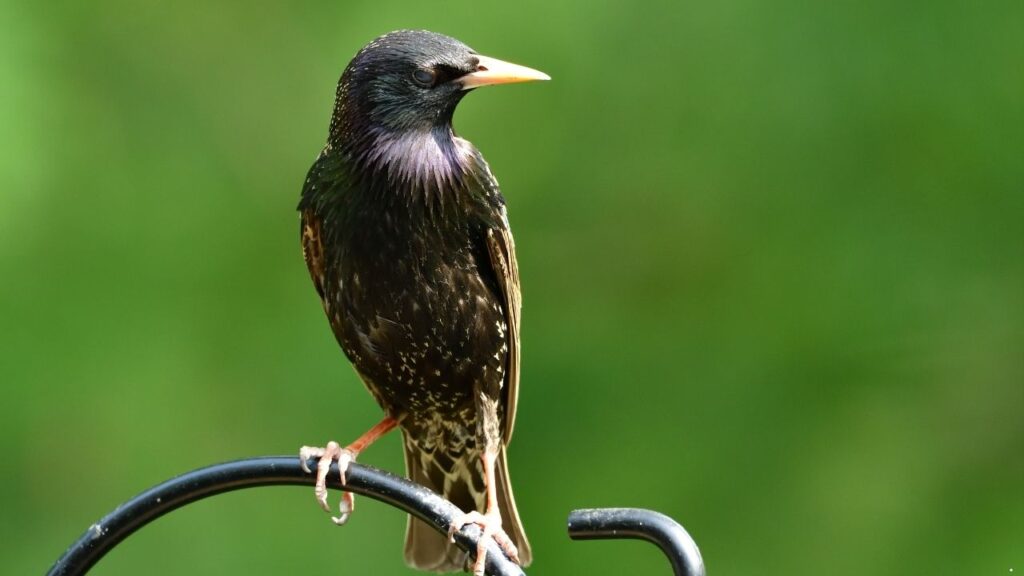
The European Starling is a striking bird known for its complex calls and impressive mimicry. Originally introduced to North America in the late 1800s, it has since become one of the continent’s most abundant songbirds.
These birds are bold and social, often seen in large, noisy flocks that wheel through the sky or mob lawns. Their glossy black feathers shimmer with green and purple hues in summer and are speckled with white spots in winter.
Distinctive Features and Behavior
Stocky, short-tailed birds with triangular wings
Yellow, sharp-pointed bill in summer; darker bill in winter
Plumage changes seasonally—from speckled white in winter to dark and glossy in summer
Young birds have browner, duller feathers
Adaptable and tough, thriving in many habitats, especially where trees are present
European Starlings are not just abundant; they are also skilled vocalists. Males often mix wheezing and sputtering sounds with perfect imitations of other bird species. This ability to mimic makes them stand out among birds that communicate through complex calls.
While sometimes seen as pests because of their large numbers and aggressive behavior, starlings win admiration for their intelligence and adaptability. Their presence across North America highlights how a gifted communicator can thrive in new environments.
Conclusion
Bird communication may not be human language, but it carries meaning in ways that feel surprisingly familiar. Through contact calls and alarm calls, one bird can quickly share important information with many birds.
During the breeding season, vocal signals become even more focused, from territorial songs used to attract females to short sounds that help parents stay connected. These specific calls, sometimes high-pitched, are clear signs of strong cognitive abilities rather than random noise.
In addition to sound, birds rely on body language and visual cues to support their messages. For instance, these creatures tend to combine calls with movement when defending territories, locating food sources, or warning of predators.
This system has evolved over time, showing a level of complexity that helps our feathered friends survive and thrive. By learning to notice these patterns, there is hope that we will better understand the quiet intelligence behind their communication.
